A useful sourcing decision starts with a written requirement that can be challenged, sampled, inspected, and approved.
How Do You Source Foldable Camping Storage Boxes for Retail and Overlanding Brands?
A foldable camping storage box is a retail product, field-use container, shipping unit, and sometimes a food-preparation surface. The sourcing task is to convert the intended use into a controlled specification that a camping storage box manufacturer can quote, sample, test, and pack consistently.
“Heavy-duty,” “food-safe,” “stackable,” and “water-resistant” are not requirements until resin, geometry, load, temperature, lid position, and acceptance criteria are stated. FDA includes food-preparation surfaces, packaging, and cookware in its description of food contact substances [1]. In the EU, food-contact materials must not release constituents at harmful levels or change food composition, taste, or odour unacceptably [2].
This is a commercial sourcing guide, not legal advice. Confirm current product, labelling, chemical, packaging, and import requirements with qualified compliance professionals and the importer of record before launch.
1. Quick Answer: What Should a Buyer Lock Before Requesting a Quote?
Work in this order: define use; freeze functional geometry; specify material and lid; set measurable load and stack conditions; decide food-contact boundaries; approve samples; then validate retail packaging and production controls. Ask suppliers to quote the same written brief, not catalog photos or nominal dimensions alone.
Include open and folded dimensions, usable internal dimensions, target net weight, resin and recycled-content position, lid and latch type, load and stack scenarios, environment, decoration, retail and master-carton pack, inspection rules, and required documents. A capacity figure without internal dimensions or a load figure without support and duration conditions is not comparable.
| Decision | Define it in the brief | Why it changes the product |
|---|---|---|
| Primary use | Camping organisation, vehicle drawer storage, basecamp pantry, retail household storage, or merchandising display | Determines geometry, appearance tolerance, handling frequency, and expected abuse. |
| Configuration | Collapsible body, detachable lid, hinged lid, or flat top cover | Affects folded height, closing sequence, stack interface, and packaging. |
| Load claim | Load inside one box; load on the lid; or stacked-system load | These are different force paths and should not share one unsupported number. |
| Surface claim | Storage only, food-contact storage, or food-preparation work surface | Determines documentation, material restrictions, testing discussion, and product copy. |
| Channel | Store shelf, e-commerce parcel, dealer shipment, or palletised B2B delivery | Determines carton design and distribution testing approach. |
The practical supplier question is: Can the factory turn the brief into a drawing, control plan, and repeatable samples?
2. Buyer Context and Risk Framing: Why Foldable Boxes Need a Systems View
Foldable boxes have more moving interfaces than rigid totes. Their base, folding sidewalls, corner joints, latches, lid, nesting features, and optional handles all contribute to performance. A failure at one interface can make an otherwise sound container unusable. A latch may hold when the box is empty but release when the walls bow under a real load. A lid may fit a single box but transfer load poorly in a five-high display stack. A box may fold smoothly at room temperature but bind after a cold vehicle night.
Overlanding use may add repeated folding, uneven support, vehicle stacking, dirt, and temperature swings. Rank each feature by consequence, likelihood, and ease of detection; use this risk register to set sample testing and inspection effort.
| Risk area | Typical ambiguous request | Better, verifiable requirement | Evidence to request |
|---|---|---|---|
| Folding | “Easy to fold” | State the required sequence, one-person operation expectation, and whether any force limit or pinch-point review is needed. | Demonstration video and sample check. |
| Latching | “Secure latch” | Define closed-lid retention under the specified internal load, orientation, and handle use. | Functional test record and sample observation. |
| Stacking | “Stackable” | State the stack count, contents mass per box, duration, surface, and whether lids must remain usable. | Loaded stack test with photos and measurement points. |
| Outdoor use | “For overlanding” | Define expected temperature, UV exposure, dirt, vibration, and vehicle-storage conditions. | Material data, test proposal, and end-use review. |
| Food use | “Food grade” | Identify exact food-contact or worktop use, temperature, duration, and food type. | Relevant material and compliance documentation for the intended market. |
| Retail delivery | “E-commerce ready” | Identify parcel or pallet route, carton, inserts, label position, and allowable cosmetic damage. | Pack-out sample and distribution-test plan. |
Do not confuse resin identification with a recycled-content or recyclability claim. ASTM D7611 says its code identifies resin and is not itself a recycling claim [3]. Agree any moulded mark and its location separately.
3. Define the Commercial Use Case Before Quoting a Camping Storage Box Manufacturer
Start with the product’s job, then issue a one-page definition and dimensional drawing. Request open dimensions, folded height, internal clear dimensions, lid overhang, handle protrusion, and stack pitch—the vertical increment of one closed unit in a stack.
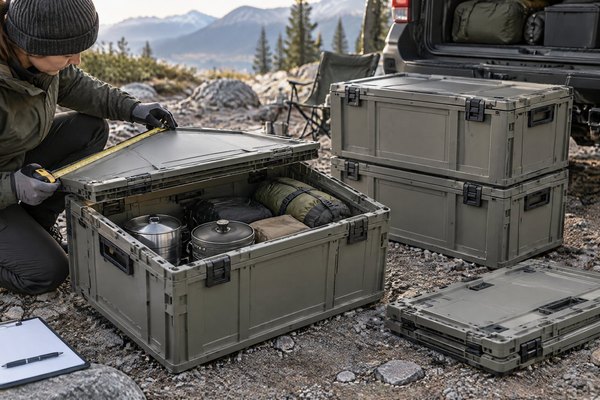
Describe contents as a load profile. State whether mass is distributed or concentrated, how the box is supported, and how it is carried. A concentrated load can bend the base, distort walls, and interfere with latches. For overlanding, check the drawer or shelf envelope in folded and open states, lid clearance, latch direction, and lower-box access.
Build a quote package that prevents false comparisons
Issue a revision-controlled quote package containing the drawing, colour standard, artwork, required retail dimensions, performance matrix, and inspection checklist. Identify mandatory requirements and items open to supplier alternatives.
Ask each supplier to state proposed resin, permitted regrind position, component weights, construction, sample stages, tests, decoration, pack-out, and exceptions. An exception log should show every variance, its effect, and a remedy.
4. Specify Resin, Regrind, Colour, and Lid Construction
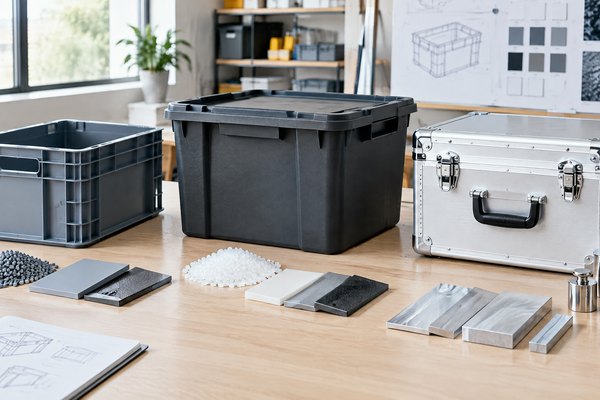
Resin is the base polymer used to mould a component. PP and HDPE are common choices, but a polymer name does not prove performance. Performance also depends on grade, wall thickness, ribs, pigment, moulding conditions, and temperature.
Ask the supplier to identify resin, grade or approved equivalent, additives, colour masterbatch, and regrind policy. Regrind is processed production scrap, not post-consumer recycled material. If recycled content is desired, define source, percentage basis, permitted parts, colour tolerance, documentation, and expected effects. Do not combine it with a food-contact claim without an intended-use review and evidence plan.
Treat the lid as a separate part. It may be loose, snap-on, hinged, split, or removable. State whether it is a dust cover, load-bearing surface, liquid-retaining closure, or only a cover. Avoid “waterproof” without a defined seal and protocol. A flat lid may serve as a camp surface without establishing food-contact suitability.
| Specification item | Questions for the supplier | Buyer acceptance focus |
|---|---|---|
| Resin and additives | What polymer grade is proposed? Are UV, impact-modifier, or other additives proposed? What substitutions require approval? | A traceable material declaration matched to the approved component. |
| Regrind/recycled content | Is any content included? In which part? How is it controlled? | No unapproved material change or unsupported sustainability claim. |
| Colour and finish | What is the colour standard? Is gloss, texture, gate location, or flow line visibility restricted? | Cosmetic sample under agreed viewing conditions. |
| Lid interface | Is the lid removable or attached? Where does it locate? Is it intended to bear stack load? | Positive fit, safe opening, and no interference with walls or latches. |
| Surface texture | Is a textured lid intended to improve grip or cleanability? | Texture does not hide defects or compromise hygiene expectations. |
For EU plastic food-contact use, the Commission describes composition rules, migration limits, and a Declaration of Compliance supported by documentation; testing uses conditions and simulants representative of intended use [4]. State whether use is dry food, cold prepared food, chopping or serving, or no food contact.
5. Engineer Folding, Hinge, and Latch Mechanics Before Scaling
A foldable box is a mechanism. Define its kinematic sequence: the order from folded to open and back. State whether the base opens first, sidewalls lock into it, the lid can close before full deployment, or a partial state creates a pinch point.
Wall joints may use living hinges, pins, tabs, sliding locks, or combinations. A living hinge is a thin polymer section designed to bend repeatedly. Do not accept a generic cycle count; request a method that states sequence, temperature, sample quantity, inspection intervals, and failure definition, such as cracking, loss of engagement, deformation, or changed operating force.
Evaluate latches under realistic contents and handling. Clarify whether they secure only the lid or also keep walls deployed. For vehicle use, check accidental actuation against adjacent gear, straps, or drawer walls.
Example functional test matrix
This example is a starting point for supplier discussion, not a universal pass standard. Values, sample numbers, and thresholds should be set for the particular SKU.
| Function | Example condition to define | Inspect for |
|---|---|---|
| Deploy and fold | Repeat the documented open/close sequence at agreed room and, if relevant, low temperatures. | Cracks, binding, incomplete lock engagement, abnormal force, or loose hinge parts. |
| Latch retention | Close the filled box using the intended latches; handle according to the defined use. | Opening, latch damage, lid shift, or loss of wall geometry. |
| Handle use | Carry a defined internal load for an agreed distance and orientation. | Handle fracture, wall pull-out, sharp edges, and permanent deformation. |
| Uneven support | Place the loaded box on agreed points or a representative vehicle shelf. | Base distortion, wall disengagement, or lid/latch interference. |
| Stack interface | Build the defined stack with specified mass, duration, and alignment tolerance. | Slippage, lid collapse, excessive deflection, or inability to access a lower box. |
6. Validate Stackability and Intended Load as Separate Claims
Stackability is the ability of units to remain aligned and stable when one sits on another. It is not the same as the maximum mass the base can carry. A credible stack specification names the number of units, the internal mass of each unit, the top surface, the alignment condition, the duration, and the acceptable outcome. It also distinguishes static storage from transport. A vehicle’s vibration can create repeated dynamic loads that a stationary garage stack does not.
Build the stack test around use. A retail display may stack empty units; overlanding may stack filled units in a vehicle. The latter needs lid compression, locating feet, anti-slip features, access, and restraint. Do not present the box as a vehicle tie-down point without explicit design and evidence.
Load language should identify three values where relevant: internal payload, top load on a closed lid, and stack-system load. Specify whether the load is uniformly distributed or concentrated. Include the temperature condition if the product will be used in cold or hot environments. Measure permanent set after unloading; permanent set is deformation that does not recover after a defined rest period. A box that returns to shape may be usable even if it visibly deflects during the test, while a small non-recovering bow could stop a lid from latching.
Ask the manufacturer to show how vertical load moves through ribs, posts, or corners into the base. Request photos or video of the actual configuration, not a bare “passed” statement.
Buyer rule: Do not use a single headline load number in packaging or product copy unless the condition behind it is defined, reviewed, and supported by the approved production configuration.
7. Confirm Food-Prep Surface Boundaries Before Making Any Claim
A storage box can be marketed for camp organisation without being represented as suitable for direct food contact or food preparation. This distinction protects accuracy. A food-prep surface is a surface intended to contact food during preparation or serving. The lid may be used informally as a camp table by consumers, but a brand should not translate that observation into a food-contact claim without defining the intended use and obtaining appropriate support.
In the United States, FDA explains that food contact substances include food packaging and components, processing equipment, food-preparation surfaces, and cookware. FDA also describes its review of migration data in relation to intended use for food contact substances that are food additives [1]. In the EU, the general framework applies to food-contact materials, while the plastic-specific rules cover composition, migration testing, and supporting compliance documentation [2] [4]. These sources demonstrate why a colour-matched resin description or supplier email alone is not enough for a specific claim.
Set the boundary in the product requirement. Ask: Will the inside of the box hold unpackaged food? Will the lid touch ready-to-eat food? Will it be used for chopping, serving, or only as a raised surface beneath another board? Which markets will receive it? What food types, temperatures, contact duration, cleaning instructions, and repeated-use expectations apply? If direct contact is not intended, brief the product and marketing teams to avoid food-contact language or icons that contradict that decision.
If direct food contact is intended, request a market- and use-specific documentation package from the supplier or its material chain. For the EU, this may include a Declaration of Compliance aligned to the intended article and supporting documentation on request by authorities, as described by the European Commission [4]. For the United States, ask the importer and qualified advisers to determine the appropriate evidence for the intended use. Keep the final approved material, pigment, additive, and surface configuration under change control. An approved body resin does not automatically approve a different lid, gasket, overmould, coating, or printed surface.
Mid-project sourcing checkpoint
Before authorising production tooling or final artwork, send CampLume the completed product brief, target-market list, drawings, required claims, pack-out concept, and any existing benchmark sample through the site RFQ form or info@camplume.com. Ask for written confirmation of open engineering questions, the proposed sample path, and the documents the supplier can provide. This is the point to resolve scope, not after cartons are printed.
8. Review Samples Through a Controlled Approval Process
Sample review is a decision system. A concept or existing-tool sample can validate size and folding; a tooling sample can validate geometry, texture, latches, and assembly; a pre-production sample should validate approved material, colour, decoration, packaging, and process. Record the stage so an early sample is never treated as production evidence.
Create an approval sheet that lists every critical requirement and the sample result. Photograph the sample open, folded, loaded, stacked, latched, and packed. Measure the exact points called out in the drawing. Note ambient conditions and any materials not yet final. Give each deviation one of three dispositions: accepted, accepted with written corrective action, or rejected. Version-control the approved “golden sample,” drawings, artwork, and packaging files.
Review samples in a shelf, vehicle drawer, or tent-side setup. Have users fold them without guidance, check latch access when units are adjacent, and inspect dirt traps, drain paths, and water-retaining features. Convert observations into engineering comments.
| Sample-review area | Practical question | Record in approval file |
|---|---|---|
| Dimensions | Does the box fit the planned retail shelf, vehicle space, and folded storage envelope? | Measured values, datum points, instrument, and tolerance result. |
| Mechanism | Can a user complete the documented sequence reliably? | Sequence, observations, failure mode, and corrective action. |
| Appearance | Is colour, texture, logo placement, and flash acceptable under agreed viewing conditions? | Approved standard, photos, defect boundary sample if applicable. |
| Load/stack | Does the sample perform in the exact agreed scenario? | Load distribution, stack count, duration, temperature, result, and photos. |
| Packaging | Does it arrive undamaged and present correctly on shelf? | Pack configuration, carton dimensions, labels, and damage observations. |
Do not treat a passing sample as permission for uncontrolled substitutions. Define change control: the supplier must obtain buyer approval before changing resin grade, pigment, wall thickness, mould, latch material, assembly method, packaging board, factory location, or test method. The buyer should also specify which changes require a new sample or a renewed test.
9. Plan Retail Packaging and Shipment Preparation Early
Retail packaging must protect the box without creating damage. Latches, lids, and corners can rub in transit. Choose a carton, sleeve, band, bag, or wrap, then test the actual product-pack combination.
Start with the channel. For single-parcel e-commerce shipments, ISTA Procedure 3A is a general simulation test for individual packaged products shipped through a parcel delivery system and covers products up to 70 kg (150 lb) [5]. It evaluates the product and package together and warns that its general test levels may not represent every distribution system [5]. For broader shipping-unit evaluation, ASTM D4169 provides a laboratory framework using anticipated hazard sequences in distribution cycles; it is not a substitute for material specifications or existing pre-shipment procedures [6]. Select a method with the testing party based on the real route and acceptance criteria rather than placing an unqualified test logo on packaging.
Design master cartons and pallet patterns from measured packed dimensions. Confirm count, orientation, dunnage, closure, gross weight, barcodes, carton marks, and pallet overhang. Check that folded units recover from carton compression and accessories cannot mark the box during vibration.
For US imports, origin marking should be planned before printing. CBP states that articles of foreign origin entering the United States generally must be legibly marked with the English name of the country of origin unless an exception applies, and explains that marking should be conspicuous and sufficiently permanent for the article [7]. Verify the correct marking approach and any other market requirements with the importer of record and qualified advisers; do not assume that a retail carton alone will solve every case.
Shipment-preparation example
A useful shipment-ready record can include the approved retail pack photograph; unit, retail-pack, and master-carton dimensions; gross and net weights; carton count; barcode and country-marking artwork; pallet pattern; handling marks; and a bill of materials for inserts. Compare this record against the first packed production cartons. If the carton board, inner wrap, or count changes, reassess whether the previously approved distribution test still represents the shipment.
10. Set Factory Quality Controls and Pre-Shipment Inspection
Translate the approved sample into incoming, in-process, and finished-goods controls. Check resin and masterbatch, purchased parts, packaging, first-off dimensions, part weight, wall-lock engagement, finish, assembly, pack count, labels, and cartons.
Classify defects before production. Critical defects are defects that create a safety, regulatory, or severe functional concern in the agreed context. Major defects materially reduce function or saleability. Minor defects are smaller deviations that do not materially affect function or normal saleability. These categories must be defined for the SKU. For example, an incomplete latch engagement may be major or critical depending on its use; a faint flow line might be cosmetic but still unacceptable if it appears in a logo panel.
Acceptance sampling can be appropriate for lot inspection, but it does not replace process control. ISO 2859-1 is an acceptance-sampling system for inspection by attributes indexed by an acceptance quality limit (AQL); it should be selected and applied with the lot size, inspection level, defect classification, and accept/reject criteria stated in the quality agreement [8]. Do not use “AQL inspection” as shorthand for quality assurance. A sampling plan can miss a rare defect, especially if the wrong features are sampled or the defect definition is vague.
| Control point | What to check | Evidence or record |
|---|---|---|
| Material release | Approved resin, colour masterbatch, additives, and any permitted recycled-content input | Supplier batch identification and traceability record. |
| First-off approval | Critical dimensions, fold sequence, latch fit, lid fit, weight, surface, and logo | Dated first-off report with measurements and photos. |
| In-process patrol | Moulded-part condition, hinge/latch engagement, assembly, contamination, and pack count | Patrol log and corrective-action record. |
| Finished-goods inspection | Appearance, function, dimensions, labels, retail pack, carton marking, and carton integrity | Inspection report against approved checklist. |
| Pre-shipment review | Sampled functional checks plus document and pack-out reconciliation | Release decision, exceptions list, and shipment photographs. |
A buyer-appointed inspector should use the drawing, defect definitions, golden-sample photos, sample plan, functional instructions, packaging checklist, and carton marks. The report should distinguish observations from agreed nonconformities. Give warehouse and customer-service teams a receiving, folding, care, and escalation checklist; evaluate recurring field feedback before changing claims or process settings.
11. Frequently Asked Questions
What resin should a foldable camping storage box use?
There is no single correct resin. Ask the supplier to propose a specific resin grade based on folding mechanism, impact, temperature, finish, and intended contact use. Review the complete part design and evidence, not the polymer label alone.
Is “stackable” enough for product packaging?
No. State the number of units, loaded or empty condition, mass in each box, alignment, duration, surface, temperature where relevant, and acceptable deflection or function after the test.
Can a flat lid be marketed as a food-prep surface?
Only if intended food contact has been clearly defined and supported for each target market and final material configuration. A flat, clean-looking lid is not by itself evidence for that claim [1] [4].
What should a buyer inspect on the first production sample?
Check dimensions, resin/colour confirmation, folding sequence, latch and lid engagement, handles, cosmetic finish, logo, pack-out, labels, and the agreed load and stack scenarios. Compare all results with the signed approval sheet.
Should a brand require ISTA or ASTM package testing?
Choose a relevant method according to the real delivery channel, shipment configuration, retailer requirement, and risk. ISTA 3A is relevant to many individual parcel shipments, while ASTM D4169 addresses shipping units and distribution hazards more broadly [5] [6]. Confirm the exact test plan with the testing provider.
What should be in a supplier change-control agreement?
Require prior written approval for changes to resin grade, pigment, recycled-content position, mould, dimensions, wall thickness, latch or gasket component, assembly method, factory, packaging materials, artwork, or test method. Define when re-sampling or retesting is required.
Related CampLume resources
Use these related pages to turn How Do You Source Foldable Camping Storage Boxes for Retail and Overlanding Brands? into a more complete, supplier-ready decision:
- Read: PP, HDPE, or Aluminum: Choosing Materials for Outdoor Camping Storage Boxes for the next connected sourcing decision.
- Explore CampLume modular storage options to compare a suitable CampLume product platform.
- See the CampLume buyer FAQ for concise guidance on samples, MOQ, quality control, compliance and shipment preparation.
Conclusion: Source the Use Case, Not Just the Box
The strongest sourcing program for a foldable camping storage box begins with a precise use case and ends with repeatable evidence. Define the resin and lid independently. Describe folding and latching as mechanisms. Separate internal payload, lid load, and stacking load. Set clear boundaries around any food-prep claim. Then let representative samples, production controls, packaging validation, and documented inspection confirm the product that will actually reach the customer.
For a project-specific review, send the use case, drawings or benchmark sample, destination markets, required claims, pack-out needs, and target launch window to info@camplume.com. CampLume can use that information to discuss an RFQ around the questions that matter: product definition, sample scope, testing evidence, packaging, and quality controls.
Project discussion
Need to apply this guide to a product programme?
Send your product category, target market, estimated quantity, current specification and packaging stage. CampLume will continue the discussion by email.
Email info@camplume.comSources and further reading
References
- 1Food Packaging & Other Substances that Come in Contact with Food - Information for Consumers
- 2Food Contact Materials
- 3ASTM D7611/D7611M Standard Practice for Coding Plastic Manufactured Articles for Resin Identification
- 4Legislation: Food Contact Materials
- 5ISTA 3A Packaged-Products for Parcel Delivery System Shipment 70 kg (150 lb) or Less
- 6ASTM D4169 Standard Practice for Performance Testing of Shipping Containers and Systems
- 7Marking of Country of Origin on U.S. Imports
- 8ISO 2859-1 Sampling procedures for inspection by attributes — Part 1: Sampling schemes indexed by acceptance quality limit (AQL) for lot-by-lot inspection