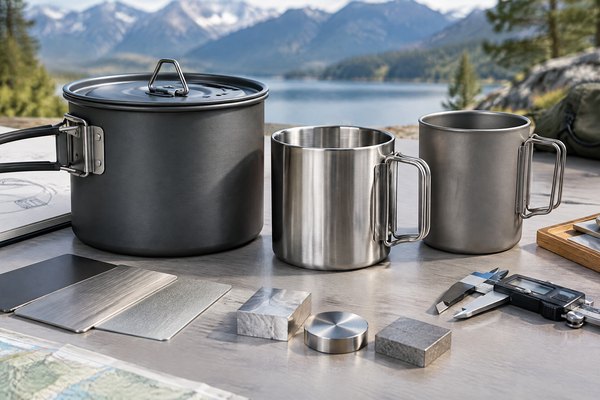
A useful sourcing decision starts with a written requirement that can be challenged, sampled, inspected, and approved.
Direct Answer (quick evaluation)
If your customers prioritize minimum weight and packability for multi-day hikes, target a lightweight backpacking cookware line; if they prioritize capacity, durability and kitchen-like features for vehicle-based trips, specify a car-camping cookware range. The deciding variables are weight-per-piece, stackability, handle design, heat source compatibility, and options for private-labeling and packaging. This guide helps product managers and buyers evaluate functional trade-offs and the OEM/ODM workflow from specification to shipping.
How To Read This Guide
This guide is written for product managers, buyers, quality managers and private-label brands evaluating backpacking cookware vs car camping cookware product range options. It covers feature comparisons, specification checkpoints, customization options (including custom camping cookware sets and custom camping pots and pans), factory testing and inspection, packaging and shipping preparation, and decision-making tools you can use during a sample review.
Key Differences: Backpacking Versus Car-Camping Product Ranges
The phrase backpacking cookware vs car camping cookware product range is not just academic — it maps to design decisions and supply chain requirements.
- Backpacking cookware: optimised for low weight, compact nesting, minimal parts, and fast boil. Materials tend to be thin hard-anodised aluminium or titanium, with low-profile lids and often nonstick coatings where desired.
- Car-camping cookware: prioritises capacity and robustness. Thicker gauges, larger diameters, more pieces (pots, pans, kettles), lids with strainers, and handles designed for stove-to-table use.
Design variables that differ across product ranges:
- Weight density (g per liter)
- Nesting efficiency and pack volume
- Handle style (folding vs fixed)
- Lid functionality (with or without strainer)
- Material finish (hard anodised vs raw aluminium vs stainless)
Understanding these differences early shapes your product specification and cost model.
Feature Checklist: What To Evaluate On Samples
When you receive a prototype or sample, focus on measurable attributes rather than marketing claims.
- Weight and pack volume: weigh each piece and measure nested height.
- Thermal performance: time-to-boil tests on representative stoves.
- Durability: dent, scratch and handle-cycling tests.
- Food safety and coating adhesion: sample lab testing as required by destination market.
Key functional features to evaluate in both product ranges include:
- camp cookware with strainer lid — useful for car-camp sets where large-capacity pots are used for pasta/boiling.
- camping cookware with folding handles — essential for packability in backpacking sets but must be tested for repeated opening/closing cycles and heat transfer.
- hard anodised aluminium camping cookware supplier considerations — hard anodised surfaces are a common material choice for durability and non-reactivity; confirm anodising thickness and finish during specification.
Practical Measurement Tests
- Boil Test: Measure time to boil 1 L of water at standard altitude and note heat source used.
- Nesting Volume: Record nested dimensions and packing orientation in a 40L and 80L pack mock-up.
- Handle Fatigue: Cycle folding handles open/close 500–1,000 times on production samples and inspect for play or failure.
Customization: Private Labeling, Sets, Materials and Packaging
OEM/ODM buyers frequently need private-label solutions. Typical customization options include:
- custom camping cookware sets: specify the number of pieces, pot sizes, pan diameter, lids, and whether a carrying bag is included.
- custom camping pots and pans: change wall gauges, diameters, handle types, and surface finish (non-stick versus raw hard anodised).
- custom packaging for camping cookware: retail-ready blister cards, printed boxes, eco-boxes or bulk wholesale cartons. Packaging design affects palletisation and shipping cost per unit.
What to specify in your product brief (minimum viable spec):
- Target SKU and set bill of materials (BOM)
- Materials with tolerances (e.g., 2.0 mm hard anodised aluminium body)
- Finish and coating requirements (coating type, thickness, cure conditions)
- Handle materials, locking mechanism and torque spec
- Lid features including whether to include a camp cookware with strainer lid and strainer hole diameters
- Nesting order and required nested dimensions
- Labeling, barcode, and any retail-ready instructions or iconography
Packaging and Branding Options (H3)
- Retail Box: Full color printed with instruction leaflet and SKU barcode. Specify box dimensions and board grade for drop testing.
- Reusable Carry Bag: Nylon or ripstop with printed or woven label — specify seam strength and zipper spec.
- Bulk Carton: Trade-friendly corrugated with internal dividers for transit protection — include pallet configuration.
Custom packaging for camping cookware can significantly change landed cost; include it early in the costing.
MOQ and Tooling Considerations (H3)
Capital tooling for stamped lids, handle hinges, or anodising masks can drive minimum order quantities. Ask your OEM/ODM partner for:
- Prototype tooling vs production tooling lead times
- Expected sample program duration (usually 2–6 weeks per iteration)
- Break-in requirements and first article inspection (FAI) plan
Design-for-Manufacturing (H3)
Early DFM review avoids late-stage change control. Typical recommendations:
- Simplify hinged folding handles to three parts max.
- Standardize lid diameters across SKUs to reduce tooling count.
- Use common nonstick coating across product families where possible to simplify inventory.
Production, Testing and Inspection Workflow
A structured workflow reduces risk between specification and mass production. The main stages you will use with an OEM/ODM camping gear manufacturer are:
- Product specification: issue the complete written spec and BOM, including target tolerances and packaging details.
- Prototype and sample review: receive pre-production samples for functional and consumer testing.
- Factory testing and inspection: perform internal QC, plus independent third-party tests if required by market regulations.
- Change control: document any design adjustments; require revised samples before continuing.
- Production run: initial production under agreed inspection protocols.
- Packaging and shipping preparation: pre-pack QC, carton labelling, and pallet build.
- Documentation and handover: receive packing list, certificates of origin, and test reports as applicable.
Sample Review Process (H3)
- First Article Inspection (FAI): verify dimensions, coating, and assembly against spec.
- Consumer Function Tests: boiling, straining (if a camp cookware with strainer lid is present), nesting and handle use.
- Packaging Fit: ensure sample fits into the intended retail box or carry bag.
Factory testing or inspection checkpoints should include plating/anodise adhesion checks, coating cure verification, dimensional checks, and handle torque testing. For folding handles, confirm locking mechanism reliability and heat insulation under stove-level temperatures.
Decision Table: Backpacking vs Car-Camping Buyer Criteria
Below is a concise comparison table to use in supplier evaluation and SKU prioritisation.
| Buyer Concern | Backpacking Cookware | Car-Camping Cookware |
|---|---|---|
| Typical Use | Multi-day backpacking, low-weight | Car or basecamp, family cooking |
| Weight Priority | Very high (grams matter) | Moderate (durability over weight) |
| Nesting & Packability | High (nesting and folding handles) | Medium (larger pieces) |
| Common Features | camping cookware with folding handles, lightweight lids | camp cookware with strainer lid, larger pans |
| Material Choices | Hard anodised aluminium or titanium | Thicker hard anodised aluminium, stainless options |
| Customization | custom camping pots and pans for weight savings | custom camping cookware sets with full accessory range |
| Typical MOQ Impact | Lower SKUs but tighter tolerances | Higher minimum order volumes for larger tooling |
Use this table during your evaluation to map SKU decisions to tooling and cost implications.
Pricing, MOQ and Lead Times: What To Expect
- Prototype development: 2–6 weeks depending on complexity.
- Sample iterations: allow 2–3 weeks per iteration for adjustments.
- Production lead time: depends on capacity and seasonality; confirm during RFQ.
- MOQ: driven by tooling, anodising batch sizes and packing format. Expect higher MOQs for bespoke moulds and lower MOQs for minor custom finishes.
When requesting quotes, always attach your product specification and requested packaging spec. Compare per-piece FOB pricing across realistic batch sizes and include the cost of required factory testing or third-party lab tests in your landed cost model.
Mid-article CTA
If you are evaluating new SKUs, email a 1-paragraph brief to sourcing@camplume.com with these details: target SKU list, desired materials (for example, hard anodised aluminium camping cookware supplier specification), target MOQ, expected retail price point, and any required certifications or market destinations. We will reply with a suggested BOM checklist and an estimated lead time for prototype tooling.
Practical Logistics: Packing, Documentation and Shipping Preparation
Packaging, shipping and documentation are often underestimated. From a buyer workflow perspective you should confirm:
- Packaging test results: drop test, vibration and compression test results where retail packaging is required.
- Shipping preparation: carton markings, pallet build and weight, and how nested sets are arranged to minimise wasted volume.
- Documentation: commercial invoice, packing list, and any test or inspection reports required by customs or retail chains.
Product application notes: specify intended stove compatibility, whether the set will be used directly on open flame, and any care instructions that must be included in your instructions leaflet.
Change control: implement a versioning system for product specs and packaging. Require signed approvals for any supplier-initiated changes.
Common Quality Issues And Remedies
- Loose folding handles after initial cycles: specify higher-cycle handle fatigue testing and acceptance criteria.
- Non-uniform nonstick coatings: demand coating thickness reports and define acceptable limits and AQL levels.
- Lid fit problems or poor strainer alignment in camp cookware with strainer lid: define lid-seat tolerances and require QA checks on lid diameters.
Include pass/fail criteria in your product specification and require the first production run to be inspected by a mutually agreed inspector.
Frequently Asked Questions (FAQ)
Q: How do I decide whether to source hard anodised or stainless cookware? A: Choose hard anodised aluminium for lighter weight and better thermal conductivity at lower cost. Stainless offers higher scratch resistance and a different customer perception. Confirm the target market's preferences and ask suppliers for sample panels to test. Consult a hard anodised aluminium camping cookware supplier for anodise thickness and surface finish options.
Q: What are realistic sample review steps for custom camping cookware sets? A: Issue a complete specification, receive prototypes, perform FAI, run consumer function tests (boil, nest, handle durability), review packaging fit and graphics, then approve or request a second iteration. Document any changes through formal change control.
Q: Are folding handles reliable for long-term use? A: Folding handles are reliable when designed for a specified number of cycles. For production, require a handle fatigue test (e.g., 500–1,000 cycles) and confirm locking torque and heat shielding performance.
Q: How should I specify a camp cookware with strainer lid? A: Specify strainer hole size(s), lid seat tolerance (± mm), and whether the lid should be multi-function (e.g., act as a small pan). Include a pass/fail test for strainer retention under boiling conditions.
Q: What documentation should accompany a shipment of custom camping pots and pans? A: Provide a packing list, commercial invoice, bill of lading/airway bill, FAI reports, inspection certificates, and any requested test reports. Retain a change-log and production records for traceability.
Q: How does custom packaging for camping cookware affect lead times? A: Custom packaging adds design, proofing and pre-press time and may require separate tooling for inserts. Factor 2–4 additional weeks for packaging design approvals and pre-production samples.
Final Conclusion and Clear CTA
Choosing between backpacking and car-camping product ranges is a trade-off between lightweight packability and kitchen-like functionality. Use measurable benchmarks (weight, nesting volume, handle cycles, lid tolerances) to make objective comparisons. Specify desired customisations early—whether you need custom camping cookware sets, custom camping pots and pans, or custom packaging for camping cookware—to avoid costly change control late in the project.
CampLume is an OEM/ODM camping gear manufacturer ready to work from detailed specifications through sample review, factory testing and inspection to packaging and shipping preparation. To start a quotation or sample program, email a short brief to sourcing@camplume.com with: target SKUs, desired materials (for example indication if you want a hard anodised aluminium camping cookware supplier spec), target MOQ, target retail price and any market-specific test requirements. We will return a BOM checklist and estimated prototype timeline so you can evaluate total cost and lead time for your product range.
If you prefer, request a structured RFQ template in your first message and include any CAD drawings or previous samples for faster evaluation.
Final CTA: Email info@camplume.com with your product category, target market, estimated quantity, current specification and packaging stage. Request a documented response that identifies assumptions, open evidence and the next approval gate.
Related CampLume resources
-
Read: How to Choose Camping Cookware Materials for a Private-Label Range for a connected sourcing decision.
-
Explore CampLume cookware options to compare a relevant product platform.
-
See the CampLume buyer FAQ for concise guidance on samples, MOQ, quality control, compliance and shipment preparation.
-
Discuss an OEM or ODM brief with CampLume when product configuration, custom branding or packaging needs to be scoped.
Project discussion
Need to apply this guide to a product programme?
Send your product category, target market, estimated quantity, current specification and packaging stage. CampLume will continue the discussion by email.
Email info@camplume.comSources and further reading