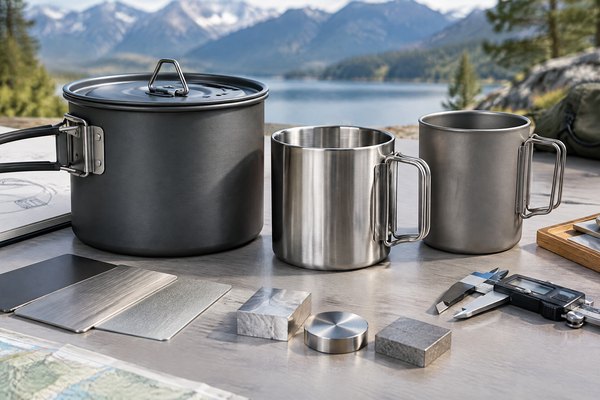
A useful sourcing decision starts with a written requirement that can be challenged, sampled, inspected, and approved.
Direct answer — what this guide gives you
If you are sourcing wholesale camp cooking equipment for a retail line, rental fleet, or private-label launch, this guide explains the steps you must take at Evaluation, Purchase Preparation, and Supplier Qualification stages. It shows how to translate use cases into product specifications, what documentation and testing to request (including camping cookware BPA free verification, camping cookware EU food contact declaration of compliance, camping cookware FDA food contact compliance, and camping cookware LFGB testing), and how to run sample and factory checks so you can accept reliable shipments.
Why this matters for CampLume buyers
CampLume is an OEM/ODM camping gear manufacturer. We supply product design, prototyping, and production capability to international buyers. The right decisions early in specification and supplier qualification reduce cost, time and compliance risk when you import camping cookware into the US, EU, UK, or other markets.
1. Evaluation: Translate Use Case Into Specification
Good requirements begin with where and how the cookware will be used. A clear spec speeds design and avoids costly iterations.
Define Use Cases
- Retail lightweight backpacking sets need minimal weight, compact nesting, and high-temp anodized aluminum or titanium.
- Family car-camping cookware focuses on capacity, ease-of-clean, and stable heat distribution.
- Communal/commissary-style portable camp kitchens require higher capacity, stackable large pans, and robust carrying systems.
List intended fuels (gas, multi-fuel stovetops, open flame), typical temperatures, and whether the product will be used with acidic foods — these affect material and coating selection.
Material & Coating Choices
Common materials: stainless steel, hard-anodized aluminum, aluminum with non-stick coating, titanium, and silicone accessories. Each has trade-offs in cost, weight, heat response, and care. When you select a coating, specify test expectations for abrasion and coating adhesion.
Size, Weight, Nesting and Kits
Be explicit about pack dimensions, cook set sequences (pot, lid, frying pan, mugs), handle style (folding, detachable), and accessory count. Include target packed dimensions to ensure retail and freight planning align.
2. Compliance & Testing Requirements Buyers Must Verify
Regulatory and chemical-safety questions differ by destination market. Request clear documentation from suppliers and confirm the applicable requirement with your compliance or legal team.
Food Contact and Chemical Safety Documentation
Ask suppliers to provide documentation demonstrating compliance with the food-contact rules for your destination market: camping cookware FDA food contact compliance for the United States, camping cookware EU food contact declaration of compliance for the European market, and camping cookware LFGB testing for Germany where requested. For consumers concerned about additives, require camping cookware BPA free verification for BPA-containing components (usually plastics and silicone).
Do not accept generic statements. Request:
- Test reports from accredited labs identifying the sample, test method, and results.
- A signed Declaration of Compliance (DoC) for the EU market that matches the delivered product.
- For FDA-related claims, ask for the supplier’s material supplier declarations and third-party testing if your legal team requires it.
Performance Testing (Durability, Abrasion, Thermal)
Ask for accelerated abrasion testing of coatings, thermal cycling for welded assemblies, and handles tested to rated weight and temperature. Specify number of cycles for your acceptance criteria.
Flame and Stability Testing
If the cookware is intended for open flame or integrated portable camp kitchens, require stability testing with loaded pots on the intended heat source.
3. Supplier Models: Choosing Private Label, OEM or ODM
You will typically choose between buying stock items for private label, engaging an OEM portable camp kitchen producer for a bespoke build, or an ODM camping cookware manufacturer to adapt an existing design.
Private Label Camping Cookware
Best when you want lower technical involvement and faster time to market. Usually lower set-up cost and higher per-unit price. Verify that the supplier will provide consistent packaging, barcodes, and any required retail labeling.
OEM Portable Camp Kitchen
OEM work is suitable when you have a detailed spec and want the factory to build to that spec exactly. Expect higher tooling or fixture work but more control over materials and testing.
ODM Camping Cookware Manufacturer
ODM partners are useful when you want a starting design to adapt quickly. This often reduces development time but can limit how much you can change without re-tooling.
Mid-article brief request (CTA)
For a fast, accurate quote and sample plan, email a short product brief to info@camplume.com with:
- Product type and key features (material, size, coating),
- Target retail price and expected MOQ,
- Destination market(s) and required food-contact standards (FDA, EU DoC, LFGB),
- Expected launch timeline and target sample date. We will reply with estimated tooling needs, lead times, and a sample/test plan.
Mid-Article CTA: Send Your Requirements
If you are evaluating wholesale camp cooking equipment, email info@camplume.com with your product category, selling market, estimated quantity, current specification and packaging brief. Ask for a documented reply that separates assumptions and deviations from the quotation.
4. Sample Development, In-factory Testing and Change Control
A disciplined sample process prevents repeated rework at scale.
Product Specification and Prototyping
Start with a spec sheet covering materials (grade and supplier), coating system (if any), critical dimensions with tolerances, weight targets, packaging, and labelling requirements. Request a production-feasible prototype and a functional prototype if ergonomics or heat management are critical.
In-Factory Testing and Third-Party Verification
Run the factory’s internal tests first (dimensions, assembly fit, surface finish). For chemical and food-contact compliance ask for third-party lab testing to confirm the production sample. Make sure test reports identify the actual sample (lot number or photo) so they match factory output.
Change Control and Approval
Document all changes to materials, coatings, or process. Require written approval when a supplier wants to substitute material or change a coating source. Use a simple change-notice form that lists the reason, risk assessment, sample approval, and updated timeline.
5. Packaging, Labeling, Documentation and Import Preparation
Packaging and paperwork are common failure points at import. Plan packaging early.
Packaging & Retail-Ready Considerations
Decide whether to use bulk shipping boxes with retail-ready inner packaging or pre-packed retail cartons. Specify packaging materials (recyclable paperboard, blister clamshell, etc.), identification (UPC or EAN code placement), and any multilingual user instructions.
Documentation: Test Reports, Declarations, and Traceability
Standard documentation buyers should request:
- Third-party test reports for food contact and coatings.
- Camping cookware EU food contact declaration of compliance where relevant.
- Camping cookware FDA food contact compliance evidence or supplier declarations for the US.
- LFGB test reports if selling in or into Germany where requested.
- A material traceability sheet and lot code system to enable recalls or targeted inspections.
Shipping Preparation
Specify carton configuration and palletization to control freight cost. Confirm the factory will label cartons with the correct HS code, product description, and net/gross weight for customs clearance.
6. Inspection, Quality Control and Pre-shipment Checks
Inspections reduce the risk of large-scale defects arriving at your warehouse.
In-line, Pre-shipment and AQL Sampling
Use a combination of in-line checks for critical process steps and a final AQL inspection before shipment. For new products, increase sample size and accept stricter AQL levels until manufacturing stabilizes.
Managing Non-Conformances
Define remediation steps: rework at factory, partial rejection, or replacement. Capture photos and NCR (non-conformance report) details. Agree on cost responsibility and timelines before accepting the first production run.
7. Pricing, Lead Time and Logistics Trade-offs
Budget and lead time are interconnected. Larger MOQs lower per-unit cost but increase inventory risk.
Buyer-Decision Table: Quick Comparison
| Option | Customization | Typical MOQ Range | Unit Cost | Typical Lead Time | Best For |
|---|---|---|---|---|---|
| Private label stock | Low | 500–2,000 | Higher | 4–10 weeks | Fast entry, low design risk |
| OEM portable camp kitchen | Medium–High | 1,000–5,000 | Medium | 8–16 weeks | Precise spec control, better unit cost |
| ODM camping cookware manufacturer | Medium | 1,000–3,000 | Medium–Low | 6–12 weeks | Quick adaptation from existing design |
Note: These ranges vary by factory, product complexity and destination. Confirm exact MOQs, tooling costs, and freight methods with a written quote.
FAQ — Practical Questions Buyers Ask
Q: What proof should I accept for "BPA-free" claims?
A: Request camping cookware BPA free verification in the form of a material supplier declaration and, where plastic or silicone is used in food-contact parts, a test report from an accredited lab that matches the production lot.
Q: Is a single lab report enough for FDA or EU compliance?
A: A single report can support a claim, but ensure the tested sample matches the production material and coating. For EU sales, also obtain a camping cookware EU food contact declaration of compliance signed by the manufacturer. Confirm the applicable requirement with your compliance team.
Q: When should I ask for LFGB testing?
A: LFGB testing is commonly requested if you will sell into Germany or want the strongest, market-accepted test for extractables and migration. If your distribution is pan-EU, the EU DoC is the minimum; add LFGB testing where your retail partners require it.
Q: How do I handle a supplier’s proposed material substitution?
A: Require a formal change notice with updated specifications, a risk assessment, and a sample run that you test before approving. Do not accept substitutions without documentation linking the new material to the original test reports.
Q: What inspection frequency is reasonable for a first production run?
A: Start with 100% critical feature verification during first-line assembly and a full pre-shipment AQL check. For subsequent runs you can reduce frequency if quality is stable.
Q: Who pays for third-party testing and sampling?
A: This is negotiable. For customized designs or new materials, buyers often share or assume testing costs to secure tailored test plans and faster turnaround.
Final Conclusion and Next Steps
Sourcing wholesale camp cooking equipment requires clarity on intended use, materials and destination-market compliance. Translate use cases into a tight product specification, insist on matching sample reports for camping cookware FDA food contact compliance, camping cookware EU food contact declaration of compliance, and camping cookware LFGB testing where needed, and document any material changes. Use a staged sample and inspection plan, and confirm packaging and documentation before shipment.
Ready to move from evaluation to a production-ready plan? Email a one‑page brief to info@camplume.com with: product sketch or reference, materials, target markets and required tests (e.g., BPA-free, EU DoC, FDA, LFGB), target MOQ and timeline. CampLume will reply with tooling estimates, a sample/test plan and a recommended QC checklist tailored to your product.
(End of guide)
Conclusion: Turn the Brief Into a Controlled Buying Decision
The practical aim of a wholesale camp cooking equipment programme is not to collect broad assurances; it is to connect the approved product configuration, sample, evidence, packaging, inspection and shipment release to the same buyer brief. That record helps the product, sourcing, quality and logistics teams resolve assumptions before they become a production or delivery problem.
Final CTA: Email info@camplume.com with the product category, target market, estimated quantity, current specification and packaging stage. Request a response that identifies assumptions, open evidence and the next approval gate.
Related CampLume resources
-
Read: How to Choose Camping Cookware Materials for a Private-Label Range for a connected sourcing decision.
-
Explore CampLume cookware options to compare a relevant product platform.
-
See the CampLume buyer FAQ for concise guidance on samples, MOQ, quality control, compliance and shipment preparation.
-
Discuss an OEM or ODM brief with CampLume when product configuration, custom branding or packaging needs to be scoped.
Project discussion
Need to apply this guide to a product programme?
Send your product category, target market, estimated quantity, current specification and packaging stage. CampLume will continue the discussion by email.
Email info@camplume.comSources and further reading