A useful sourcing decision starts with a written requirement that can be challenged, sampled, inspected, and approved.
Direct answer (quick): If you are buying OEM/ODM camping cookware for the US market and want sellers to handle landed cost and customs, choose a DDP delivery term and prepare a full product specification, correct HS code, packaging artwork, and quality acceptance criteria before requesting a camping cookware OEM quote. Exact duties, labelling and documentation depend on the cookware material, finish and the final US customs classification—confirm the applicable requirement for each SKU.
Key Decision Points Before You Request A Quote
Before you ask five factories for price, make decisions that materially affect cost and compliance:
- Product concept: item list (pots, pans, nesting sets, kettles), material (anodised aluminium, stainless steel, titanium, non-stick coated), intended use (backpacking, family camping, car camping). Materials and coatings determine testing and HS classification.
- Target retail configuration: single unit retail box, multi-piece set, or bulk value pack. This drives the packing engineering and the camping cookware carton packing specification.
- Branding and pack: do you need a branded colour box, barcode labels, UPC/EANs, hangtags or just plain neutral packaging? Ask whether the factory supports camping cookware branded colour box design and printing.
- Minimum order quantity (MOQ), target landed cost and lead time: these determine whether to accept a factory’s standard pack or require custom tooling and carton specs.
- Logistics preference: DDP vs FOB vs EXW. If you plan camping cookware DDP shipping to USA, specify this early so the factory can price duties, brokerage, and carrier selection into the camping cookware OEM quote.
Make these choices before sending an RFQ. A partial brief leads to assumptions and variable quotes.
Product Specification & Sample Workflow
High-quality procurement begins with a complete, traceable specification and a disciplined sample process.
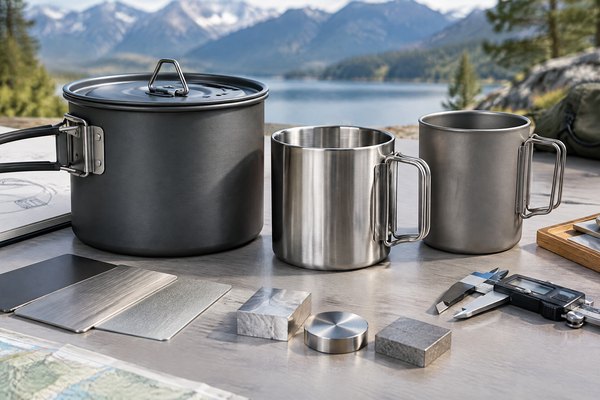
Materials, Coatings and Finish
List the exact substrate (e.g., 1.0 mm 304 stainless steel, hard-anodised aluminium, Grade 1 titanium), surface finish (mirror, brushed, anodised matte), and any coatings (PTFE, ceramic). Include tolerances for critical dimensions and any food-safe certification requirements for coatings.
Specify allowable material suppliers or require factory to disclose mill certificates if that is part of your compliance program.
Dimensions, Weight and Pack Size
Provide fully detailed CAD drawings or dimensioned sketches with tolerances. Include finished weight, collapsed dimensions (for nesting sets), and the intended retail pack size. The final carton size and method of internal packing are essential inputs to arrive at a correct camping cookware carton packing specification for sea freight and DDP cost calculations.
Sample Development, Review and Approval
Plan a sample schedule:
- Proto sample: for form, fit and visual checks.
- Engineering sample: implemented tooling/presses, with correct materials and finishes.
- Pre-production sample (PPS): produced from the produced tooling and packaging you expect to ship.
Document approval with a written sign-off (photo evidence plus a signed sample approval form). Keep a versioned sample file: sample #1, #2, PPS v1, etc. The sample approval should reference the product spec and the laboratory or factory test plan.
Packaging, Branding and Labelling Requirements
Packaging affects retail presentation, transit protection, compliance and landed cost. Define packaging early—changing it later disrupts production and shipping schedules.
Barcode, Label and Retail Packaging
Provide your barcode requirements early and specify where barcodes and labels will be applied. If you need the factory to apply scannable barcodes, list format (UPC-A, EAN-13) and the placement on the retail pack. Ask the factory how they handle camping cookware barcode and label packaging practices and whether they can pre-apply labels during packing.
If your importer requires additional markings (country-of-origin, country of origin text, batch/lot numbers), include placement instructions in the pack spec.
Branded Colour Box And Custom Colour Options
If you require a camping cookware branded colour box, submit print-ready dielines and a colour approval standard (PANTONE references). For private-label products that need a particular finish, request mock-ups and colour chips. Where exact hues are critical, specify camping cookware custom colour tolerances and require pre-production colour approval.
Note: box printing, varnish and lamination change both unit and carton pack dimensions and weight, affecting freight and DDP cost calculations.
Carton Packing Specification
Provide the camping cookware carton packing specification including: carton external dimensions, internal partitioning, pallet configuration (units per layer, layers per pallet), cushioning materials, corner protectors, and pallet wrap instructions. Include net and gross weight per carton and the preferred pallet type (wooden or heat-treated, ISPM 15 compliance if required). These details must match the export documentation for customs declaration and are essential for accurate camping cookware DDP shipping to USA estimates.
Compliance, HS Codes and Documentation
Legal and customs obligations vary by product and import destination. For each SKU, identify the likely customs classification early in the project.
HS Code Import and Classification
Provide any intelligence you have about tariff lines. Where you don’t know the number, request the factory’s suggested heading but confirm with your customs broker or US customs authority. Use the camping cookware HS code import to estimate duties and to determine whether special documentation (e.g., anti-dumping, quota, or FDA/USDA notifications) applies.
Remember: classification can change with material, set composition (individually sold vs set), and whether the unit is for retail or institutional use.
Tests, Certificates and Country-Specific Rules
List required tests (food-contact migration, heavy metals, non-stick coating durability, flammability of pack) and request lead times for testing. Ask whether the factory can provide test reports from accredited third-party labs or if you will arrange testing after samples. For US imports, some cookware may require FDA-compliant material statements or CPSIA tracking if sold for infants—confirm the applicable requirement for each SKU.
Document list to request in the RFQ: commercial invoice, packing list, bill of lading/airway bill, certificate of origin (if required), and any test certificates or material declarations.
Mid-Article CTA: Send Your Requirements
If you are evaluating camping cookware DDP shipping to USA, email info@camplume.com with your product category, selling market, estimated quantity, current specification and packaging brief. Ask for a documented reply that separates assumptions and deviations from the quotation.
Production, Quality Control and Change Management
A short, explicit QC and change-control plan avoids costly rework at scale.
Factory Testing And Inspection
Specify inspection stages: pre-production (tooling), first-article inspection, in-process checks (critical dimensions, coating coverage), and final random inspection (AQL sampling). Define acceptance criteria and communicate what constitutes a hold-and-test sample. Where applicable, include factory testing for pressure (kettles), handle torque, non-stick abrasion or salt-spray for plated finishes.
In-Process Quality Controls
Ask the factory to provide checklists and photos from inline QC. If you will use a third-party inspector, list stages where independent inspection is mandatory.
Change Control
Define a change-control process: how the factory must notify you of material substitutions, tooling changes, or delays, and an approval process for non-critical vs critical changes. Even seemingly minor cosmetic changes can force new label approvals or alter HS classification.
Shipping & Logistics Options
Shipping terms drive responsibility for documentation, duty payments and lead time. Decide up-front whether you want DDP pricing or to control import yourself.
Camping Cookware DDP Shipping To USA (Practical Notes)
If you request camping cookware DDP shipping to USA, the seller quotes a price that includes export duties, international freight, insurance and all import duties and customs clearance costs, delivering goods to your nominated address. For buyers using DDP:
- Provide final consignee name and address, EIN/Tax ID if needed for import entry, and any special broker instructions.
- Confirm whether the DDP quote includes trade remedies or import bonds. Clarify liabilities for customs penalties arising from incorrect HS code declarations.
- Expect the seller to request payment terms that reflect the additional cash flow and risk of covering duties.
Always confirm the specific responsibilities in writing and use a trusted customs broker or verify that the seller will use a licensed US customs broker on your behalf.
Other Logistics Points
Compare lead times for sea vs air (air shortens lead time but increases cost per unit). For consolidated shipments, ensure packing and palletisation instructions are followed strictly to avoid extra handling charges at destination.
Cost Drivers, OEM Quotes and Buyer Decision Table
When you request a camping cookware OEM quote, the main cost drivers are material type and gauge, coating or anodising, tooling and mould costs, packaging complexity, order quantity, and the chosen delivery term (e.g., DDP to USA). Add testing, labels, barcode application, and freight insurance as costs to the per-unit calculation.
Markdown buyer-decision table (concise):
| Decision Area | Low-Cost Option | Higher Control / Higher Cost |
|---|---|---|
| Material | Thin aluminium, standard anodise | Thick 300-series stainless or titanium |
| Packaging | Bulk polybag + master carton | Branded colour box + insert, barcode applied |
| Shipping Term | FOB / EXW | DDP (seller handles duties) |
| Testing | Sample-based | Full batch testing & certificates |
Mid-article CTA (clear email brief request):
To get an accurate camping cookware OEM quote and DDP pricing, email a brief to sourcing@camplume.com with: SKU list and sketches, material and finish choices, target MOQ, required packaging (include dielines if you need a camping cookware branded colour box), target delivery term (e.g., camping cookware DDP shipping to USA), desired lead time, and known HS codes. Include your target FOB or landed cost per unit and intended US sell price if available—this helps us recommend trade-offs.
FAQ (Practical Questions)
Q: How should I decide between a branded colour box and neutral bulk packing?
A: Use your retail channel and positioning as the guide. Branded colour boxes increase retail appeal but add cost, weight and lead time. If you sell online in unbranded bundles, neutral bulk may be quicker to market.
Q: Can the factory apply my barcodes and labels?
A: Many OEM/ODM factories can apply barcodes during packing. Specify barcode format and placement and confirm whether they will scan and verify labels prior to sealing cartons.
Q: Who confirms the HS code used for customs declaration?
A: The factory can provide a suggested HS code, but you or your customs broker should confirm the camping cookware HS code import for each SKU before shipment to avoid surprises.
Q: What happens to cost if I change the pack after production starts?
A: Late-stage pack changes typically cause repro costs for artwork, print delays, and may require new approvals. Include change-control terms in the purchase order.
Q: Does DDP remove all buyer responsibility?
A: DDP transfers import clearance and duty payment to the seller, but buyers still need to ensure product compliance and provide required importer information. Confirm responsibilities in writing.
Conclusion And Next Steps
A smooth launch for camping cookware with DDP delivery to the USA begins with a complete specification, a clear packaging brief (including camping cookware barcode and label packaging, branded colour box and camping cookware carton packing specification), the right HS code assessment, and a documented sample approval and QC plan. If you want a precise camping cookware OEM quote that includes camping cookware DDP shipping to USA, send a detailed brief to sourcing@camplume.com with the items listed above. CampLume is an OEM/ODM camping gear manufacturer able to prepare samples, support packaging artwork and provide production QC—but final compliance and import classification should be confirmed for each SKU and destination market.
If you would like a checklist template for your RFQ, sample approval form or a packing specification worksheet, email sourcing@camplume.com with your product outline and target volumes and our procurement team will return a tailored RFQ checklist within two business days.
FAQ
What should buyers confirm for camping cookware food-contact claims?
Confirm the exact material, coating or component, intended food-contact use, target market, available documentation and any test scope with qualified compliance advisers. Do not apply one document to unrelated variations without review.
How should a cookware sample be reviewed?
Check the actual material and finish, fit of lids and handles, packability, markings, care information, visible defects and retail pack. Note which sample is a development sample and which represents the proposed bulk configuration.
Can a private-label logo be added without changing the product?
Often a logo, label or packaging change can be scoped separately, but the buyer should confirm decoration method, placement, artwork files, MOQ, approval sample and any effect on lead time or packaging.
What belongs in a cookware shipment release pack?
Include the approved product and packaging reference, packing list, carton dimensions and count, label or artwork approval, inspection outcome and any documents agreed for the destination market.
Final CTA: Email info@camplume.com with your product category, target market, estimated quantity, current specification and packaging stage. Request a documented response that identifies assumptions, open evidence and the next approval gate.
Related CampLume resources
-
Read: How to Choose Camping Cookware Materials for a Private-Label Range for a connected sourcing decision.
-
Explore CampLume cookware options to compare a relevant product platform.
-
See the CampLume buyer FAQ for concise guidance on samples, MOQ, quality control, compliance and shipment preparation.
-
Discuss an OEM or ODM brief with CampLume when product configuration, custom branding or packaging needs to be scoped.
Project discussion
Need to apply this guide to a product programme?
Send your product category, target market, estimated quantity, current specification and packaging stage. CampLume will continue the discussion by email.
Email info@camplume.comSources and further reading