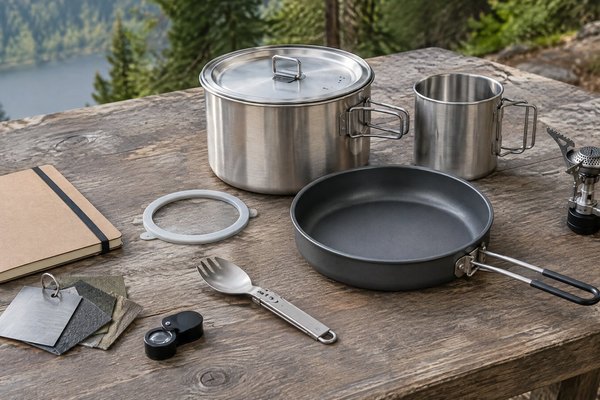
A useful sourcing decision starts with a written requirement that can be challenged, sampled, inspected, and approved.
How Should Brands Source Food-Contact Camping Cookware for US and European Markets?
Camping cookware faces food, heat, abrasion, cleaning and transport. For brands selling in the United States and Europe, a pot, pan, mug or utensil is more than a logo-bearing shape: its food-contact materials, instructions, claims, packaging and evidence must align with its intended use.
The responsible question is not, “Is this product food safe?” It is, “Can the supplier identify every food-contact material, define intended use, control production and support the exact product and claims?” In the EU, food-contact materials must be made under good manufacturing practice and must not transfer constituents into food at levels that endanger health, unacceptably change food composition, or deteriorate taste or odour. [3] [4] In the United States, food-contact substances that are food additives need an applicable authorization, exemption or other lawful basis for intended use. [1]
This is commercial and technical sourcing guidance, not legal advice. Requirements can depend on the product, material, destination, supply chain and claim. Confirm current rules and obtain qualified regulatory advice where needed.
Module 1 — Quick Answer: What is the practical sourcing sequence?
A sound purchase process starts with the intended use, not a catalogue photograph. Define food contact, heating method, temperature and duration range, repeated use, cleaning and selling markets. Then map every food-contact component: body, interior coating, lid underside, rivets, gaskets, grips, collapsible parts, utensils and food-storage lids.
Ask the supplier to connect each material and process to a controlled specification and market-relevant evidence. Review representative samples before approving artwork or mass production. Align claims, care instructions, marks, packaging and e-commerce content with supported use conditions. Use pre-shipment inspection and lot traceability to confirm goods still match the approved sample and bill of materials.
Evaluate a camping cookware manufacturer as an evidence partner as well as a producer. A low quote does not establish alloy grade, coating chemistry, migration basis, process control or shipment consistency.
Module 2 — Buyer Context: Why is camp cookware a higher-risk format than an ordinary vessel?
Outdoor cookware is compact, nestable and repeatedly transported. A folded handle can expose a plastic grip to heat, nesting can abrade a finish, and a removable gasket can be lost or incorrectly fitted. A “backpacking” pot may also be used over a campfire or for food storage.
The relevant regulatory concept is normal or foreseeable use. Under the EU framework, assessment is not limited to an ideal product photo: the material must satisfy the safety rule under normal or foreseeable conditions. [4] US food-contact review likewise depends on intended use and limitations; FDA describes Food Contact Notifications (FCNs) as company- and use-specific. [1] [2] A raw-resin document is not automatically evidence for a finished folding spork or lid used with hot acidic food.
Risk is distributed across the supply chain. The brand sets use and claims; the factory controls materials and assembly; upstream suppliers hold composition information; laboratories test defined samples. The buyer must join these records rather than treat one report as a universal passport.
| Sourcing decision | Why it changes the evidence request | Buyer question to put in the brief |
|---|---|---|
| Uncoated stainless-steel pot | The alloy, welds, rivets and any non-metal parts may all be relevant. | What is the exact body, lid, rivet and handle material specification? |
| Coated aluminum fry pan | The substrate, pretreatment, coating system, cure and use limits must be aligned. | Which surface is coated, what food and heat uses are supported, and what is the coating supplier evidence? |
| Plastic or silicone lid, cup or utensil | The specific polymer, colorants, additives and intended food/temperature use can affect the assessment. | Is the evidence for repeated hot-food contact, and does it cover the actual resin and color? |
| Nesting multi-piece set | Contact can occur between articles during storage; packaging and abrasion controls matter. | What prevents cosmetic damage, contamination or mixed components during packing? |
| EU sale in several countries | EU rules may coexist with relevant national provisions where no specific EU measure exists. | Which countries are launch markets, and what country-specific review is required? |
Module 3 — Establish the market and product boundary before requesting a quotation
Create a one-page product-use statement for each stock-keeping unit (SKU). Name the product, revision, markets, food-contact components, heating source, maximum intended temperature if known, food types, repeated-use status, washing method, age-grade if relevant and exclusions. “Outdoor cookware” is too broad. “One-person uncoated 304 stainless-steel pot with foldable stainless handle, for boiling water and heating food on a backpacking gas stove; not for microwave use” is a usable starting point.
Do not stretch one product across incompatible uses. A cup for hot drinks is not necessarily a direct-flame pot; a pan assessed for a coated interior is not automatically a sealed food-storage container. Physical capability does not provide a documented basis for a brand claim. If a pot is marketed with a stove, examine the products separately; this guide addresses cookware, not fuel appliances.
For EU sales, begin with the framework rule and identify any material-specific EU measure. The European Commission identifies the broad framework in Regulation (EC) No 1935/2004, specific measures for materials including plastics and ceramics, and possible national provisions where no specific EU measure exists. [3] For plastics, Regulation (EU) No 10/2011 includes composition, restriction and migration-testing rules; a written Declaration of Compliance (DoC) is supported by documentation available to authorities on request. [3]
For US sales, avoid “FDA approved” as a generic product description. FDA explains that food-contact uses may rely on a food additive regulation, FCN or Threshold of Regulation exemption when the substance is a food additive, and applicable specifications and limitations must be followed. [1] An FCN is effective only for the identified manufacturer or supplier and notified use. [2] Request the supplier’s documented basis for the exact material and use, not a broad assertion.
Define the route for special products early
Some choices bring additional logistics and evidence questions. The European Commission states that polyamide or melamine kitchenware originating in or consigned from China or Hong Kong is subject to specified EU import controls, including a declaration and laboratory report for named analytes. [3] Do not assume every plastic camping product follows that route; identify material, origin and destination before booking freight and obtain specialist confirmation where appropriate.
Module 4 — Map food-contact surfaces and define materials with precision
A food-contact surface directly contacts food. The EU GMP regulation uses that definition and distinguishes the non-food-contact side. [5] Make the map practical: list each component, material, location, direct or incidental contact, and whether heat, friction or cleaning may change exposure. Treat it as a controlled specification and update it when a component changes.
For a metal pot, “stainless steel” is a family, not a complete specification. Record the stated alloy/grade, finish, weld and rivet design, and every additional food-contact element. For aluminum, distinguish bare, anodised and coated surfaces. Hard anodising is an electrochemical surface treatment, not interchangeable with a polymer non-stick coating. Define coating family, color, layers, substrate preparation, cure process, location and stated use limits.
For polymers and elastomers, name the base material rather than only “BPA-free” or “silicone.” Ask for grade, relevant colorant, supplier identity or traceable code, and intended food/temperature use. A gasket, collapsible cup wall and handle cover may differ. Prevent ink, adhesive or packaging transfer to food-contact areas during packing; EU GMP addresses transfer from non-food-contact printing inks through a substrate or by set-off. [5]
| Component example | Material definition that is too vague | Definition that supports review | Evidence to request or confirm |
|---|---|---|---|
| Nesting pot body | “Food-grade steel” | Stated stainless-steel grade/alloy, finish, contact side and fabrication route | Material certificate or supplier declaration; finished-product traceability; use-specific review |
| Fry-pan interior | “Non-stick coating” | Coating system, layer structure, color, substrate preparation, cure and intended use | Coating supplier declaration, relevant finished-article evidence and controlled process parameters |
| Lid gasket | “Silicone” | Elastomer grade, color, contact location, temperature/use range and supplier code | Material declaration, food-contact basis and retained part identification |
| Folding grip | “Heat-resistant plastic” | Polymer grade, colorant, position relative to food and heat source | Specification, heat/use limitations, assembly check and care-instruction wording |
| Paper band or carton | “Eco packaging” | Paper/board type, inks, adhesive, contact relationship and disposal claim basis | Artwork approval, packaging specification and claim substantiation file |
A useful material-definition rule
Write the material definition so a replacement is visible. If a supplier can substitute a resin, coating, colorant, rivet, gasket or ink without changing the wording, it is probably too vague. Require written notification and buyer approval before changes to food-contact materials, formulas, relevant process conditions or claim-bearing packaging.
Module 5 — Translate material choices into a controlled product specification
The buyer’s core document should be a technical specification pack, not chat messages. It should identify the approved configuration and acceptance criteria. Attach drawings, bill of materials (BOM), finish samples, logo and packaging artwork, labeling copy, instructions, approved reference sample and revision history. Give each document a version number and date.
Use the pack to separate negotiable styling from non-negotiable evidence. Handle color and logo placement may be commercial choices; a food-contact polymer, coating system, use limit and test-sample configuration are control points. Confirm which options are supported and which need review or testing. Do not presume a new color, coating, lid or factory has no compliance effect.
A clear specification improves factory communication. EU GMP requires documented quality-assurance and quality-control systems, starting-material specifications, instructions and records relevant to finished-article compliance and safety. [5] A brand need not dictate a factory’s internal system, but should see how its configuration becomes incoming-material controls, in-process checks, finished-goods checks and lot records.
In-article CTA — Turn your concept into a reviewable sourcing brief
If your team is developing a private-label pot, pan, mess kit, mug or utensil, send intended use, markets, materials, target claims and preliminary artwork to info@camplume.com or submit the site RFQ form. Request project-specific confirmation of configurations, sample route, documentation scope, testing assumptions and change control before treating a quotation as final product approval.
Module 6 — Make claims, instructions and packaging reflect the evidence
Marketing language is part of the sourcing specification. Under the EU framework, labeling, advertising and presentation of food-contact materials and articles must not mislead consumers. [4] A defensible claim names a supported feature and does not imply use broader than the evidence or instructions support.
Avoid “non-toxic,” “chemical-free,” “eco-safe,” “indestructible” or “safe for all heat sources” unless the brand can define, substantiate and maintain them. “Food-contact suitable for the specified intended use” may be more accurate in a technical file than a sweeping front-of-pack assurance; still review consumer copy for the relevant market. A material claim should not become a performance claim: “stainless steel” does not prove dishwasher suitability, and “BPA-free” does not establish suitability for direct flame or very hot oil.
Instructions should state supported use boundaries: compatible heat sources, empty-heating limits, fill level, handle positioning, coating care, cooling/cleaning, microwave or dishwasher status, and damaged-component guidance as relevant. Do not copy generic care text; test wording against the construction and carton and listing claims.
| Proposed claim or statement | What the brand should define | Safer sourcing action |
|---|---|---|
| “Food safe” | Which food-contact surfaces, markets and intended uses are covered? | Replace unsupported shorthand with a controlled technical basis and market-reviewed copy. |
| “PFAS-free” or “BPA-free” | Scope, threshold or analytical method, components covered and date of evidence | Obtain component-level supplier confirmation and decide whether the claim is precise enough to publish. |
| “Non-stick” | Coating system, care limits and expected performance definition | Align sample evaluation, utensil guidance and packaging claims to the approved coating. |
| “Campfire safe” | Direct-fire design, handle/attachment exposure and instruction conditions | Validate the actual configuration; do not infer it from a similar pot. |
| “Recyclable packaging” | Material composition, local collection reality and claim scope | Keep a substantiation record and avoid implying universal recyclability. |
Packaging communicates and protects. Use clean separators so cookware does not rub through an approved finish in transit. Ensure leaflets, desiccants, protective films and promotional inserts cannot create contamination or assembly confusion. For US imports, review country-of-origin marking early. CBP states that foreign-origin articles entering the United States generally must be legibly marked with the English country name unless an exception applies; marking should be conspicuous and sufficiently permanent. [7] Confirm the approach for the import model rather than assuming carton-only marking is enough.
Module 7 — Build a documentation and testing scope that answers specific questions
There is no useful universal request for “all compliance documents.” Build a document matrix recording the question answered, configuration, issuer, date, market and revision. Keep finished-goods evidence separate from upstream declarations, linked by BOM and component identifiers.
For EU plastic food-contact components, the Commission explains that the DoC is based on supporting documentation available to enforcement authorities on request. [3] For other materials, requirements may differ; where no specific EU measure exists, national measures may matter. [3] For the US, ask how the supplier’s authorization, listing, FCN, exemption or other basis applies to the actual manufacturer/supplier and intended use. FDA’s inventory identifies intended use, limitations, specifications and manufacturer/supplier for an effective FCN. [2]
A testing plan should be hypothesis-led: start with material and use, then define the need for testing and representative conditions. Migration testing is not a generic pass/fail ritual. For EU plastics, the Commission describes food simulants, representative time/temperature conditions, specific migration limits (SMLs) and an overall migration limit (OML). [3] Conditions and sample preparation must fit the claim and instructions.
Testing may also address dimensions, nesting fit, sharp edges, handle retention, coating appearance/adhesion, lid fit, cleanliness, distortion, artwork and pack integrity. Scope is product-dependent. Ask the laboratory and supplier for sample identity, method, conditions, acceptance basis and limitations—not a one-line “passed” summary.
| Evidence item | What it should identify | Typical buyer review question |
|---|---|---|
| Controlled BOM and material declarations | Component, grade/formulation reference, supplier and revision | Does every direct food-contact component appear, including gasket, rivet and lid underside? |
| Supplier DoC or use declaration | Market basis, intended conditions of use, issuer, date and limitations | Does it cover this part, this supplier and this product use? |
| Laboratory report | Sample identity, method, conditions, result and report date | Does the test sample match the approved material, coating and configuration? |
| Factory batch/lot records | Production date, material lots, inspection records and release status | Can a retailer complaint be traced to a shipment and component source? |
| Instructions and artwork approval | SKU, languages, claim copy, warnings and revision | Do the care instructions narrow any claim that would otherwise overpromise? |
| Risk assessment and technical file index | Hazards, mitigations, standards/evidence mapping and responsible owner | Can the brand retrieve the decision path if an authority or customer asks? |
For EU general product documentation, official EU guidance says manufacturers should prepare it before placing a product on the market, keep it available to authorities on request and normally retain it for 10 years unless legislation specifies otherwise. It identifies the product label, user instructions, risk assessment, critical materials and test reports as relevant content. [6] Verify the exact legal role and retention requirement for product and market; assign an owner and preserve a searchable file.
Module 8 — Audit factory controls and create a product-specific test plan
A factory review should follow material flow, not a marketing checklist. Ask how incoming lots are identified, approved materials separated, mixing and assembly controlled, relevant cure/heating parameters maintained and inspections recorded. Confirm treatment of rework, rejects, nonconforming material and approved changes.
EU GMP is a useful operational benchmark: it requires documented quality assurance and control, suitable starting-material specifications, corrective measures and records of specifications, manufacture and quality-control results. [5] A buyer cannot infer finished-product compliance merely because a factory uses “GMP”; ask to see control logic for the product.
Example: coated camping skillet factory plan
For a coated skillet, the approved sample should identify substrate, pretreatment, coating system, cure profile or controlled cure window, appearance standard, logo location, handle parts and packing method. Incoming inspection can verify named coating and substrate lots; in-process checks can record preparation and cure parameters under the validated process. Finished-goods checks may examine coverage, blistering, unintended exposed metal, burrs, handle security, flatness and nesting protection. Define support for any use-related claim before mass production, not after cartons are printed.
Example: uncoated stainless-steel mess kit factory plan
For a nesting mess kit, focus on grade/finish identification, sharp edges, burr removal, handle movement, rivet condition, lid fit, nesting clearance, cleanliness and packing protection. Clearly identify food-contact components.
Module 9 — Use samples and pre-shipment inspection to verify the approved configuration
Sampling is staged. Begin with an engineering sample to review shape, nesting, component layout and intended-use feasibility. Move to a pre-production sample representing proposed materials, coatings, markings, instructions and packaging. Retain a signed or uniquely identified reference sample. For any meaningful change, assess whether approval remains valid or needs a new sample, documentation review or test.
Review samples in realistic use conditions. Use food simulant only in the agreed laboratory plan; informal kitchen use is not a formal compliance test. Practical checks can include repeated handle folding, nesting/packing, gloved lid removal, washing to draft instructions and carton inspection after transit simulation. Record observations, photos, sample code and disposition.
A pre-shipment inspection should compare production goods with the approved specification and reference sample. Verify SKU mix, quantity, workmanship, specified dimensions/tolerances, available material/component markings, finish, handle/lid function, cleanliness, instructions, origin marking, barcode/carton data, packing and carton condition. Inspection does not replace material evidence or laboratory testing; it catches configuration and workmanship drift.
Shipment-preparation example
For a four-piece set with pot, fry pan, lid and folding spork, verify approved pot/lid material and finish, pan interior coating, spork polymer/color, and separators preventing scratches. Also check approved multilingual instructions and correct origin marking. If an alternate spork resin or lid gasket is found, hold the lot until change-control and evidence review are complete.
Module 10 — Configure private-label OEM/ODM options without losing traceability
Private label commonly changes logos, colors, packaging, bundles and accessories. OEM may use an existing manufacturer design with the brand’s configuration, while ODM can involve a manufacturer-developed design adapted to brand requirements. In either model, distinguish cosmetic customization from changes affecting materials, food contact, heat exposure, instructions, claims or evidence.
Put these questions in the RFQ: Which body and lid materials, coating systems and colorways are controlled? Is logo marking on a food-contact surface? Does a new handle material change heat/use instructions? Can a utensil, cup or storage lid be included without expanding test/documentation scope? Which identifiers and lot marks trace retailer returns or complaints? Confirm each project-dependent answer in writing before artwork release.
The brand should own or retain access to its approval record: CAD/drawings, BOM, sample sign-off, evidence matrix, artwork, instructions, test reports, inspection criteria and change history. Require notice before changes to critical materials, component supplier, coating formula, manufacturing location, process or packaging that can affect the product. A responsible camping cookware manufacturer identifies the review needed for a proposed change rather than treating substitutions as routine.
Module 11 — FAQ: What do buyers most often need to clarify?
1. Does “food-grade stainless steel” prove US and EU compliance?
No. It is a commercial description, not a complete configuration record. Ask for stated alloy or grade, contact-surface map, intended use, component details and relevant finished-article evidence.
2. Do we need the same documents for a steel pot and a plastic lid?
Not necessarily. The evidence should follow the material and intended use. EU plastics have a specific EU measure and DoC mechanism; other material groups can follow different EU or national requirements. [3]
3. Can we use one test report for every color and size?
Only if laboratory, supplier and technical review establish coverage of those configurations and conditions. A new resin, colorant, coating, substrate, surface area or use condition can change the assessment.
4. Is an FDA FCN a universal approval for our finished cookware?
No. FDA says an FCN is effective for the identified manufacturer or supplier and specified intended use, subject to its limitations. Verify the chain of supply and the exact use. [1] [2]
5. What should care instructions say about a coated camp pan?
State only use, heating, utensil and cleaning limits supported by the approved configuration. Include practical cautions that reduce foreseeable misuse and review wording against marketing claims.
6. When should a supplier change trigger a new review?
Before implementation if it changes a food-contact material, coating system, colorant, critical component, factory/process, use condition, packaging affecting contact or protection, or claim-bearing information. Document the decision even when no new test is needed.
Related CampLume resources
Use these related pages to turn How Should Brands Source Food-Contact Camping Cookware for US and European Markets? into a more complete, supplier-ready decision:
- Read: Aluminum, Stainless Steel, or Titanium: How to Choose Camping Cookware for Your Product Line for the next connected sourcing decision.
- Explore CampLume camping cookware options to compare a suitable CampLume product platform.
- See the CampLume buyer FAQ for concise guidance on samples, MOQ, quality control, compliance and shipment preparation.
Conclusion — Source the evidence chain, not just the cookware
For US and European launches, responsible cookware sourcing joins design to proof. Start with food-contact surfaces and intended use. Define materials and coatings so substitutions are visible. Build claims, instructions and packaging around the supported configuration. Maintain a linked file of material information, test scope, factory controls, sample approvals, inspections and traceability.
This approach helps a brand ask better questions of a camping cookware manufacturer while avoiding unsupported promises. For a project-specific cookware sourcing inquiry, contact info@camplume.com or use the site RFQ form with target markets, intended use, preferred materials, claims and private-label requirements.
Project discussion
Need to apply this guide to a product programme?
Send your product category, target market, estimated quantity, current specification and packaging stage. CampLume will continue the discussion by email.
Email info@camplume.comSources and further reading
References
- 1Understanding How the FDA Regulates Substances that Come into Contact with Food
- 2Inventory of Effective Food Contact Substance (FCS) Notifications
- 3Legislation — Food Contact Materials
- 4Regulation (EC) No 1935/2004 on Materials and Articles Intended to Come into Contact with Food
- 5Commission Regulation (EC) No 2023/2006 on Good Manufacturing Practice for Materials and Articles Intended to Come into Contact with Food
- 6Preparing Technical Documentation
- 7Marking of Country of Origin on U.S. Imports