A useful sourcing decision starts with a written requirement that can be challenged, sampled, inspected, and approved.
What Should Retail Buyers Specify for a Foldable Camping Kitchen Station?
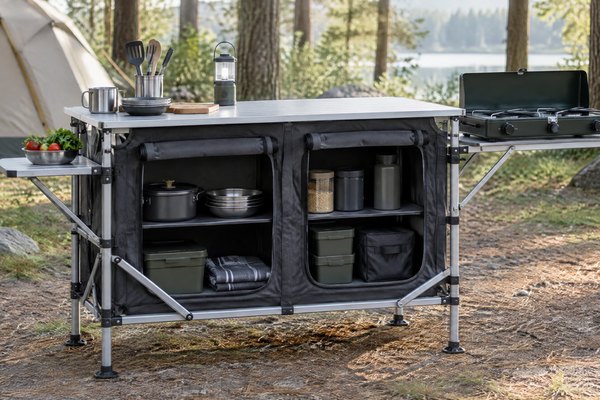
A foldable camping kitchen station is a multi-part camp-furniture system combining a food-preparation worktop, folding frame, textile storage, connectors, and often accessories in one retail carton. Its sourcing risks sit at the interfaces: a stable frame can be undermined by an unsupported top, a fabric cabinet by weak stitching, and a compact product by a carton that does not restrain moving parts.
For a foldable camping kitchen station wholesale program, write the specification around intended use, measurable dimensions, material identity, load conditions, heat-use limits, pack-out, and inspection criteria. The EU General Product Safety Regulation requires economic operators to place only safe products on the market and considers product characteristics, packaging, assembly, instructions, foreseeable use, and warnings. [1] This is procurement guidance, not legal advice; brands should confirm market-specific obligations with their own compliance professionals.
Quick Answer: What must the buying specification cover?
Specify the station as a complete, use-defined system rather than a catalogue photo. At minimum, the purchase specification should identify the deployed and folded dimensions; worktop material and usable area; frame material, tube profile, wall thickness, finish, and folding mechanism; each storage fabric and its attachment points; the separate working-load limit for every load-bearing surface; the required stability condition; permitted and prohibited heat uses; accessory interfaces; retail pack configuration; sample approvals; and the exact tests and inspection acceptance rules.
A sound brief also states what the product is not. For example: it is not a surface for an open flame unless the final, tested design is expressly designated for that use; textile cabinets are not cookware storage next to a heat source; and a total system load must not be substituted for an individual shelf limit. These boundaries make retailer copy, instructions, factory checks, and customer support more consistent.
1. Start with the retail use case and the risk map
Write a one-paragraph intended-use statement before choosing materials. Define the user, environment, cooking arrangement, weather exposure, packed transport mode, and whether the station will be used with a separately sold stove. “Outdoor kitchen station” is too broad to direct engineering or inspection. “Portable food-preparation and organized storage station for adult campers, used on reasonably level ground with a separately supported stove” is materially more useful.
Food-contact materials should not release constituents at levels harmful to health or change food composition, taste, or odour unacceptably. [2] If the worktop will be marketed for direct food preparation, define the contact material and intended use, then request the supporting evidence appropriate to the destination market rather than using a vague “food grade” line.
| Buyer decision | What to specify in the brief | Why it changes the engineering decision |
|---|---|---|
| Primary user scenario | Car camping, family campsite, event catering support, or retail display; adult use; expected terrain | Sets the need for footprint, leveling features, and instructions. |
| Cooking architecture | Separate stove on a designated side shelf, stove stand, or ground-level appliance; cookware handling workflow | Determines heat boundaries, clearances, and the proximity of fabric storage. |
| Sales route | Store replenishment, palletized wholesale, parcel direct-to-consumer, or a combination | Determines carton strength, package testing, and master-carton design. |
| Market claim | General prep/storage, direct food-contact prep top, or stove-support surface | Drives material evidence, labeling, warnings, and validation. |
| Retail positioning | Entry, core, or premium; target folded weight and shelf footprint | Makes trade-offs between tube construction, panels, hardware, and packaging visible. |
Definition: a working load limit is the maximum load a brand authorizes under stated normal-use conditions. It is not the same as an unspecified “test load,” and it should never be inferred from a photograph or from the total weight of a sample.
2. Specify the worktop before the accessory list
The worktop is the customer’s primary interaction surface. Specify it with a dimensioned drawing, not a general material label. State the overall outer dimensions, the unobstructed usable area, thickness, edge profile, panel joints, joint gaps, drainage features if any, and the method by which the top connects to the frame. Include a tolerance plan that distinguishes cosmetic gaps from function-critical gaps.
Choose the worktop by use, not by appearance
Aluminum slats can reduce packed volume but need defined spacing, end treatment, cross-supports, and deformation limits. Solid engineered panels need moisture management and protected edges. A stainless-steel insert needs a specified gauge, edge treatment, attachment method, and finish. Coated steel needs defined adhesion and corrosion expectations rather than an assumed outdoor-life claim.
Require a controlled BOM identifying the relevant alloy or grade, panel construction, coating system, finish code, and substitution-control process. State whether raw edges are rolled, hemmed, capped, or shielded so the inspector can check burrs, exposed fasteners, and finish variation.
Define cleanability and direct food-contact boundaries
A product may reasonably be sold as a general camp worktop without being positioned as a chopping board or direct food-contact article. The specification should state which claim the brand intends to make. Where direct food contact is intended, identify the food-contact layer, expected food types, time and temperature conditions, cleaning method, and the documents or test evidence the importer needs. The European Commission notes that food-contact rules include safety and inertness principles, labeling, compliance documentation, and traceability; plastic food-contact articles may have additional requirements. [2]
For a general-prep claim, put practical requirements into the product standard: surface must be cleanable with the stated household method; no unfinished absorbent edge may be exposed; no water should become trapped where it can soil the carry bag; and no component should shed in normal set-up and wipe-down. These are useful design targets, not substitutes for a required market assessment.
Worktop questions for the approved sample
Inspect the top deployed and packed: it should seat on every support, remain level on the defined test floor, clean at joints, have safe edges, stay secure with permitted accessories, and show no unacceptable rub mark after agreed cycles. Record results, photographs, measurements, and sample revision.
3. Make frame construction, folding action, and stability measurable
Describe the frame by material, tube shape and nominal dimensions, wall thickness, structural joints, corrosion-protection system, feet, caps, locks, hinges, and bracing. For mixed-metal assemblies, confirm protection of interfaces; for coated steel, define finish and coverage expectations.
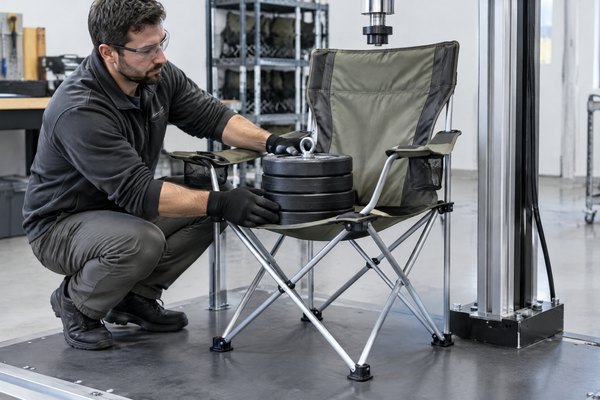
The deployed geometry should list overall height, worktop height, base footprint, center-of-load assumptions, and any adjustable feet. Avoid a generic “stable design” statement. The buyer needs an agreed stability method: surface condition, whether accessories are installed, which storage compartments are loaded, load placement, external force direction if applicable, and pass/fail definition. A recognised benchmark to discuss with a laboratory is the EN 581 family; BSI describes BS EN 581-3 as covering mechanical safety requirements for outdoor tables used for camping, domestic, and contract applications. Buyers should verify the current edition, applicability, and test plan for the exact product configuration rather than treating a standard title as automatic proof of compliance. [3]
Separate strength from stability
Strength asks whether the structure remains intact and functional under a defined load. Stability asks whether it resists tipping or uncontrolled movement under a defined condition. Durability asks whether repeated use impairs strength, stability, or function. Each needs its own test instruction and record.
A useful buyer specification names the following separately:
- Worktop distributed working load: load spread across the stated usable area.
- Worktop point-load condition: localized load at the agreed worst-case position, such as near a joint or outer edge.
- Side-shelf working load: separate limit, with the accessory or hinge position identified.
- Textile shelf and cabinet load: separate limit per shelf or pocket, including the effect of a loaded zipper or door.
- Hanging rail or utensil-hook load: a limit per hook and a combined limit if multiple hooks are used.
- Carry-bag load: the product’s packed weight plus any separately approved accessories, not an arbitrary extra load.
Specify the units, load duration, loading location, and whether the load is static or repeated. The published retail instructions should match the approved values exactly. A total station load is helpful as a system summary only if it does not obscure the lower limits on individual shelves or appendages.
| Component | Minimum technical information to request | Example acceptance language to customize |
|---|---|---|
| Main worktop | Material stack, dimensions, support map, distributed and point-load conditions | “No fracture, loss of support, sharp edge, or permanent deformation beyond the agreed limit after the stated test.” |
| Main frame | Tube profile, nominal wall, joint drawings, bracing, finish, feet | “All locks engage; no crack, separation, loose fastener, or loss of function after the agreed cycle and load sequence.” |
| Folding joints | Hinge/lock specification, pinch-zone drawing, opening sequence, lubrication policy | “The station opens and folds without abnormal binding; no accessible pinch or cut hazard beyond the agreed assessment.” |
| Textile storage | Fabric composition and weight, backing, mesh grade, zipper, stitch density, attachment layout | “No seam opening, zipper failure, tear, or detachment under the agreed compartment load and cycle count.” |
| Accessory mounts | Interface dimensions, fastener type, maximum accessory load, compatibility list | “Accessory remains retained during the defined load and movement check; no interference with fold-down.” |
4. Treat fabric storage as a structural and user-facing component
Fabric storage carries real loads and needs its own specification: cabinet body, shelves, mesh, doors, webbing, bindings, closures, zippers, and liners. “Oxford fabric” does not define fiber content, construction, coating, color, seam construction, or reinforcement.
State whether a compartment is for dry goods, cookware, cleaning supplies, or utensils. If it is dry storage only, say so. A removable windscreen or utensil organizer needs a defined retention method and packed location. Do not claim protection from pests, contamination, or weather without validating the complete design.
The frame-to-fabric attachment is a high-risk interface. Require a drawing showing every hook, sleeve, rod, snap, or strap. In inspection, check that attachment points are fully stitched, aligned, and free of loose thread; cabinet shelves sit on all supports; doors close without catching the frame; and storage fabric does not enter the hinge path during folding. Ask the factory how the station should be dried and packed after a wet demonstration. A carry bag that seals in a damp fabric cabinet can create a predictable customer-service problem.
5. Set heat-use boundaries in the product, packaging, and instructions
A worktop and a cooking appliance are different systems. A foldable camp kitchen may support food preparation and organization while a separate stove sits on its own stand or in a specifically designed zone. Buyers should never assume that a metal-looking surface, mesh shelf, or windscreen proves that an open-flame or high-heat use is safe.
Write a heat-use boundary that answers five questions: Which appliance types, if any, are permitted? Where may they sit? What must the user keep clear? Which parts must remain unheated? What warning and set-up instruction must appear? A claim such as “heat resistant” needs a defined temperature, exposure duration, test method, construction revision, and intended scenario. Otherwise, use a conservative instruction that reflects the validated product design.
A buyer can include an installation-preparation sequence in the sample brief:
- Set the station on the defined level, firm surface and fully extend the feet.
- Lock the frame and seat the worktop before hanging storage or attaching accessories.
- Load shelves within their individual stated limits, with heavier items low and centered.
- Establish the separately defined cooking area, or position a separate appliance according to its own instructions.
- Keep textiles, carry bag, and packaging outside the stated heat boundary.
- Before folding, remove loose items, allow equipment to cool, empty the storage compartments, and dry wet fabric.
6. Control accessories as interfaces, not bonus items
List every included, optional, and excluded accessory in a controlled matrix. Typical parts include a side table, utensil hooks, lantern pole, windscreen, basin frame, spice rack, detachable cabinet, and carry bag. Record material, finish, mounting location, permitted load, packed position, and whether it remains attached when folded.
Ask two questions for every accessory: What happens if it is missing? and What happens if it is attached incorrectly? If a missing accessory prevents safe use, it is not a minor packing defect. If an accessory can be fitted on the wrong side and cause the unit not to fold, add poka-yoke geometry, directional marking, or clearer instructions. Poka-yoke means a design feature that makes an incorrect assembly difficult or impossible.
Avoid designing around unverified compatibility. If a brand plans to offer an accessory bundle later, obtain interface dimensions, safe load boundaries, and a revised stability check before advertising it. A product photo showing a stove, basin, or lantern should not become an implied compatibility claim unless the full configuration has been reviewed.
Sourcing checkpoint: At this stage, send CampLume a controlled specification sheet, the intended sales markets, target channel, and any required test or inspection program through the site RFQ form or info@camplume.com. Ask for confirmation of what is feasible in the final configuration, what requires development validation, and which documents the supplier can provide. Do not approve a claim, standard, or performance figure that has not been confirmed for the production design.
7. Use samples to turn requirements into a frozen production standard
Start with an engineering or development sample to resolve layout, ergonomics, folded volume, and accessory interference. Then use a revised sample for function, load, stability, and packaging development. Before bulk production, issue a golden sample: the buyer-approved physical benchmark for visible materials, color, assembly sequence, fit, functional feel, and pack-out. Label it with SKU, revision, approval date, and controlled deviation list. Keep photographs and measurements with it.
| Sample stage | Buyer objective | Evidence to retain | Change-control question |
|---|---|---|---|
| Development sample | Validate format, use flow, and engineering direction | Measurements, set-up video, risk list, annotated photographs | Which components are still provisional? |
| Functional/validation sample | Run agreed load, stability, folding, heat-boundary, and packaging checks | Test plan, raw observations, photos, revised drawings | Does the tested build match the proposed production BOM? |
| Pre-production sample | Confirm production materials, workmanship, instructions, and retail carton | Approved artwork, BOM, assembly manual, inspection checklist | Are any suppliers, finishes, or pack methods changing after approval? |
| Golden sample | Freeze the acceptable retail standard for production comparison | Signed sample ID, defect boundary photos, critical dimensions | Who must approve any deviation before shipment? |
8. Specify factory testing as a transparent protocol
A test name without a test protocol is not enough. The buyer should request a test plan that states the sample quantity, sample condition, configuration, loads, fixtures, sequence, inspection points, pass/fail criteria, and report format. Factory tests are valuable process controls, but they do not automatically replace independent testing or market-specific assessment.
For the core station, consider a repeatable factory program that includes dimensional confirmation, opening and closing cycles, lock-engagement checks, worktop and shelf loading under the agreed conditions, stability verification, visual finish review, and a final packing check. A practical functional test sequence may include set-up, accessory installation, compartment loading, a loaded opening/closing attempt only if the design allows it, unload, fold, and pack. The supplier should declare whether the station is intended to be folded with accessories attached and with storage empty.
If an external laboratory standard is requested, provide the laboratory with the complete configuration: worktop, shelves, attached textile storage, all included accessories, instructions, intended loads, and every claimed use boundary. A test on a base frame may not represent a retail configuration with a side shelf and loaded cabinet. In the United States, a General Certificate of Conformity applies when a general-use consumer product is subject to a CPSC-enforced safety rule that requires testing and certification; it is not a generic certificate for every adult camp-furniture product. The responsible importer or manufacturer should determine whether it applies and retain the supporting information in English. [4]
Sample test worksheet for buyer customization
| Check | Defined condition | Pass/fail record |
|---|---|---|
| Folding function | Specified number of open/close cycles, station unloaded unless otherwise designed | All locks operate; no abnormal binding, loose fastener, or damaged fabric. |
| Worktop load | Agreed distributed and point-load placement, duration, and configuration | No loss of support, structural damage, or deformation beyond the approved limit. |
| Storage load | Each compartment loaded to its own stated limit; closures operated as intended | No seam failure, detached attachment, failed closure, or frame interference. |
| Stability | Defined floor, accessory configuration, load placement, and applied condition | No tip, uncontrolled slide, or loss of lock under the agreed method. |
| Visual finish | Defined lighting and viewing distance, with approved defect boundary sample | Finish matches approved standard; no critical cosmetic or safety defect. |
| Pack-out | Final retail carton, inserts, accessories, instructions, barcode/artwork | All components present, protected, and scannable; carton closes without distortion. |
9. Engineer the packaging for the actual shipment route
Packaging test selection should match the route rather than a blanket request for “drop test passed.” The International Safe Transit Association (ISTA) distinguishes simple integrity screening from general-simulation procedures designed to model damage-producing transport forces, conditions, and sequences. Its published procedures include parcel, less-than-truckload, unitized-load, furniture-package, and international-direct-import contexts. [5] For example, ISTA 2C is described as a partial-simulation procedure for individual furniture packages transported in a container, while 3A addresses individual packages in a parcel delivery system up to its specified weight range. [5] A buyer should ask the test provider which procedure and configuration match the actual distribution route.
Define retail-carton dimensions, gross-weight limit, board and print requirements, internal protection, master-carton quantity, pallet pattern, stack height, and handling marks. Request final pack-out photos and sealed-carton weights. For U.S.-bound cargo, CBP states that most solid-wood packaging is covered by ISPM 15 and must be treated and visibly, permanently marked; manufactured wood materials are among listed exclusions. [6] Confirm destination requirements with freight and customs teams.
10. Build pre-shipment inspection around critical defects and real use
Pre-shipment inspection should use the frozen sample and the controlled specification, not the inspector’s personal judgment. Define critical defects as defects that may create a safety or regulatory risk, major defects as defects that materially impair function, saleability, or customer experience, and minor defects as limited departures that do not materially impair function or appearance. The buyer should set the sampling plan, acceptance threshold, rework procedure, and shipment-release authority in the purchase contract or quality agreement.
The checklist below is intentionally specific to a folding camp kitchen. Add retailer barcodes, language versions, warnings, and document requirements for the target market.
| Inspection area | Inspection points | Examples of rejectable findings to define in advance |
|---|---|---|
| Identity and documentation | SKU, revision, BOM, instruction version, labels, carton artwork, traceability code | Wrong revision, missing warning, unapproved artwork, unreadable or missing batch code. |
| Frame and top | Tube dents, weld/joint integrity, coating, caps, burrs, worktop seating, flatness | Exposed sharp edge, loose lock, cracked joint, missing foot, top not fully supported. |
| Folding function | Opening sequence, lock engagement, hinge clearance, folded retention, carry-bag fit | Cannot lock, binds in normal operation, fabric enters hinge, unit opens in the bag. |
| Textile storage | Color match, stains, stitch quality, zipper operation, shelf supports, attachment alignment | Open seam, broken zipper, loose hook, unapproved color variation, storage sagging off support. |
| Accessories and count | Every included part, mounting location, protective bags, hardware/label match | Missing hook or panel, wrong accessory color, loose hardware damaging the worktop. |
| Carton and shipment readiness | Carton closure, corner protection, gross weight, barcode scan, pallet and packing condition | Crushed carton, rattling parts, failed scan, moisture damage, unmarked regulated wood packaging. |
For EU online listings, product offers directed at consumers in the Union must visibly provide prescribed manufacturer and product-identification information and warnings where applicable under Article 19 of the GPSR. [1] Procurement teams should therefore make labeling, traceability, and instruction content part of the product release, not a last-minute ecommerce task. The exact content depends on the product and selling arrangement.
11. FAQ: Foldable camping kitchen station wholesale specifications
1. What load should a foldable camping kitchen station be rated for?
Specify separate working-load limits for the worktop, each shelf, fabric cabinet, side table, hook rail, and carry bag. State the load placement, duration, and use configuration. Do not use one total figure to imply that every component carries the same amount.
2. Can a buyer call the worktop food-safe or food grade?
Only make a direct-food-contact claim after defining the contact material and intended use and obtaining the documentation or testing appropriate to the destination market. A general worktop and a food-contact surface are different commercial claims. [2]
3. Can a portable gas stove sit on the station?
Do not assume so. Specify a separately validated appliance-support zone or instruct users to keep the appliance separate, based on the final design. The supplier should confirm the stated heat boundary, clearances, warnings, and validation basis for the exact configuration.
4. What should be checked on the factory sample?
Check dimensions, worktop support, frame locks, folding action, fabric attachments, zippers, accessory fit, individual load conditions, stability, carry-bag fit, instruction sequence, and final carton protection. Compare the sample against the controlled BOM and drawings.
5. Which packaging test is suitable for a wholesale program?
Choose it by distribution route. ISTA provides different procedures for screening, furniture packages, parcel delivery, LTL, unitized loads, and other distribution conditions. Confirm the selected procedure, parcel or pallet configuration, and pass criteria with the test provider. [5]
6. What documents should the supplier provide before shipment?
Request the approved specification and BOM, sample approval record, test reports or factory test records agreed for the program, final inspection report, carton and packing-list data, and destination-specific documents that the importer determines are required. If solid wood is used in U.S.-bound shipping packaging, confirm compliant marking and treatment. [6]
Related CampLume resources
Use these related pages to turn What Should Retail Buyers Specify for a Foldable Camping Kitchen Station? into a more complete, supplier-ready decision:
- Read: How to Source a Folding Camp Kitchen Station for Retail and Private Label for the next connected sourcing decision.
- Explore CampLume camp furniture options to compare a suitable CampLume product platform.
- See the CampLume buyer FAQ for concise guidance on samples, MOQ, quality control, compliance and shipment preparation.
Conclusion: buy a defined system, not a generic camp table
The most dependable foldable camping kitchen station programs begin with a disciplined written brief. It defines the retail use case, separates worktop and shelf loads, identifies the materials and frame interfaces, sets explicit heat-use boundaries, controls accessories, uses samples to freeze the production standard, aligns packaging tests to the transport route, and inspects both function and pack-out before release.
For US and European brands, the same discipline also supports more credible product information. It prevents a marketing image from becoming an unsupported use claim, and it gives the brand a traceable record of what was designed, approved, tested, packed, and inspected. The final specification should remain a living controlled document: revise it when a material, supplier, accessory, load, heat boundary, instruction, or carton configuration changes.
To discuss a project-specific foldable camping kitchen station wholesale brief, email the intended market, target channel, drawings or feature list, and required validation items to info@camplume.com.
Project discussion
Need to apply this guide to a product programme?
Send your product category, target market, estimated quantity, current specification and packaging stage. CampLume will continue the discussion by email.
Email info@camplume.comSources and further reading