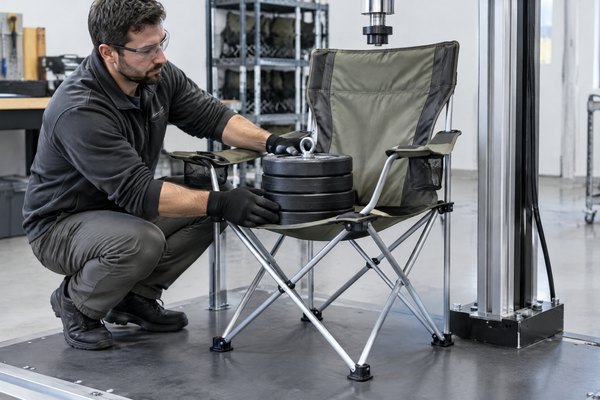
A useful sourcing decision starts with a written requirement that can be challenged, sampled, inspected, and approved.
Direct answer (TL;DR): Choose an OEM camping chair manufacturer by first defining the product specification and target costs, then qualify camping chair factories for capabilities and quality systems, run structured sample reviews and factory testing, and lock packaging/shipping requirements into contract and change-control processes before committing to bulk camping chairs.
Why Use an OEM Camping Chair Manufacturer
If you are a private-label brand, retailer or importer, an OEM camping chair manufacturer provides manufacturing capacity, tooling and repeatable quality for volume production. A good OEM partner will translate your specification into production-ready drawings, manage prototype tooling, and deliver consistent runs of camping furniture for venues ranging from weekend campers to festival rentals. For companies wanting product development support, an ODM or custom camping chair manufacturer can shorten time-to-market; for basic sourcing of commoditized seating consider a folding camping chair supplier that handles standard SKUs.
Key buyer outcomes to expect from a qualified partner:
- Repeatable product that meets your performance and regulatory needs
- Predictable lead time and landed cost for bulk camping chairs
- Clear documentation (specs, test records, inspection reports) for import and retail
Purchase Preparation: Define Requirements First
Purchasing starts with a complete product specification. Without this you will get widely varying quotes and sample outcomes.
Define Application and Use Cases
Document exactly how the chair will be used: recreational camping, car-camping, backpacking, beach use, festival seating, or rental/communal use. Application determines load rating, fabric abrasion, frame tubing thickness, and drainage.
Performance Specifications and Materials
Specify materials and measurable performance targets: frame material and wall thickness, coating type (powder, e-coat), fabric type and denier, stitch pattern, hardware corrosion resistance, load capacity (e.g., 120–150 kg), and desired pack size. Include acceptance criteria for seams, welds and finish. This is the core of your product specification.
Commercial Targets: Price, MOQ, Lead Time
Set a realistic target unit price, acceptable MOQ and required lead time. Bulk camping chairs typically require MOQ discussions tied to tooling or SKU complexity. Decide whether you will accept standard SKUs from a camping furniture manufacturer or require a custom camping chair manufacturer to create tooling.
Supplier Qualification: What To Check In A Camping Chair Factory
A structured qualification process saves time. Treat it like a mini-audit: review capabilities, inspect a sample line, and verify testing routines.
Factory Capabilities and Layout
Confirm the camping chair factory has dedicated frames, sewing, and assembly lines. Ask for photos or a short video of production areas, jigs, welding stations, and finishing (powder coat or plating). For combined product ranges, confirm whether the partner is also a camping table manufacturer or primarily focused on chairs—different product groups may have distinct tooling and QA needs.
Quality Management and Testing
Request information on incoming material inspection, in-process checks and final inspection (AQL). Ask how they document failures and corrective actions. If you need specific tests (fatigue, load, flammability for fabric in certain markets), confirm who will arrange testing and where — CampLume is an OEM/ODM camping gear manufacturer and can prepare test-ready samples, but you should confirm the applicable market requirement and whether you or the factory will commission external labs.
Supply Chain and Sourcing
Ask for primary raw material suppliers (fabric, zippers, frames) and lead times for those materials. A reliable camping chair manufacturer will have multiple suppliers or contingency plans for critical items like zippers and bonded fabrics.
Sample Development, Review and Approval
Prototyping and sample sign-off are central to reducing surprises in production.
Prototype to Pre-Production Samples
Start with a functional prototype to verify fit and form, then move to a pre-production sample built on the final tooling and with production materials. Document all dimensions and tolerances in a spec sheet carried forward to production.
Structured Sample Review
Use a sample review checklist: dimensions, load test results, seam and weld quality, finish appearance, packaging mock-up and labeling. Capture photos and timestamped notes. If a sample fails, request corrective actions and a new sample with clear changes noted — this is your first change-control event.
Approvals and Sign-Off
Get written approval for the final sample — itemize any allowable deviations and state the impact on price or lead time. Approval should be a formal document that becomes part of the order pack.
Mid-article action request (brief to get a realistic quote): Email sourcing@camplume.com with a one-paragraph brief containing: product name, target dimensions and weight capacity, preferred materials, estimated annual volume, target unit price, destination port/country, required tests/certifications, and desired lead time. A sample picture or sketch is very helpful.
Production Controls, Factory Testing and Inspections
Once the pre-production sample is approved, lock in production controls to protect quality and schedule.
- In-line inspection: define checkpoints (frame welding, powder coat, fabric cut and sew, final assembly). Require the factory to report results per checkpoint.
- Factory testing: specify the tests that must be carried out (static load, cyclic fatigue, zipper pull, fabric abrasion if relevant). For regulated markets, confirm the specific standards that apply and whether lab testing is needed.
- Pre-shipment inspection (PSI): define AQL levels, sample sizes, and whether you will use a third-party inspector.
Describe expected documentation: incoming material certificates, process control logs, in-process inspection reports, final test reports, and the pre-shipment inspection report. These documents feed into customs and retailer compliance checks.
Mid-Article CTA: Send Your Requirements
If you are evaluating OEM camping chair manufacturer, email info@camplume.com with your product category, selling market, estimated quantity, current specification and packaging brief. Ask for a documented reply that separates assumptions and deviations from the quotation.
Packaging, Shipping Preparation and Documentation
Packaging both protects product quality and reduces landed cost. Make packaging part of the spec.
- Packaging spec: include carton dimensions, unit per carton, inner protection, hang tags, instruction leaflets and barcodes. State palletization rules and maximum weight per pallet.
- Labeling and compliance: specify country-of-origin labeling, fiber content for fabrics (if required by destination market), and any retailer-specific label formats.
- Shipping prep: confirm carton strength for shipping lane (sea/RoRo/air) and whether dunnage is required for bulk camping chairs. Request a full packing list template and photograph of loaded pallets/samples before vessel loading.
Document checklist to collect from the factory: commercial invoice, packing list, bill of lading or AWB, packing photos, inspection reports and any testing certificates required by your market. Confirm the applicable import documentation with your customs broker — CampLume will provide the factory-level docs but you should confirm destination requirements.
Sourcing Models and Buyer Decision Table
Choose the model that matches your timeline, budget and product differentiation needs. Below is a concise decision table to help decide between common options.
| When to Choose | Typical Pros | Typical Cons | Best For |
|---|---|---|---|
| OEM camping chair manufacturer | Control over spec, reproducible production | Longer development, tooling cost | Private-label brands ordering bulk camping chairs |
| ODM / custom camping chair manufacturer | Faster design-to-market, existing designs | Less control over unique IP unless negotiated | Brands wanting a unique SKU quickly |
| Folding camping chair supplier (standard SKU) | Lowest unit cost, fast availability | Limited customization | Retailers buying standard folding chairs in volume |
| Camping furniture manufacturer that also makes tables | One-stop supplier for sets | Complexity of mixed-product sourcing | Brands selling coordinated seating + camping table sets |
Risk Management, Change Control and After-Sales Considerations
Prepare for changes and returns before they occur.
- Change control: define a formal approval process for any engineering or material changes after the sample approval. Require documented impact analysis for cost, schedule and quality.
- Traceability: include a batch or lot code on carton labels to trace production runs if failures occur.
- Warranty and returns: define defective handling terms — who pays for return freight, who issues credit and how reworked inventory is handled. For large orders of bulk camping chairs, pre-agree thresholds for acceptable failure rates and associated remedies.
- Post-launch testing: consider periodic re-tests or random inspections on subsequent lots to ensure ongoing compliance with your original sample.
Practical Workflow Example (buyer perspective)
- Product specification issued to three vetted camping chair manufacturers.
- Request costs based on pre-production tooling or standard SKU pricing; collect preliminary lead times and MOQs.
- Select factory and pay for prototype/sample. Run sample review and iterate to pre-production sample.
- Sign sample approval form and full PO with packaging, inspection and test requirements. Define change-control process.
- Factory begins production; buyer either schedules third-party in-line inspections or accepts factory QC reports.
- Pre-shipment inspection performed; failing lots quarantined for rework.
- Factory furnishes packing photos and shipping docs; goods dispatched.
- On receipt, perform incoming QC and feedback defects to supplier per agreed RMA/warranty process.
FAQ
Q: What is a realistic MOQ for custom camping chairs? A: MOQ varies with complexity and tooling. Simple, non-molded folding designs might have low MOQs; custom tooling for frames or molded parts raises MOQ. Ask each camping chair manufacturer for the MOQ tied to tooling amortization.
Q: Who pays for sample development and testing? A: Typically the buyer pays prototype costs and any third-party lab tests required for market compliance. Negotiate whether sample costs will be credited against first production run.
Q: Are folding camping chair suppliers able to supply matching camping tables? A: Some camping furniture manufacturers offer matched sets; others specialize in chairs. Include table needs in your initial RFQ so suppliers can confirm capability or refer you to a sister line.
Q: What inspections should I require pre-shipment? A: At a minimum request a visual quality check, functional load test on a sample, and packing/palletization verification. For regulated markets, add required lab test evidence.
Q: How should I handle specification changes during production? A: Use a written change-control process: buyer issues a change request, factory provides impact analysis on cost and schedule, both parties sign an amendment before implementation.
Q: How do I estimate shipping costs for bulk camping chairs? A: Estimate based on carton dimensions, units per carton, and palletization. Ask suppliers for FOB or EXW quotes and run those through freight forwarder estimates for landed cost comparison.
Conclusion and Next Step
Selecting the right OEM camping chair manufacturer is a methodical process: define the product specification, vet the camping chair factory and its testing practices, run structured sample reviews, and lock in packaging, inspection and change-control terms before production. If you are planning a new SKU or a bulk order of camping furniture, send a clear brief to get realistic pricing and lead times.
Email sourcing@camplume.com with: product description, sketches or photos, target materials, estimated annual volume, desired price range, required tests, and target delivery window. CampLume is an OEM/ODM camping gear manufacturer prepared to prepare sample proposals and capability information based on your brief.
Final CTA: Email info@camplume.com with your product category, target market, estimated quantity, current specification and packaging stage. Request a documented response that identifies assumptions, open evidence and the next approval gate.
Related CampLume resources
-
Read: What Should Buyers Check Before Ordering Wholesale Camping Chairs? for a connected sourcing decision.
-
Explore CampLume furniture options to compare a relevant product platform.
-
See the CampLume buyer FAQ for concise guidance on samples, MOQ, quality control, compliance and shipment preparation.
-
Discuss an OEM or ODM brief with CampLume when product configuration, custom branding or packaging needs to be scoped.
Project discussion
Need to apply this guide to a product programme?
Send your product category, target market, estimated quantity, current specification and packaging stage. CampLume will continue the discussion by email.
Email info@camplume.comSources and further reading