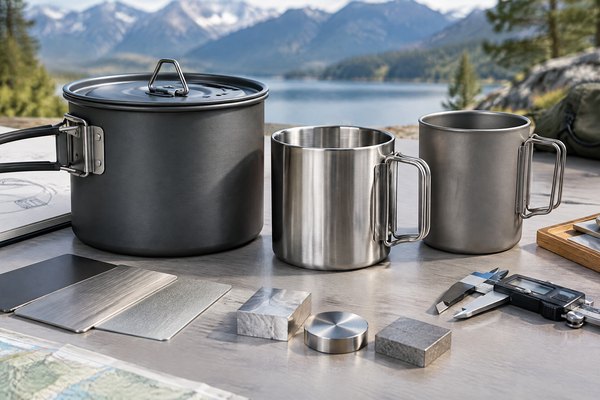
A useful sourcing decision starts with a written requirement that can be challenged, sampled, inspected, and approved.
Direct answer (short)
If you are sourcing car camping cookware sets wholesale for private label or retail, choose the material and set size that match your customer profile (car campers wanting lightweight stainless sets; family campers wanting durable enameled or cast iron), confirm regulatory and packaging requirements for the destination market, and put a formal product specification and sample-review plan in place before committing to production. CampLume is an OEM/ODM camping gear manufacturer that can develop, sample and produce cookware to private-label specifications—requirements always depend on the exact product and destination market.
Which Cookware Types B2B Buyers Commonly Order
Buyers typically choose among lightweight stainless sets, cast iron, aluminum with hard-anodized finishes, and collapsible or silicone items for space savings. For larger offers or retail bundles, outdoor kitchen equipment wholesale (portable grills, prep stations, sinks) is commonly paired with cookware.
Stainless Steel Sets
Stainless steel is the most common choice for mainstream car campers who prioritize corrosion resistance and a polished retail look. If your core SKU is a value-to-mid-tier offering, consider stainless steel camping cookware sets wholesale as a baseline.
Cast Iron and Enamel
Cast iron is favored for heat retention and durability; many brands offer enameled variants that simplify cleaning. If your channel targets weekend family trips and rental fleets, evaluate cast iron camp cookware wholesale alongside lighter alternatives.
Lightweight & Collapsible Options
For backpacking-adjacent car camping lines or packs sold to urban customers with limited trunk space, offer aluminum or silicone options that reduce weight and pack volume.
Key Purchase Decisions: Sizing, Material, and Use Case
Your choice of family camping cookware sets wholesale versus compact two-person lines should reflect expected use and price points.
2 Person vs 4 Person Camping Cookware Set
One of the most common specification choices is sizing: a 2 person vs 4 person camping cookware set differs not only in pan and pot diameter, but in overall pack volume and heat-source compatibility. For two-person sets, suppliers typically focus on single-burner compatibility, nesting pieces and shared utensils. Four-person sets require larger pots (2–3 L vs 4–6 L), more individual plates or bowls, and sturdier lids.
Practical rule: target a 2 person set for ultralight car campers and couples; use 4 person sets for family-focused retail or camping-rental businesses.
Matching Material To Customer Expectations
- If the buyer wants premium retail appeal and longevity, choose stainless steel or enameled cast iron.
- For value-driven SKU lines where weight matters, aluminum or hard-anodized materials may be better.
- For specialty niche SKUs (heritage collections, heavy-duty rental cookware) include cast iron camp cookware wholesale options.
Customization And Private Label: What To Specify
Private-label and promotional orders often request custom finishes, private packaging and branding. Specify these items in your initial tech pack to get accurate lead-time and cost estimates.
Custom Logo Camping Cookware — Scope To Define
When requesting custom logo camping cookware, provide:
- Exact logo artwork (vector file) and color codes
- Desired marking method (laser etch, pad print, enamel transfer, embossing)
- Location and size of the logo on each piece
- Any legal or safety marks that must remain visible
Note: Marking methods behave differently on materials (laser etching is reliable on stainless; pad printing needs testing on enamel and painted surfaces). Include sample stamping in your sample review plan.
Packaging And Retail Ready Options
Decide between bulk cartons, branded retail boxes, or hanging-card packaging. For family camping cookware sets wholesale, retailers often request shelf-ready boxed sets with UPC and hang holes. For DTC brands you may prefer premium hinged boxes with printed instructions.
Product Specification And Sample Review Workflow
A clear specification and sample-review process reduces delays and costly change orders.
Step 1 — Detailed Product Specification
Create a spec sheet covering:
- Materials, wall/thickness, coating type and tolerances
- Component list (pots, lids, handles, nestable rings, utensils)
- Weight, packed dimensions, nesting order
- Performance expectations (heat source compatibility, oven-safe limits)
- Packaging, labeling and barcodes
Include an approved artwork file when you request custom logo camping cookware.
Step 2 — Proto and Pre-Production Samples
Request a fully finished proto sample that represents final materials, marking and packaging. Use the proto to validate weight, stacking, lid fit, and handle ergonomics. Approve or mark changes in writing.
Step 3 — Pilot Run / Production Samples
Before full production, require a short pilot run to confirm mass-production consistency, and test at least one pack from that run through packaging and shipping simulations.
Factory Testing, Inspections, And Documentation
Quality controls and documented inspections protect your order and brand.
Typical Factory Tests And Inspections
- Dimensional checks against tolerance
- Finish inspection (scratches, coating uniformity, welds or joins)
- Functional tests (lids fit, handles torque, nesting)
- Pack-out verification (counts, inserts, instruction leaflets)
Confirm the applicable regulatory and safety requirements for cookware sold into your markets (labelling, materials compliance) and include compliance steps in your documentation package.
Third-Party Testing And Certificates
Some buyers request independent testing for food contact or performance. If you require third-party reports, specify the test scope, accredited lab and acceptable limits in the initial PO. CampLume can coordinate sample submissions but confirm the exact tests required for your destination market.
Packaging, Shipping Preparation And Logistics
Packaging decisions affect landed cost and retail presentation.
Pack-Out And Carton Optimisation
Decide whether final pack-out is done at source or consolidated at a distribution center. For car camping cookware sets wholesale, nesting items tightly reduces carton volume and lowers freight per set.
Labeling And Documentation For Import
Ensure shipping documents, commercial invoices, packing lists and any required compliance declarations match the product spec. For branded retail packaging, confirm UPC/GTIN placement and barcode quality before mass printing.
Change Control And After-Sales Issues
Large or repeat orders need a formal change-control process.
Change Control Steps
- Submit change requests to the factory with a clear reason and effective date
- Require signed approval for any tooling or artwork changes
- For safety- or performance-impacting changes, request re-sampling before acceptance
Warranty, Returns, And Damages
Agree terms for defective units found on arrival, acceptable defect rates, and remedies (replacement, credit, or rework). Include inspection photos and non-conformance examples in the contract.
Pricing, Minimums And Lead Times (What To Expect)
Wholesale pricing depends on material, set complexity, customization and packaging. Typical drivers:
- Material cost (stainless or cast iron vs aluminum)
- Custom logo camping cookware marking and tooling
- Packaging quality and retail-ready finishes
- Order quantity and freight method
For family camping cookware sets wholesale, buyers often order higher volumes but expect thicker gauge materials; for niche lines (cast iron camp cookware wholesale) MOQ may be higher due to heavier and more complex tooling.
Quick Buyer-Decision Table
| Buyer Goal | Recommended Material | Typical SKU Size | Notes |
|---|---|---|---|
| Ultra-light couple’s set | Lightweight aluminum / hard-anodized | 2 person camping cookware set | Low packed volume, nestable, single-burner friendly |
| Family / rental durable set | Enameled cast iron or heavy SS | 4 person camping cookware set | Prioritize durability and heat retention |
| Mid-market retail | Stainless steel | 2–4 person versatile sets | Good balance of appearance and cost |
| Premium private label | Custom finishes on SS or cast iron | 2–4 person, premium packaging | Requires sample approvals and custom marking |
Mid-Article Supplier Brief CTA
If you want a targeted quote, email a short sourcing brief to info@camplume.com with:
- Target SKU name and primary material (e.g., stainless steel 3-piece set)
- Desired pack size (2 person vs 4 person camping cookware set) and order quantity range
- Branding needs ("custom logo camping cookware" — include vector artwork)
- Preferred packaging style and any destination-market requirements
- Target FOB or DDP port (if known)
Include your requested sample timeline (proto and pilot-run expectations). CampLume will respond with a sample plan, estimated lead times, and initial cost ranges. Requirements and final pricing depend on detailed specs and destination market rules.
Practical Product Application Examples
- Over open coals: cast iron camp cookware wholesale items are a practical fit, but require clear cleaning instructions.
- Gas stove and portable burners: stainless steel and hard-anodized aluminum perform well and heat quickly.
- Car-camping with limited space: consider nesting kits with detachable handles or multi-use lids to reduce pack volume.
FAQ
Q: What documentation should I ask for when importing cookware? A: At minimum request a signed commercial invoice, packing list, bill of lading/AWB, and a product specification sheet. If your market requires materials compliance reports or lab testing for food contact, specify those tests in your PO.
Q: How do I decide between stainless steel and cast iron for a retail line? A: Match material to customer use and price expectations. Stainless steel suits general retail due to weight and corrosion resistance. Cast iron is heavyweight and marketed on durability/heat retention—ideal for rental fleets and high-end heritage lines.
Q: Can I put my logo on each pot and on the packaging? A: Yes—most suppliers offer marking on metal and printing on packaging. Deliver vector artwork, select marking methods, and require a marked prototype to validate color, placement and durability.
Q: What tests should I run during sample review? A: Check dimensional tolerances, lid fit, handle strength, finish adhesion, and perform field use trials (heating, pouring, cleaning). If preparing for markets with material compliance rules, include those lab tests in your plan.
Q: Are there packaging options to reduce shipping cost? A: Yes—optimize nesting, reduce filler material, and use efficient carton sizes. Consolidated shipping from the factory to a distribution center can also cut costs if you control pack-out.
Q: How do I manage changes after production starts? A: Use formal change-control: written request, factory acknowledgment, sample re-approval if changes affect fit, finish or safety, and update order documents to reflect new terms.
Final Conclusion and Clear CTA
Sourcing car camping cookware sets wholesale requires matching material and size to your end user, controlling customization early (custom logo camping cookware needs clear artwork and marking method), and documenting the full QA and shipping workflow. For direct support on specifications, sample plans and a commercial quote, email a concise brief to info@camplume.com with the SKU details, target order quantity, packaging preferences and vector logo files. CampLume is an OEM/ODM camping gear manufacturer ready to produce sample and pilot runs—final requirements and timelines depend on the exact product and destination market.
(End of guide)
Final CTA: Email info@camplume.com with your product category, target market, estimated quantity, current specification and packaging stage. Request a documented response that identifies assumptions, open evidence and the next approval gate.
Related CampLume resources
-
Read: How to Choose Camping Cookware Materials for a Private-Label Range for a connected sourcing decision.
-
Explore CampLume cookware options to compare a relevant product platform.
-
See the CampLume buyer FAQ for concise guidance on samples, MOQ, quality control, compliance and shipment preparation.
-
Discuss an OEM or ODM brief with CampLume when product configuration, custom branding or packaging needs to be scoped.
Project discussion
Need to apply this guide to a product programme?
Send your product category, target market, estimated quantity, current specification and packaging stage. CampLume will continue the discussion by email.
Email info@camplume.comSources and further reading