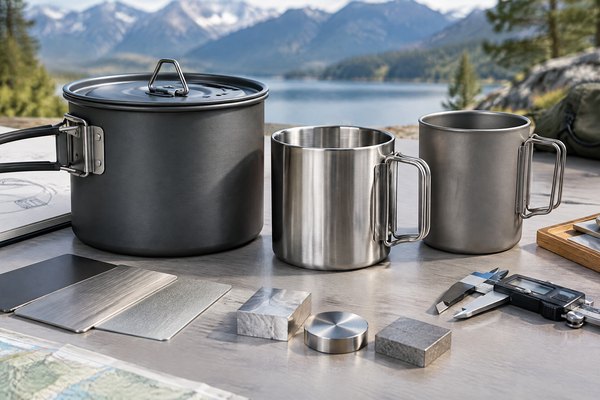
A useful sourcing decision starts with a written requirement that can be challenged, sampled, inspected, and approved.
Direct answer (what busy buyers need first)
If you need lightweight, fast-heating, durable cookware with excellent nonstick capability for general camping and backpacking, hard anodised aluminium products are usually the better option. If you prioritise chemical inertness, high-temperature durability, and long-term appearance for car-camping or overlanding camp kitchen equipment, stainless steel is frequently the safer choice. Which is best for you depends on the specific product use case, finish (nonstick vs bare), forming and machining needs, and destination-market regulatory/packaging requirements.
This guide compares hard anodised aluminium vs stainless steel camp cookware from an OEM/ODM sourcing and product-management perspective. It covers material properties, manufacturing and supplier considerations, design features (including nesting cookware and removable handles), quality workflow, a concise buyer-decision table, and an actionable email brief you can send to suppliers.
Material overview: basic trade-offs
Hard anodised aluminium
- Pros: Higher surface hardness than untreated aluminium, excellent heat conduction (fast, even heating), lower weight, good candidate for high-quality nonstick coatings or factory anodised surfaces. Many buyers choose hard anodised aluminium for lightweight camping cookware sets.
- Cons: Not inherently stainless; edge-chipping or deep scratches can expose base metal. Anodised surfaces are porous at microscopic scale and normally sealed; finish and sealing process quality vary between manufacturers.
Stainless steel
- Pros: Chemically inert, durable against scratches and deformation, compatible with high heat (oven, direct flame), often perceived as premium and easier to clean without special coatings.
- Cons: Lower thermal conductivity so cookware design often needs an aluminium core or clad layer to improve heat distribution; heavier than aluminium.
Practical selection rule
- Choose hard anodised aluminium when weight and thermal performance dominate (backcountry, ultralight sets, many nesting camping cookware sets).
- Choose stainless steel when chemical resistance, long-term look and dishwasher/overheat robustness matter (overlanding camp kitchen equipment, glamping, rental fleets).
Field performance: heat, weight, durability, and nonstick
Heat conduction and cooking performance
Aluminium conducts heat roughly four times faster than stainless steel. For direct-flame camping stoves and rapid-boil situations, hard anodised aluminium pots and pans reach cooking temperature faster and distribute heat more evenly without a thick bonded base.
If you specify stainless steel, require a bonded aluminium or copper disc in the base for even cooking. That adds manufacturing steps and cost.
Weight and transport
Weight matters for backpacking and many consumer-branded nesting cookware sets. Hard anodised aluminium wins here. For overlanding camp kitchen equipment where vehicle capacity is not a constraint, stainless steel’s extra weight is often acceptable for the resilience it provides.
Surface and food release
If you plan factory-applied nonstick coatings, work with a qualified nonstick camping cookware supplier who manufactures and tests coating adhesion for anodised substrates. Hard anodised aluminum is routinely finished with PTFE or ceramic nonstick systems, but coating process control, cure schedule, and end-to-end testing are essential to avoid blistering or peeling in use.
Stainless steel sets are typically sold without nonstick coating; some buyers elect to offer a ceramic-coated stainless product but expect different adhesion and finishing challenges.
Design and product variants buyers request
Nesting sets vs individual pieces
Buyers increasingly weigh portability and retail presentation. Compare nesting cookware vs individual camp cookware pieces on packaging size, SKU complexity, and cost of dies/molds.
- Nesting camping cookware set manufacturer capabilities: A capable OEM will design tolerances so pots/pans stack securely without rattling, and include packing cloths or divider trays to protect nonstick finishes during shipping.
- Individual pieces allow more flexible merchandising but increase BOM complexity and shipping cube.
Removable-handle systems
Removable handle camping cookware set designs reduce packing volume and simplify storage. Ask suppliers about handle locking mechanism durability, heat shielding, and how the removable joint affects dimensional tolerances for nesting.
Overlanding and modular kitchens
For overlanding camp kitchen equipment, buyers often request heavier-gauge stainless steel, fold-out work surfaces, and cookware that tolerates high-temperature grilling or spalsh. Specify load-bearing requirements and expected field abuse so the manufacturer can recommend material thickness and reinforcement.
Manufacturing and supplier selection criteria
When evaluating a hard anodized aluminum camping cookware manufacturer or a stainless-steel supplier, use the following checklist during RFQ and factory visits.
- Capability and equipment: extrusion/rolling, deep drawing, CNC trimming, bead rolling, anodising tanks (for aluminium), vacuum-coating or powder-coat lines, and PTFE/ceramic nonstick lines.
- Experience with nesting tolerances and removable-handle mechanisms.
- Finished-goods handling: protective packing, slip-sheeting, and appropriate packing for nonstick surfaces.
- Quality system and records for material traceability.
- Samples and testing: willingness to produce pre-production samples and follow a documented sample-approval process.
Require a capability statement and ask for process maps showing where anodising, coating, or bonding occurs. Confirm whether the supplier is an OEM/ODM who can provide private-label services and technical support for tooling and dielines.
Quality workflow: specification to change control
Below is a practical workflow to include in your supplier agreement. Each stage should be documented and signed off.
- Product specification and drawings: Define alloy grade, wall thickness, anodise thickness (microns), coating type (if any), handle attachment torque, and nesting tolerances.
- Sample review: Request a first article sample, perform functional tests (heat, handle lock, nesting fit), and sign an approved inspection report (AIR) or engineering change order if modifications are needed.
- Factory testing and inspection: Agree acceptance criteria for chemical composition certificates, dimensional inspections (PPAP or equivalent), adhesion tests for coatings, and accelerated wear testing for handles.
- Packaging and shipping preparation: Specify inner packing (e.g., kraft boxes, foam inserts, bulk polybags), carton strength, and palletization pattern. Include retail-ready packaging artwork and barcode placement.
- Documentation: Request full packing lists, certificates of conformance, and test reports. Confirm whether MSDS for coatings or surface treatments are available for import.
- Pre-shipment inspection (PSI): Arrange third-party inspection or define factory inspection checkpoints with sample size and acceptance criteria.
- Change control: Require a change-notice period for material, process, tooling, or subcontractor changes. Define who approves engineering changes and how obsolete stock will be handled.
Testing and compliance buyers must check
- Coating and adhesion tests: 3M cross-hatch adhesion, T-bend, and boiling-water tests for nonstick.
- Anodic coating thickness: micro-metered test and porosity checks. For hard anodised aluminium, ask for anodic layer thickness and sealing method.
- Migration and food-contact: Confirm the nonstick or coating supplier can provide statements for food-contact safety appropriate to your destination market. Do not assume universal compliance—confirm the applicable requirement for each market.
- Mechanical: handle pull tests, torque and cyclic open/close tests for removable handles, and drop tests for nesting assemblies.
Concise buyer-decision table
| Decision Factor | Hard Anodised Aluminium | Stainless Steel | Recommendation (Buyer Type) |
|---|---|---|---|
| Weight | Low | High | Lightweight/backpacking buyers choose aluminium |
| Heat Response | Fast, even | Slower unless clad | Direct-flame cooking: aluminium preferred |
| Surface Durability | High with anodize; vulnerable if scratched | Very high | Long-term fleet use: stainless |
| Nonstick Options | Excellent | Limited | Nonstick camping cookware supplier options favor aluminium |
| Cost | Moderate | Higher (if clad) | Budget-conscious brands: aluminium |
| Overlanding Use | Good but requires careful finish sealing | Excellent | Overlanding camp kitchen equipment often uses stainless |
Cost, lead times and packaging considerations
- Tooling: Deep-drawn aluminium pots and stainless shells use different tooling. Expect separate mold costs and longer setup for bonded bases or multilayer clad stainless.
- Lead times: Prototype anodising and coating cycles can add weeks. Factor time for sample iterations, adhesion cure verification, and documentation.
- Packaging: For nesting camping cookware set manufacturer arrangements, ask for sample retail pack and bulk pack to confirm fit and cost. Protective inner packaging is critical when nonstick finishes are included.
Mid-article CTA — Email brief request
If you want a comparable quotation or a matched-spec sample, email a short brief to sourcing@camplume.com. Include:
- Target market(s) (US / EU / UK / other)
- Product type (nesting set, individual pieces, overlanding camp kitchen equipment)
- Preferred material (hard anodised aluminium or stainless steel) and any required oxide/coating thickness
- Required features (removable handle camping cookware set, nonstick, lid type)
- Target FOB or landed price and expected annual MOQ
- Any required certifications or testing
We will respond with a capability outline, estimated tooling costs, prototype lead time, and a suggested sample test plan.
Application scenarios and recommended configurations
Backpacking and lightweight day trips
- Preferred: hard anodised aluminium with low stack height, removable handles, and hard-anodised exterior for scratch resistance.
- Supplier ask: confirm wall thickness, anodise micron, and abrasion testing regimen.
Family camping and overlanding
- Preferred: stainless steel cook sets or aluminium/stainless hybrid with bonded base. Designs with robust removable handles and dishwasher-safe finishes are typical.
- Supplier ask: request high-gauge stainless (e.g., 18/8 or 304) and verify forming capabilities for heavy-gauge deep draws.
Rental fleets and commercial use
- Preferred: stainless steel for appearance and sterilisation; define life-cycle expectations and set replacement guidelines in contract.
- Supplier ask: include durability testing, spare-part supply for handles, and clear change-control clauses.
FAQ (practical, procurement-focused)
Q: Can I specify a PTFE nonstick on hard anodised aluminium and still sell in EU/UK? A: Yes, but you must confirm the coating supplier’s compliance statements and ensure the factory provides adequately cured adhesion tests and any migration or food-contact documentation required by the destination market.
Q: How should I judge a nesting camping cookware set manufacturer on tooling skill? A: Request examples of close-tolerance nesting sets, dimensional reports, and production photos showing stack fit. Test samples and a trial pack run are essential.
Q: Are removable handles durable enough for repeated field use? A: They can be, if designed with robust locking mechanisms and specified cyclic tests. Require handle cycle testing and a spare-part policy in the contract.
Q: What inspections are normal before shipment? A: Dimensional checks, coating adhesion tests, functional tests (handle lock, lid fit), and random sampling for finish defects. A pre-shipment inspection (PSI) or third-party inspection is typical.
Q: How do I control changes to alloy or coating mid-production? A: Include a written change-control clause requiring notice, sample approval, and documentation of any substituted materials. Define time and cost responsibility for requalification.
Final conclusion and CTA
For most lightweight and nonstick consumer-branded cookware lines, hard anodised aluminium offers the best combination of weight, heat performance, and compatibility with factory-applied nonstick finishes. For heavy-duty, long-life, or overlanding camp kitchen equipment where chemical resistance and cosmetic longevity are priorities, stainless steel (or stainless-clad bases) is usually preferable.
If you’re ready to move from evaluation to specification, send a focused brief to sourcing@camplume.com with the information requested in the mid-article CTA. CampLume is an OEM/ODM camping gear manufacturer that can produce prototypes, run defined factory tests, and support the documentation and change-control processes you need to qualify a product for your market. We will provide a capability statement, an estimated tooling and sample schedule, and a recommended test plan tailored to your target market and product application.
Final CTA: Email info@camplume.com with your product category, target market, estimated quantity, current specification and packaging stage. Request a documented response that identifies assumptions, open evidence and the next approval gate.
Related CampLume resources
-
Read: How to Choose Camping Cookware Materials for a Private-Label Range for a connected sourcing decision.
-
Explore CampLume cookware options to compare a relevant product platform.
-
See the CampLume buyer FAQ for concise guidance on samples, MOQ, quality control, compliance and shipment preparation.
-
Discuss an OEM or ODM brief with CampLume when product configuration, custom branding or packaging needs to be scoped.
Project discussion
Need to apply this guide to a product programme?
Send your product category, target market, estimated quantity, current specification and packaging stage. CampLume will continue the discussion by email.
Email info@camplume.comSources and further reading