A useful sourcing decision starts with a written requirement that can be challenged, sampled, inspected, and approved.
Inflatable Tents vs Pole Tents: Which Format Fits Your Camping Product Range?
1. Why does the inflatable tent vs pole tent decision matter to a B2B buyer?
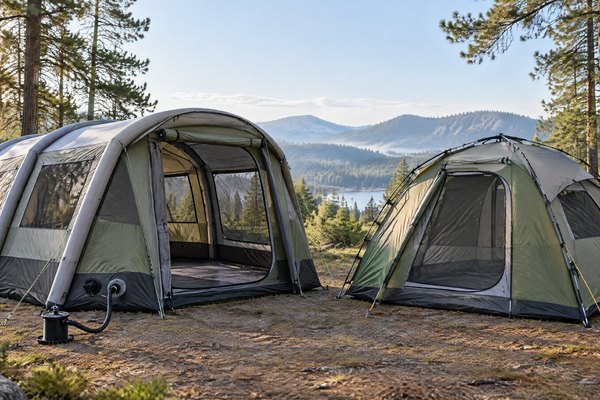
An inflatable tent uses pressurised air beams—typically an inner bladder in a structural sleeve—in place of most rigid poles. A pole tent uses flexible poles, hubs, or rigid uprights to support the fabric structure. For an outdoor brand, the choice changes the bill of materials (BOM), assembly sequence, spare-parts model, packaging, factory test plan, instructions, and incident response.
Both formats can be appropriate when designed, specified, and validated for a defined user and environment. ISO 5912:2020 covers camping-tent safety, performance, and fitness for use; it does not make either frame format inherently superior. [1] Select the format whose intended product promise is easier to control and support, not the novel catalogue feature.
For US and European brands, the decision belongs in a product-safety and documentation system. CPSC guidance recommends identifying hazards, considering foreseeable use and misuse, and eliminating or guarding risks before warnings. [2] In the EU, the General Product Safety Regulation (GPSR) requires an internal risk analysis and technical documentation appropriate to the product’s risks. [3] This operational guide is not legal advice; confirm market-specific requirements, claims, and economic-operator roles.
2. Quick Answer: Which format usually fits which range?
Choose inflatable tents when your product range values a low-complexity pitch experience for vehicle-based camping, family camping, basecamp, or premium comfort-led shelters—and when you are ready to control air-beam, valve, pump, and repair-service variables as deliberate product components. The principal buyer question is not “does it pitch quickly?” but “can the brand define inflation, anchoring, pressure checks, and field repair clearly enough for the intended user?”
Choose pole tents when your range needs compact structural parts, broad familiarity, modular pole replacement, or a format suitable for hikers and technical campers. The principal buyer question is not “are poles old-fashioned?” but “can the brand lock pole geometry, fittings, handling instructions, and replacement-pole identification tightly enough to prevent wrong assembly or component substitution?”
For an inflatable tent vs pole tent programme, the strongest decision normally comes from six ranked inputs: intended use, user skill, packed-volume target, service capability, channel requirements, and risk tolerance. Do not decide from setup time alone.
| Buyer priority | Inflatable tent tendency | Pole tent tendency | Sourcing decision to make |
|---|---|---|---|
| Family, car-camping, or glamping experience | Can reduce structural parts handled during pitching; the user still needs correct inflation and anchoring. | Familiar structure, but multiple poles and crossing sequences can increase setup steps. | Define the allowed setup sequence and the minimum instruction format before design freeze. |
| Backpacking or compact travel | Air beams, pump, and sleeve construction may work against a strict packed-weight or packed-volume brief. | Segmented poles can be designed for compact packing and targeted replacement. | Set a verified packed-size and complete-kit mass target, including all accessories. |
| First-time-user ease | Fewer loose structural pieces may help, but valve and pressure errors become material. | Colour-coding and pre-attached poles can simplify use, but pole routing still needs control. | Conduct observed user pitching with people unfamiliar with the product. |
| Field repair model | Requires a practical route for valve, bladder, puncture, and pump issues. | Requires a clear route for broken sections, ferrules, hubs, and shock cord. | Select spare parts, IDs, repair instructions, and support ownership before launch. |
| Multi-channel retail | A bulky pump or battery-powered pump can add package, return, and transport considerations. | A pole bundle can create puncture or abrasion risks if packed without adequate protection. | Approve retail carton, inner protection, and returns inspection criteria as part of the product. |
| Range differentiation | Supports a comfort, convenience, or large-shelter story when substantiated by the product experience. | Supports a technical, lightweight, expedition, or familiar-assembly story when the specification supports it. | Ensure marketing claims match the approved instructions, test evidence, and actual included kit. |
3. What buyer risks should frame the project before a format is chosen?
The first risk is mismatch between tent and use case. Either format can suit a drive-up shelter, but user tolerance, exposure, and repair expectations differ for a tent carried all day. Define occupants, trip duration, transport mode, season, site, weather exposure, cooking policy, and user skill. “Four-person inflatable tent” is too vague to guide engineering.
The second risk is uncontrolled components. A tent is a system: fabric, coatings, mesh, floor, seams, zips, webbing, buckles, stakes, guylines, carry bag, labels, instructions, and air- or pole-frame parts. A change in one part can affect the system. CPSC cautions against exposure to unauthorised raw-material substitutions through weak specifications or controls. [2] The same principle applies to a new valve supplier, revised pole ferrule, changed seam tape, or different stake profile.
The third risk is over-reliance on one test or label. A pressure-hold check does not establish all-weather performance, and a fabric test does not validate the finished tent. Use component, finished-product, packaging, and user-installation checks. State the claim, method, sample condition, and acceptance rule in the quality plan.
The fourth risk is after-sales ambiguity. Replacement poles need identifiable length, diameter, section count, end fitting, and sometimes colour code. Inflatable-tent faults need distinction among punctures, valve leaks, sleeve damage, loose connections, and inflation-procedure issues. Without an approved troubleshooting tree, support may misdiagnose the fault, send the wrong part, or encourage unsafe use.
Finally, separate engineering from regulatory assumptions. GPSR safety assessment considers physical, mechanical, chemical, and presentation characteristics and requires relevant documentation for ten years after market placement. [3] In the US, assess applicability product by product; where CPSC rules cover a general-use product, the overseas importer issues the GCC on appropriate testing. [4]
4. How should buyers make the core format decision?
Start with the job-to-be-done, not the frame
Write a one-page product-use statement before quotations. State occupants, transport mode, season, site, weather exposure, intended user, cooking policy, and repair expectations. It gives an OEM/ODM supplier a basis for geometry, materials, ventilation, anchoring, and instructions.
Then list critical user actions. Inflatable designs require valve use, inflation order, anchoring, guying, and tension checks. Pole designs require pole identification, routing, assembly, controlled flex, anchoring, and tensioning. Choose the format whose actions are realistic for the expected customer.
Score the decisions that cause downstream cost
Use a weighted scorecard and record the reasoning. A format that wins on consumer setup can still lose if it needs a customer-support system the brand cannot sustain. A pole design can suit a technical range when its specification, repairability, and pitch instructions are controlled.
| Decision criterion | Questions for an inflatable tent project | Questions for a pole tent project | Evidence to request before approval |
|---|---|---|---|
| Installation | Is the inflation method manual or electric? What prevents incorrect valve use or excessive pressure? | How many pole families are present? Can a user confuse sleeve paths or force a section? | Draft instructions, observed setup video, and a task-by-task setup review. |
| Structural system | What are the air-beam sleeve, bladder, joint, valve, hose, and pressure-control specifications? | What are the pole alloy/fibreglass grade, diameter, wall, segment, ferrule, hub, and shock-cord specifications? | Revision-controlled drawings, BOM, approved supplier list, and a physical sample. |
| Repair | Which faults are user-serviceable, and which require replacement? | Can a user identify and replace the correct pole section or complete set? | Repair-kit contents, illustrated troubleshooting, and spare-part identifiers. |
| Weather and anchoring | What site preparation, peg pattern, guying, and reinflation checks are necessary? | What pole orientation, stake order, guying, and tension adjustments are necessary? | Anchoring diagram, warnings, and test/field-evaluation protocol tied to intended use. |
| Range economics | Do pump, valve, bladder, and repair-kit choices fit the desired retail position? | Do pole material, hub design, replacement stock, and protective packing fit the desired retail position? | Landed-cost assumptions separated by tent body, frame, accessories, packaging, and spares. |
| Support | Can support distinguish an inflation issue from damage and explain safe next steps? | Can support identify the correct pole set from a customer photo, part code, or kit label? | Customer-service decision tree, spare-part catalogue, and escalation process. |
Treat anchoring as a shared safety system
Neither format removes the need for suitable anchoring, site selection, and user judgement. The manual should state required anchoring, guying, pitch checks, and takedown conditions. Apply the CPSC safety sequence: eliminate feasible risks, guard practical ones, then warn. [2]
5. What does installation look like in practice for each format?
For an inflatable tent: inspect the site; orient the tent; close and inspect valves; inflate designated beams in the approved sequence; stake, guy, and tension; fit remaining components; then check alignment and entries. The manual should show valve positions, connectors, sequence, and project-specific inflation guidance. “Inflate fully” is not adequate.
For a pole tent: inspect the site; lay out the tent; assemble labelled pole families; follow the correct sleeve or clip route; seat ends without force; raise, stake, guy, and tension. The core risk is forcing a pole into the wrong route or length. Use clear drawings, visible part IDs, and a no-force warning.
For both formats, trial the unboxing-to-repacking journey with unfamiliar users. Ask them to identify parts, pitch from the included instructions, address a simulated problem, and repack. Record confusion, errors, and bag-fit failures as product evidence.
6. Which component controls distinguish a resilient OEM/ODM programme?
A BOM is the controlled list of parts in the approved configuration. It should identify the part, revision, material or performance specification, colour, approved-source rule, quantity, and inspection method. Link it to drawings, artwork, packaging, labels, instructions, quality checks, and a golden sample—a controlled physical reference, not a substitute for measurable specifications.
For inflatable models, control the air system: beam configuration, sleeve and bladder construction, joints, valves, caps, pump interface, adaptors, repair method, and bladder-replacement procedure. Define prevention of valve mix-ups and record air-system revisions. Decide whether the pump is bundled, optional, or excluded. Treat an electric pump’s plug, battery, documentation, packaging, and transport status as product requirements.
For pole models, control the complete assembly, not just the nominal material: family code, length, segments, diameter, construction, ferrules, hubs, end tips, shock cord, clips, sleeves, and repair sleeve. Protect pole ends in transit. Give replacement parts readable codes rather than ambiguous names such as “main pole.”
Across both formats, lock fabric, coatings, colour, mesh, floor, seam tape, zips, webbing, buckles, thread, reinforcements, stakes, guylines, bags, cartons, and instructions. Permit no substitution that could affect safety, performance, fit, evidence, instructions, or claims without written approval. CPSC advises that testing plans account for material and process variability and that material changes receive review and, where needed, retesting. [4]
7. How do logistics and intended use change the sourcing decision?
Start logistics at the sketch stage. Confirm the complete sellable unit: tent, fly, inner, frame, stakes, guylines, pump where included, repair items, instructions, and packaging. Compare packed dimensions and gross mass with channel requirements. An inflatable tent may add beam construction and a pump; a pole tent needs protection around pole ends. Compare complete-kit, not tent-body, weight.
Ask whether the package protects valves, fabric, and pole ends; whether the warehouse can identify model, colour, size, lot, and origin marking; and whether an electrical accessory changes the freight path. IATA classifies lithium batteries as Class 9 dangerous goods and requires availability of an applicable UN 38.3 test summary for most relevant cells, batteries, and battery-powered equipment. [5] Confirm the exact battery, watt-hour rating, packing instruction, documentation, and carrier acceptance before air freight.
For US imports, country-of-origin marking is a design and packaging review item rather than an afterthought. Subject to exceptions, 19 CFR §134.11 requires an imported foreign article or its container to show the English country name conspicuously, legibly, indelibly, and permanently enough for the item or container. [6] Confirm the relevant marking approach, origin determination, tariff classification, and import documentation with qualified customs professionals for the actual transaction.
For EU-bound products, build material transparency into the supplier request. ECHA explains that the SCIP obligation covers articles placed on the EU market that contain Candidate List substances of very high concern above 0.1% weight by weight, and that EU/EEA importers should obtain the necessary information from non-EU suppliers. [7] For a tent, ask for a component-level material declaration covering fabrics, coatings, prints, plastics, metals, repair items, and packaging as appropriate. Do not accept a broad statement that lacks product, component, revision, date, scope, and responsible party.
Need an OEM/ODM comparison that is tied to your range rather than a generic tent category? Send your target user, size range, planned channels, required markets, complete-kit packaging target, and initial design references to info@camplume.com. Ask for a project-specific BOM, sample route, test matrix, and component-control proposal before committing to either format.
8. What sampling plan reduces expensive surprises?
A disciplined sample route separates learning from approval. Begin with a design/engineering sample to check dimensions, layout, component interfaces, pitch sequence, ventilation, door operation, and early ergonomics. It may use provisional materials, so it should not be treated as proof of final colour, waterproofness, structural performance, or packaging fit. Record every open issue in a revision log.
Next, request a material and component confirmation stage. This is where the buyer checks fabric hand feel and construction, mesh, zips, webbing, buckles, stakes, guylines, valves or poles, carry bag, repair kit, labels, and artwork. For an inflatable model, include the actual pump interface and every valve type. For a pole model, include each pole family, hub, tip, and shock-cord configuration. The supplier should show the proposed BOM revision against the physical parts.
A pre-production sample should represent the intended production materials, construction, and packaging as closely as possible. Use it for final instruction writing, consumer pitch trials, packing trial, carton verification, and planned laboratory or internal evaluation. Ask the supplier to identify any difference from the approved technical pack in writing. A sample that differs from the likely production build can still be useful, but its limits must be explicit.
The following example shows how a buyer can turn format-specific uncertainty into a review plan. The acceptance criteria are deliberately project-dependent; establish them in writing with the supplier and appropriate test resources.
| Sample or review activity | Inflatable tent example | Pole tent example | Record to retain |
|---|---|---|---|
| Engineering pitch | Check beam layout, valve accessibility, pump connection, and usable interior shape. | Check pole routing, hub engagement, end-seat fit, and crossing geometry. | Setup observations, issue list, photos, and drawing revision. |
| Component review | Compare bladder, sleeve, valves, pump adaptor, repair patch, and caps to the BOM. | Compare every pole set, ferrule, hub, shock cord, end tip, and repair sleeve to the BOM. | Approved component samples and revision-controlled BOM. |
| Finished-sample check | Run the defined inflation/hold and inspection sequence; inspect seams, doors, and anchoring points. | Assemble and disassemble repeatedly under the defined sequence; inspect stress points, seams, and pole interfaces. | Test method, conditions, results, deviations, and corrective actions. |
| Pack-out trial | Confirm pump, repair kit, and instructions fit without stressing valves or fabric. | Confirm pole bundle and stakes are isolated so they cannot abrade or puncture soft goods. | Packing photos, carton drawing, gross mass, and dimensions. |
| User comprehension | Ask an unfamiliar user to identify valves, inflate, anchor, and troubleshoot a simulated leak. | Ask an unfamiliar user to identify pole families, erect, anchor, and identify a simulated broken section. | Observed-task record and final instruction changes. |
9. What should the factory-testing and quality plan cover?
Factory testing should answer a buyer’s actual failure questions, not just generate a report. ISO 5912:2020 can inform the discussion because it addresses camping-tent safety, performance, and fitness for use, but the project still needs product-specific methods, sample selection, conditions, and acceptance limits. [1] Ask the supplier which requirements it proposes to use, what is tested in-house versus externally, and how it will tie the evidence to the exact production configuration.
At incoming inspection, the plan may include confirmation of identity and condition for fabric, mesh, zippers, webbing, buckles, stakes, valves, bladders, poles, hubs, and packaging materials. The most useful control is not merely “inspect incoming materials.” It is a documented link between each critical part, the purchase specification, the check method, a lot reference, and a disposition when the part does not match.
During production, include controls for cut-panel orientation, reinforcement placement, seam construction, seam-tape application where used, zipper installation, pole sleeves or air-beam sleeves, stake loops, guyline points, labels, and part packing. For inflatable systems, make a defined air-system inspection part of the line or finished-product process: valve seating, connection integrity, the project-defined inflation procedure, and inspection for loss or distortion under the approved conditions. For pole systems, verify pole-set completeness, end fitting engagement, hub fit, shock-cord condition, and the correct pole family in the correct retail kit.
At finished-goods inspection, inspect the full retail configuration rather than a stripped tent body. Open and close doors; check windows and vents; inspect stitching and seams; verify part count; pitch a sample according to the final manual; check labels and artwork against approved files; and perform the agreed pack-out check. Define the inspection sample plan and defect classifications jointly; do not let a default inspection level substitute for a risk assessment. Shipment release should require evidence that corrective actions from prior samples or inspections are closed.
If the product is sold in the EU, use the quality records to populate—not replace—the required technical documentation, risk analysis, and evidence trail. GPSR says the documentation should include a product description and essential safety characteristics, and, where appropriate, risk analysis, mitigation measures, test reports, and standards applied. [3] This is a reason to design your records for retrieval by model, colourway, revision, and production lot.
10. What should buyers inspect before shipment and prepare for customer support?
A pre-shipment inspection is strongest when the checklist is based on approved documents rather than a generic tent list. The inspector should have the signed sample reference, BOM, drawings, final artwork, label files, user manual, carton specification, packing list, component count, test requirements, and a list of known risk points. For an inflatable model, include the correct pump or adaptor, valves and caps, air-beam locations, repair items, and packing protection. For a pole model, include pole-family IDs, segment counts, hub or clip condition, protective sleeves, and separation of sharp or hard parts from fabric.
The inspection should also test traceability. Can a carton be linked to a product model, revision, and production lot? Can the product label and instructions be matched to the regional version? Is the country-of-origin marking placed as approved? Is the customer service team able to tell which replacement part belongs to which model revision? CPSC recommends lot or batch controls as a way to identify units that may be affected by a safety issue, and recommends documentation to support corrective action and recall readiness. [2]
Prepare support materials before the first shipment lands. For each format, create: a setup guide; an illustrated parts list; a care and storage guide; a weather and anchoring reminder; a troubleshooting flow; a safe-use escalation rule; and a replacement-part order map. The inflatable version should distinguish likely valve, connection, pressure-procedure, and puncture concerns without asking consumers to improvise a repair. The pole version should distinguish wrong pole route, incomplete assembly, bent or broken section, and missing component. Set a policy for images, proof of purchase, part identification, and escalation to the brand’s product-safety owner.
The final sourcing requirement is a change-notification clause. Require advance written notice of proposed changes to materials, component suppliers, construction methods, colour standards, packaging, labels, pump/electrical accessories, or manufacturing location. Review whether the change affects the risk assessment, instructions, tests, certificates, material declarations, origin marking, and approved sample. In the United States, CPSC advises reassessing and potentially retesting when a material change could affect compliance; a product or component test must be sufficient for the certification being made. [4]
11. FAQ: Inflatable Tent vs Pole Tent for B2B Buyers
Is an inflatable tent always faster to set up?
No. It can reduce loose structural parts, but inflation, valve handling, anchoring, guying, and final tension checks still take time. Evaluate complete setup and repacking with unfamiliar users.
Are pole tents automatically better for lightweight ranges?
No. Pole construction often suits compact travel designs, but packed mass and volume depend on the complete specification: fabric, floor, hardware, stakes, accessories, and packaging. Confirm a complete-kit target.
What is the most important inflatable-tent component to control?
Control the air system as a complete subsystem: beam sleeve, bladder, valves, caps, pump interface, repair method, instructions, and replacement path. A valve alone is not the system.
What is the most important pole-tent component to control?
Control each complete pole family and interface: material/construction specification, diameter, segment count, ferrules, hubs, shock cord, tips, route, and part identification. “Aluminium pole” is not a sufficient specification.
Should a brand include an electric pump?
Only when it improves the defined user experience enough to justify added product, packaging, after-sales, and transport controls. If it uses a lithium battery, confirm the battery evidence and transport path before shipment. [5]
Can a factory test replace field setup trials?
No. Factory checks validate specified build features, while observed field setup reveals instruction, handling, packing, and user-error problems. Use both, with methods tied to the intended use.
Related CampLume resources
Use these related pages to turn Inflatable Tents vs Pole Tents: Which Format Fits Your Camping Product Range? into a more complete, supplier-ready decision:
- Read: What Waterproof Rating Should a Camping Tent Have? A B2B Buyer Guide for the next connected sourcing decision.
- Explore CampLume tents and shelter options to compare a suitable CampLume product platform.
- See the CampLume buyer FAQ for concise guidance on samples, MOQ, quality control, compliance and shipment preparation.
Conclusion: Select the format you can specify, verify, and support
The right inflatable tent vs pole tent decision is a system decision. Inflatable construction can fit a comfort-led, vehicle-based, or large-shelter range when air-system controls, anchoring instructions, and repair support are built into the programme. Pole construction can fit compact, familiar, and technical ranges when pole geometry, routing, component identification, and replacement support are treated as core product requirements.
In either case, start with the customer and environment, then control the components, sample in stages, test the finished configuration, inspect against approved documents, and prepare customer support before launch. The strongest sourcing brief asks not only “what can this tent do?” but also “what must remain true in production, transit, consumer setup, and service for the product promise to hold?”
For a project-specific comparison, send your target market, user scenario, preferred range position, size concept, packaging target, and required documentation to info@camplume.com. Request a written OEM/ODM scope that identifies the proposed format, controlled components, sample stages, test questions, shipment checks, and customer-support deliverables.
Project discussion
Need to apply this guide to a product programme?
Send your product category, target market, estimated quantity, current specification and packaging stage. CampLume will continue the discussion by email.
Email info@camplume.comSources and further reading
References
- 1ISO 5912:2020 Camping tents — Requirements and test methods
- 2Manufacturing Best Practices
- 3Regulation (EU) 2023/988 on general product safety
- 4General Use Products: Certification and Testing
- 5IATA Guidance Document for Lithium Batteries and Sodium ion Batteries — 2026
- 619 CFR Part 134 Subpart B — Articles Subject to Marking
- 7ECHA SCIP database questions and answers