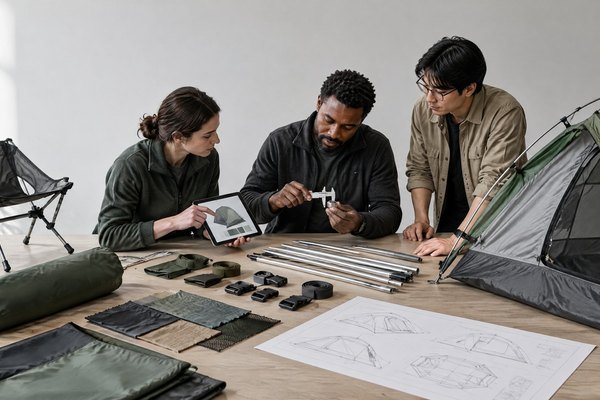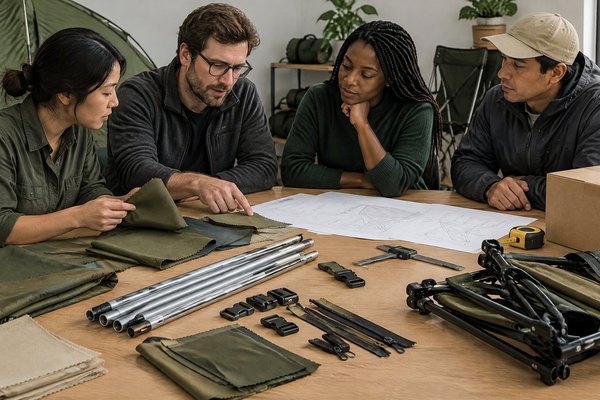
A useful sourcing decision starts with a written requirement that can be challenged, sampled, inspected, and approved.
What Should Be Included in an OEM Camping Gear RFQ?
A camping-gear request for quotation (RFQ) translates a brand’s product concept into a common basis for supplier engineering, sampling, testing, packing, and commercial comparison. If the brief is vague, quotes may look comparable while describing different products.
For outdoor brands selling in the United States and Europe, the RFQ also needs to make the intended market explicit. Product-safety documentation, traceability information, country-of-origin marking, battery transport paperwork, and packaging controls can affect the product design and landed-cost plan. For example, the EU General Product Safety Regulation requires manufacturers to conduct an internal risk analysis and prepare technical documentation before placing covered products on the market; the documentation can include test reports and standards applied. [1] This guide is procurement guidance, not legal or compliance advice. Confirm product-specific obligations with qualified compliance, customs, and legal advisers.
Quick Answer
A supplier-ready OEM camping gear RFQ checklist should contain eleven connected modules: (1) buyer and programme context; (2) product definition; (3) bill of materials and performance specifications; (4) target markets and compliance assumptions; (5) demand, MOQ, and commercial inputs; (6) sampling and approvals; (7) branding and packaging; (8) testing and quality controls; (9) inspection, shipment, and import preparation; (10) quotation format and commercial terms; and (11) supplier response questions and document handover.
The practical test is simple: an unrelated supplier should be able to quote the same configuration, explain every exception, and identify every missing decision without relying on a sales call. Include drawings, photographs, colour references, artwork, test expectations, and a response deadline as attachments. Ask suppliers to list assumptions separately rather than silently substituting materials or methods.
Why camping-gear RFQs fail: buyer context and risk framing
Camping gear combines soft goods, load-bearing structures, weather-exposed materials, hardware, instructions, and packaging. A tent can fail because of a seam, pole, fabric coating, guyline, zipper, stake, warning label, or carton—not only its headline material. An RFQ must define the system, not just a product name.
Separate positioning from verifiable requirements. “Premium family tent,” “ultralight,” “all-weather,” and “eco-friendly” are useful context, not acceptance criteria. Convert each into measurable inputs: user capacity, packed weight, dimensions, fabric construction, coating, pole material, accessories, tolerances, and required test or inspection evidence.
A second risk is the false comparison. One supplier may price a smaller carton, lower-grade zipper, alternate alloy, or basic polybag while another includes a colour box, spare parts, and inspection. Require a line-by-line deviation schedule stating every alternative and its price and timing effect.
The third risk is starting compliance at the final inspection stage. Target-market, user-age, electrical, chemical, warning, traceability, and transport requirements can change the design before tooling or materials are committed. ISO 5912:2020 is a current international standard that specifies requirements for safety, performance, and fitness for use of camping tents; it can be a useful reference where a tent programme calls for that standard or selected elements of it. [2] It does not replace a brand’s product-specific assessment or applicable legal requirements.
RFQ principle: Do not ask a supplier to “make it compliant.” State the intended countries, sales channels, end user, product claims, and evidence required. Then ask the supplier to identify the standards, tests, labels, documentation, and exclusions it believes are relevant.
The 11 RFQ modules: a decision framework for outdoor brands
Module 1: Identify the buyer, programme, and decision path
Open with a short programme brief. Give the legal buying entity, brand name, product family, project code, product owner, target launch window, forecast horizon, and preferred communication language. State whether the supplier is being considered for OEM production from your finished design or for ODM development from a supplier platform. OEM generally means production to the buyer’s defined design and specifications. ODM normally includes supplier-led design or platform adaptation, so the RFQ must say who owns approvals, drawings, artwork, tooling, and resulting design files.
Describe the target user and use scenario. A two-person backpacking tent, a car-camping family tent, a festival shelter, a beach chair, and a youth sleeping bag carry different load, weather, setup, misuse, and labeling considerations. Identify whether the item is for adults, children, or a mixed family audience. Do not use “kids” as a marketing shorthand only; it can change testing, certification, and traceability questions. In the United States, children’s products subject to applicable CPSC safety rules generally require third-party testing and a written Children’s Product Certificate from the domestic manufacturer or importer. [5]
Specify decision gates. For example, request a feasibility response, development sample, pre-production sample, and production release sample. Name who can approve each gate and what evidence is needed. This makes it clear that an email complimenting a sample is not a production authorization.
Module 2: Define the product configuration, not merely the category
Create one RFQ line for each stock-keeping unit (SKU), colourway, size, and market version. Include a product name and a stable internal reference number. Attach a dimensioned drawing, annotated photographs, a component map, and a “what is included” list. State whether variations may share components or packaging. If details are still open, mark them TBD and ask the supplier to price a defined baseline plus each option.
For a tent, list the flysheet, inner, groundsheet, poles, stakes, guylines, repair sleeve, bag, instructions, and any footprint. Define the condition for every measurement, such as pitched floor area, deployed chair height, or packed weight including accessories. Identify the governing CAD revision or master sample if attachments conflict.
| RFQ field | What to state | Why it affects the quote |
|---|---|---|
| SKU and variation | Product code, size, colourway, market version, quantity by SKU | Drives material consumption, colour matching, labels, and packing |
| Included components | Complete product and accessory list | Prevents missing stakes, bags, repair parts, manuals, or hangtags |
| Dimensions and weight | Measurement condition, target, tolerance, unit | Supports fit, freight, usability, and inspection checks |
| Performance intent | Use case, climate, user load, setup frequency, product claims | Guides engineering and appropriate validation questions |
| Visual standard | CAD, drawings, approved sample, material swatches, colour references | Creates an objective basis for finish and branding approval |
Module 3: Write technical specifications at component level
A component-level specification is the core of an effective OEM camping gear RFQ. For every material and part, give the requested construction, grade, colour, finish, size, and performance evidence. If you do not know the exact input, provide the intended outcome and require the supplier to propose a specification with a datasheet, sample, and stated limitations.
For textiles, identify fibre content, construction, nominal mass, coating or laminate, colour reference, print method, and relevant water, UV, abrasion, or test requirements. “Ripstop polyester” can encompass different yarns, densities, coatings, and weights. Require evidence for any recycled-content or chemical declaration.
For structures and hardware, name the material, cross-section, finish, critical dimensions, moving parts, and corrosion expectation. For tent poles, clarify material, diameter, segments, shock cord, and tips; for zippers, state chain type, slider, direction, and colour. For load-bearing items, define the load case and permitted deformation or failure criteria rather than requesting a generic “strong” frame.
For assembly, specify critical seam construction, reinforcements, seam sealing, adhesive restrictions, print placement, and tolerances. Ask for a preliminary bill of materials (BOM), process flow, and critical-to-quality points. A BOM is the controlled list of materials and components used in one finished SKU.
Module 4: Name target markets, claims, labels, and documentation
State every intended market and sales channel at the beginning of the RFQ. The same product may need different language panels, responsible-party details, retailer data fields, or channel documentation.
For EU consumer products within scope, GPSR requires manufacturers to conduct an internal risk analysis and create technical documentation. It also requires a responsible economic operator established in the Union, whose name and contact details must appear on the product, packaging, parcel, or accompanying document. [1] Ask who prepares safety-file inputs, preserves production and test records, supplies batch data, and reviews labels; do not assume an overseas factory fills that role.
For US imports, request the country-of-origin mark, location, method, and artwork proof. CBP states that foreign-origin articles entering the United States must generally bear the English country name, conspicuously and as permanently as the product permits, unless an exception applies. [3] Confirm origin conclusions with a customs adviser, especially where components and assembly occur in different countries.
If a product is intended primarily for children, include a children’s-product field, age grade, rule review, certification owner, lab requirement, and tracking-label plan. CPSC guidance says labels must be visible, legible, and permanently affixed to the product and packaging to the extent practicable, with manufacturer or importer, production, and batch information. [4]
Do not claim a standard, a regulation, a safety result, or a sustainability attribute on packaging until the substantiation, wording, and market applicability are approved. The RFQ should carry the latest approved claim matrix, not an unreviewed marketing deck.
Module 5: Give meaningful MOQ, forecast, and commercial inputs
MOQ, or minimum order quantity, is not one number. Distinguish finished-goods MOQ per SKU, colour MOQ, fabric dye-lot MOQ, component MOQ, packaging-print MOQ, and carton MOQ. Ask suppliers to quote each constraint separately and to state whether unused materials or printed packaging remain buyer-owned inventory. This is more useful than asking, “What is your MOQ?”
Provide a realistic initial order range and annual demand scenario, labelled non-binding unless your terms say otherwise. State order cadence, colourway-combination opportunities, destination region, and required delivery date. Ask what determines MOQ: fabric mill run, custom hardware, printing, assembly efficiency, or carton configuration.
State currency, price validity, development charges, payment assumptions, requested Incoterm, named destination, and freight treatment. Incoterms allocate defined delivery, cost, and risk responsibilities; name the exact rule and place, then have a qualified logistics or trade professional confirm it.
Module 6: Control sampling, approvals, and changes
Sampling is the cheapest time to find an unclear requirement. Specify the sample type, purpose, quantity, configuration, and required deliverables. A development sample tests whether the concept can be made. A pre-production sample is the proposed production build before mass manufacture. A golden sample is the mutually approved physical reference retained for comparison; use this term only if both parties agree to label, date, and control it.
Ask the supplier to quote sample charges, freight, schedule, substitutions, and production changes. Require a submission pack with BOM revision, measurement report, photographs, known deviations, test plan, and updated quotation. Disclose hand-cut components or non-production tooling.
Set a written change-control rule. No change to material, construction, factory, process, packaging, artwork, or test scope should proceed without written approval after cost, timing, compliance, visual, packing, and prior-test impacts are stated.
RFQ checkpoint: Before sampling, ask the factory to return a redline copy of the specification. Its unanswered questions and proposed deviations are valuable evidence of where your brief still needs a decision.
Need a quote that can be compared rather than merely collected? CampLume can review a structured camping-gear RFQ and respond against its defined assumptions. Send the specification package to info@camplume.com or use the site RFQ form, and request a documented deviation list with the quotation.
Module 7: Specify branding, instructions, retail packaging, and master cartons
Provide artwork, colour references, dielines, language versions, barcode data, and a label-placement drawing. Define what is buyer-supplied, who approves product printing, labels, manuals, cartons, and warnings, and the required brand-mark application method.
Write the packaging brief in layers: the consumer-facing pack; internal protection against abrasion, sharp components, moisture, or loose hardware; and the export carton. Define carton weight and dimension targets, inner-pack quantity, SKU-mix policy, palletisation, shipping marks, and barcode location. Request a packaging drawing and packing list before approval.
If wood pallets, crates, dunnage, or other regulated wood packaging will enter or transit the United States, identify this in the shipping section. USDA APHIS says importers must ensure wood packaging material is pest-free, debarked, treated, and marked with an ISPM 15 logo; noncompliant shipments will not be allowed to enter. [7] Include an instruction to use compliant marked wood packaging or an alternative such as plastic pallets or engineered wood where appropriate, then confirm the final plan with the freight and customs team.
Instructions need their own field: languages, warning owner, assembly, maintenance, spare parts, diagrams, revision control, and final approval. For tents, request a set-up sequence matching the packed contents; for chairs, show lock engagement and folding points.
| Packaging and information control | RFQ question | Evidence to request |
|---|---|---|
| Product identification | What SKU, batch code, origin mark, and revision appear on the product and package? | Artwork proof and label-placement drawing |
| Retail presentation | What is the consumer pack and how is the product protected within it? | Dieline, pack-out photos, packaging BOM |
| Export readiness | What are units per carton, carton dimensions, gross/net weight, and shipping marks? | Carton specification and draft packing list |
| Setup and safety information | What instructions, warnings, languages, and approval owner apply? | Controlled manual proof and translation workflow |
| Wood packaging | Will pallets, crates, or dunnage be used for US-bound shipments? | ISPM 15 marking confirmation or alternate-packaging plan |
Module 8: Build a risk-based testing and factory-quality plan
Testing should follow the product’s risks, claims, users, and markets. Do not ask for “all tests” without the method, version, sample configuration, pass criteria, and report owner. Distinguish material, component, finished-product, and production-control evidence.
For tents, request a plan for fabric, seam, pole, zipper, setup, stability, and water-ingress risks. If using ISO 5912:2020, ask which clauses can be addressed and any exclusions; ISO describes it as covering tent safety, performance, and fitness for use. [2] Do not claim compliance without evidence for the exact configuration.
For seating, define user load, test orientation, locking function, textile attachment, and stability. For sleeping bags, address material composition, fill distribution, zipper function, and claimed care outcomes. For battery-powered products, include chemistry, capacity, battery supplier, installed or removable configuration, charging method, markings, and transport questions.
Lithium batteries are regulated as hazardous materials for US transportation. PHMSA says lithium cells and batteries offered for transportation must have passed the UN Manual of Tests and Criteria, section 38.3 design tests, and manufacturers must make test summaries available on request. [6] An RFQ for a battery-containing product should therefore request the applicable UN 38.3 test summary, battery identification, and the supplier’s proposed transport and packaging documentation—not a generic statement that the battery is “shipping compliant.” Confirm mode- and route-specific requirements with the carrier and qualified dangerous-goods specialist.
Ask for incoming, in-process, and final checks; measurement points; defect definitions; rework, calibration, traceability, and record controls. AQL, or acceptance quality limit, is a sampling-inspection approach. If used, specify the standard, level, defect definitions, sample basis, and acceptance authority.
| Stage | Example camping-gear check | RFQ output required |
|---|---|---|
| Incoming material | Fabric shade, pole dimensions, zipper function, logo-component finish | Incoming inspection criteria and supplier certificates where requested |
| First-off / pilot build | Complete tent pitch, chair lock engagement, label placement, packed weight | First-off report, photos, and deviation disposition |
| In-process | Seam construction, reinforcement placement, torque or assembly checkpoints | Process control plan and recorded critical checks |
| Finished product | Functional setup, measurements, appearance, accessories, barcode scan | Final-inspection checklist and defect definitions |
| Shipment release | Carton count, carton drop or handling checks if agreed, shipping marks, pack-out | Pre-shipment inspection report, packing list, and release status |
Module 9: Prepare for inspection, shipment, and import handover
Specify inspection provider, timing, sample plan, location, failed-result treatment, reinspection responsibility, and required evidence. A pre-shipment inspection verifies the defined specification; it cannot correct an unclear one.
Request an order- and SKU-linked document list: invoice, packing list, carton marks, origin-mark proof, required test reports, certificates or declarations, inspection report, and shipping data. Keep documents revision controlled. For EU sales, GPSR requires technical documentation to be available to authorities for ten years after market placement. [1] Allocate file inputs and retention clearly.
Ask suppliers to quote cargo-ready timing only after materials, artwork, samples, and testing are confirmed. For each milestone, state its prerequisite: artwork release, sample approval, order, material booking, production start, inspection, and cargo handover.
Module 10: Demand a quote in a comparison-ready format
Give every supplier the same quotation template. Require a price by SKU, quantity tier, currency, Incoterm and named place, packaging configuration, tooling or development charge, sample charge, test charge, and optional cost. Require a separate price for variants such as alternate fabric, recycled-content option, custom hardware, upgraded packing, or different carton count. Ask for price validity and all assumptions.
A complete response distinguishes one-time costs—such as tooling, artwork setup, test preparation, or packaging plates—from recurring unit costs. State whether duties, freight, insurance, destination charges, and inspection are included or excluded. Obtain customs classification and landed-cost advice from suitable specialists rather than relying only on a factory quote.
Request capacity and subcontracting disclosure without asking for unverified output promises. Ask which steps are in-house, which facility will make the product, and how material, batch, and final-product traceability are maintained.
Module 11: Require supplier confirmation, deviations, and a document index
Close the RFQ with a controlled response sheet. Ask the supplier to confirm receipt of every attachment; list open questions; identify each deviation; provide a proposed BOM; state sample and quotation validity; name the technical and commercial contacts; and return a document index. The index should list document title, revision, date, owner, and status. Require suppliers to say “not available” where evidence cannot yet be provided. A transparent gap is more useful than a generic assurance.
Ask which materials have long lead times, which parts require custom tooling, which requested tests remain unproven, and what information is needed for a firm price. These questions shift discussion from sales language to engineering evidence.
How to compare camping-gear quotations fairly
Compare quotations in layers. First, confirm scope equivalence: SKU, BOM, accessories, packaging, labels, instructions, test plan, and Incoterm. Second, compare commercial terms: quantity tiers, currency, one-time costs, payment, price validity, and exclusions. Third, compare execution readiness: sample plan, deviation list, proposed controls, document availability, and clarity of response. A supplier that cannot map its quote to the RFQ may still be capable, but its price is not yet comparable.
Use a weighted internal scorecard rather than choosing on unit price alone. Link each criterion to an RFQ requirement and retain evidence links with the score.
| Comparison criterion | What a buyer should compare | Warning sign |
|---|---|---|
| Technical alignment | BOM, dimensions, accessories, tolerances, and documented deviations | “Equivalent” material without a datasheet or a stated difference |
| Market readiness | Label proposal, test plan, responsible documents, battery or children’s-product questions | Generic promise of compliance with no market or product scope |
| Sampling readiness | Sample configuration, evidence pack, revision control, change process | Sample price without an approval path or production-equivalence statement |
| Packaging and logistics | Pack-out, carton data, origin marks, wood-packaging plan, documents | Unit price quoted before packaging or delivery terms are defined |
| Commercial transparency | Quantity tiers, one-time costs, currency, Incoterm, validity, exclusions | One bundled price that cannot be reconciled to the requested scope |
FAQ: OEM camping gear RFQ checklist
1. What is the minimum information needed for an OEM camping gear RFQ?
At minimum, provide the product type and SKU scope, drawings or photos, included components, target markets, target quantities, packaging level, requested delivery term, sample objective, and a response deadline. Add a deviation sheet so suppliers can identify unknowns rather than make undisclosed assumptions.
2. Should an RFQ include a target price?
It can. A target price can help determine feasibility when it is clearly labelled as a target and tied to a defined quantity and delivery basis. It should not replace the full specification, because price without scope encourages specification drift.
3. How should MOQ be requested for a camping product?
Ask for MOQ by finished SKU, colour, fabric dye lot, custom component, printed packaging, and export carton. Request the price effect at several quantity tiers and ask which constraints can be combined across colourways or related SKUs.
4. What testing should be requested for a tent or outdoor chair?
Request a risk-based test proposal tied to the product’s intended use, claims, users, and target markets. Define the selected method, configuration, pass criteria, lab or factory responsibility, and report ownership. For tents, ISO 5912:2020 can be a relevant reference when selected for the programme. [2]
5. When should packaging be finalized?
Finalize packaging before production release, after the product configuration, label content, barcode data, instructions, and shipping configuration are known. Approve a pack-out sample or clear packaging specification, not only a visual carton design.
6. How do I compare two supplier quotes that have different prices?
Normalize them to the same SKU, BOM, quantity, packaging, testing, Incoterm, currency, and exclusion list. Then compare the documented deviations and one-time costs. Do not treat quotes as comparable until every difference is either resolved or priced separately.
Related CampLume resources
Use these related pages to turn What Should Be Included in an OEM Camping Gear RFQ? into a more complete, supplier-ready decision:
- Read: How to Audit a Camping Gear Supplier Before Placing Your First Order for the next connected sourcing decision.
- Review the CampLume OEM and ODM process to compare a suitable CampLume product platform.
- See the CampLume buyer FAQ for concise guidance on samples, MOQ, quality control, compliance and shipment preparation.
Conclusion: turn an RFQ into a controlled sourcing record
The best OEM camping gear RFQ is a controlled decision document. It tells suppliers what they are quoting, requires deviations to be disclosed, and creates an evidence trail for samples, testing, packaging, inspection, and shipment release.
For outdoor brands, the essential discipline is to connect the product specification to the market, factory controls, and landed-goods plan. Put the target user, intended countries, components, packaging, evidence, and quote assumptions in one brief. Then compare suppliers on the same basis.
To request a structured review or quotation for an OEM or ODM camping-gear programme, email the completed RFQ package to info@camplume.com.
Project discussion
Need to apply this guide to a product programme?
Send your product category, target market, estimated quantity, current specification and packaging stage. CampLume will continue the discussion by email.
Email info@camplume.comSources and further reading
References
- 1Regulation (EU) 2023/988 on general product safety
- 2ISO 5912:2020 Camping tents — Requirements and test methods
- 3Marking of Country of Origin on U.S. Imports
- 4Tracking Label Business Guidance
- 5Children's Product Certificate
- 6Transporting Lithium Batteries
- 7Import ISPM 15-Compliant Wood Packaging Material into the United States