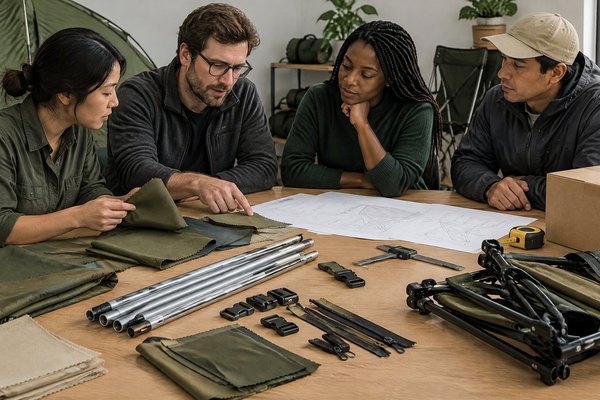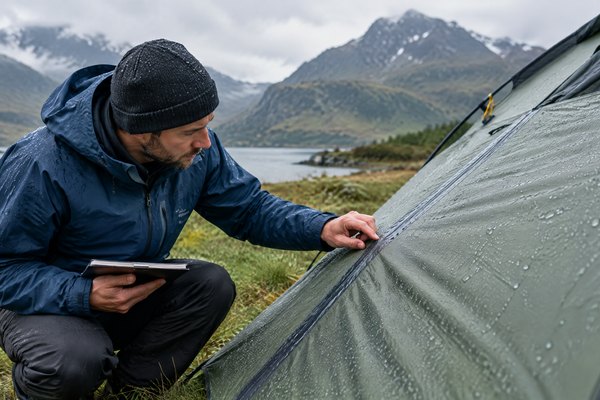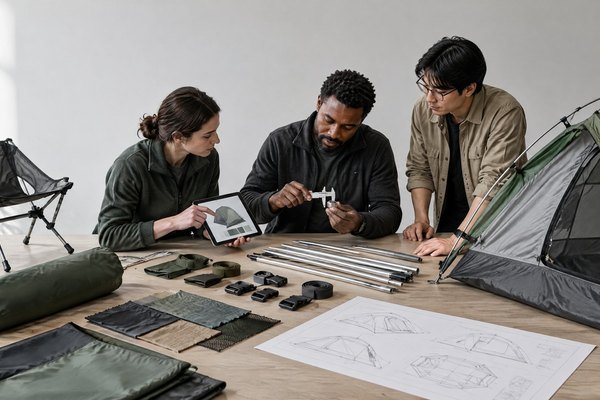
A useful sourcing decision starts with a written requirement that can be challenged, sampled, inspected, and approved.
OEM vs ODM Camping Gear: Which Sourcing Model Is Right for Your Brand?
Choosing between OEM, ODM and co-development is not primarily a catalogue decision. It is a decision about who controls the product definition, who carries development work, and what evidence supports the product when it reaches a US or European market. For an outdoor brand, that decision affects the ability to differentiate a tent, camp chair, sleeping bag, cookware set or accessory; it also affects sampling, tooling, documentation, change approvals and the practical cost of a late revision.
The right model depends on the product’s maturity and the buyer’s commercial objective. A brand with a proven construction and detailed specification usually needs OEM manufacturing. A brand validating a category or seasonal assortment may gain speed from an ODM platform. A buyer with a clear user problem but incomplete engineering may benefit from co-development. In every case, the buyer should turn the chosen model into a written product, quality and contract workflow before production begins.
Quick Answer
Choose OEM when your brand owns, or intends to own, a distinct design and can define the critical materials, dimensions, performance requirements and approval gates. It offers the strongest product control, but normally requires more buyer input, more development discipline and potentially dedicated tooling.
Choose ODM when speed, lower development effort and a proven supplier platform matter more than exclusive construction. It can be appropriate for colour, trim, packaging and selected feature changes, provided the buyer verifies what may be changed, what remains standard, and whether the product documentation matches the final configuration.
Choose co-development when your brand has a market brief and functional direction but needs the supplier’s engineering input to turn that concept into a manufacturable product. It works best when design ownership, development costs, tool ownership, sample acceptance, test responsibilities and future use rights are agreed in writing.
For all three models, do not choose based only on the initial quotation. Select the model after comparing the complete control system: design ownership, speed, customization ceiling, technical documentation, tooling, minimum order quantity (MOQ), sample approval, change control and contract terms.
1. Start With the Buyer Context, Not the Product Label
Outdoor buyers often use “OEM” and “ODM” as shorthand for “custom” and “ready-made.” That shortcut is incomplete. Two suppliers can both call a project OEM while one expects the buyer to provide complete production-ready files and the other expects to engineer the product from a sketch. Similarly, an ODM item may permit a new fabric, colourway and private-label packaging, but not a revised frame, seam construction or load-bearing geometry.
The practical sourcing question is therefore: what must remain under your brand’s control for this product to be commercially, technically and compliantly acceptable? Write the answer before requesting quotations. Consider the intended user, use environment, price tier, channel, brand promise, target markets, expected product life and the consequences of a design or material substitution.
Camping gear can combine textiles, coatings, webbing, structures, hardware, packaging and instructions. A cosmetic-looking change may affect fit, strength, weather resistance, chemical content, labelling or packing. A sample is evidence, not a substitute for a controlled specification.
For products sold under a brand’s own name or trademark in the European Union, the GPSR treats that person as the manufacturer for the regulation’s purposes. The regulation requires manufacturers to ensure products are designed and made safely, conduct an internal risk analysis, and prepare and maintain technical documentation; it also says that documentation must be kept available to market-surveillance authorities for 10 years after placement on the market. [3] This makes the ownership and documentation conversation material even when production is outsourced.
This guide is general commercial and operational information, not legal advice. Product rules depend on the finished product, materials, intended users and destination market. Confirm the requirements that apply to a specific SKU with appropriate compliance, customs and legal advisers.
2. Define OEM, ODM and Co-Development Before You Quote
OEM: manufacture to the brand’s controlled design
Original equipment manufacturing (OEM) describes a project in which the buyer supplies, owns or tightly controls the product definition and appoints a manufacturer to make it. The definition may include drawings, a bill of materials (BOM), grading or tolerance requirements, construction details, artwork, labelling, packaging, inspection criteria and test plan. The factory may contribute manufacturing feedback, but it should not treat substitutions or design changes as routine commercial choices.
An OEM tent project, for example, might specify the canopy fabric, coating target, pole diameter and material, seam construction, guy-line layout, floor construction, dimensions, packaging and brand labels. The supplier’s role is to confirm manufacturability, identify tooling or process needs, make samples, and manufacture against the approved technical package.
OEM can support differentiation, but does not automatically create exclusivity. Separate pre-existing supplier know-how from buyer-controlled files, artwork, patterns, paid tooling and approved configuration. State who may use and modify each asset after the relationship ends.
ODM: adapt a supplier-owned platform
Original design manufacturing (ODM) generally means the supplier has designed a product platform that the buyer selects and adapts. The buyer may add branding and packaging and may sometimes choose from available fabrics, colours, finishes, components or feature options. The supplier usually owns the core design and may sell the same or closely related construction to other customers, subject to any agreement.
For a camping chair, an ODM path could mean selecting an established frame and seat pattern, then choosing the fabric colour, logo treatment, carry bag and carton artwork. It can reduce early engineering work because the platform already exists. It does not remove the buyer’s need to validate the exact final configuration. A larger logo patch, different fabric weight, new coating, altered armrest or retail packaging may affect performance, instructions, claims and records.
ODM is a faster route to market, not a promise that a base product is interchangeable across markets. Ask which parts are fixed, which options are validated, whether a requested change creates a new version, and what evidence covers the final configuration.
Co-development: share the path from brief to manufacturable product
Co-development sits between these approaches. The buyer brings the target customer, use case, commercial brief and brand direction. The supplier brings product engineering, material or component knowledge, prototyping and process input. Neither party should assume ownership from the project label alone.
Co-development fits a buyer that knows its user problem but has not finalised the pattern, attachment geometry or manufacturing sequence. Define deliverables at concept, prototype, engineering-sample, pilot and release stages, plus the approver and outcome if the target cost or function is not feasible.
| Sourcing model | Typical starting point | Buyer control | Typical speed to a first commercial sample | Customization scope | Main management risk |
|---|---|---|---|---|---|
| OEM | Buyer-owned or buyer-controlled specification | High when files and approvals are complete | Dependent on design readiness, material sourcing and tooling | Broad, including construction and component selection | An incomplete specification creates expensive assumptions and revision loops |
| ODM | Supplier’s established product platform | Moderate; highest around approved option sets | Often faster because the base product and process already exist | Usually branding, colour, packaging and defined options | Assuming a small change is already validated or exclusive |
| Co-development | Buyer brief plus supplier engineering | Shared until ownership and approvals are defined | Dependent on concept complexity and decision speed | Targeted innovation within a jointly defined scope | Unclear ownership, cost allocation or approval authority |
3. Use a Decision Framework That Reflects Your Real Constraints
A buyer should choose the model by scoring the project against several dimensions, rather than by asking which label is “better.” Start with a one-page decision brief that names the non-negotiables. If the buyer’s competitive advantage is a distinct structure, pack format, comfort system or material specification, that points toward OEM or co-development. If the commercial advantage is a fast, coherent private-label assortment, an ODM platform may be more appropriate.
Design ownership and brand differentiation
Ask whether the product must be visibly and functionally unique, or whether a differentiated offer can be built around merchandising, bundle strategy, customer service and brand presentation. OEM is usually appropriate where the design itself is a protected commercial asset. ODM may be appropriate where the buyer accepts a shared core platform. Co-development needs explicit allocation because the valuable output may include ideas, drawings, prototypes, patterns, fixtures and data created during the project.
“Ownership” has several layers. Artwork is not a CAD model; a paid mould is not necessarily a right to move it; and a custom colourway is not automatically exclusive. List each asset and assign ownership, possession, permitted use and exit rights.
Speed and internal capacity
ODM may reduce early product-development work, but the buyer still needs time for sample review, packaging and instruction approval, product claims review, test planning and purchase-order release. OEM can be fast when the buyer has a mature technical package, an approved component library and quick decision makers. Conversely, OEM becomes slow when every drawing, material and measurement is being decided after sampling begins.
Co-development needs a disciplined buyer counterpart. Assign one decision owner, set a response window, and separate objective requirements from preferences. Otherwise, iteration becomes open-ended.
Customization, tooling and MOQ
MOQ is the minimum quantity a supplier requires for an order, material, colour or component. It may differ by finished SKU, fabric lot, custom hardware, printed packaging or carton. It should not be treated as one universal number. A low finished-goods MOQ can still require a larger fabric commitment or a mixed-SKU programme.
Tooling is the equipment or fixture used to produce or control a part, such as a mould, die, welding fixture, cutting template or test fixture. New tooling can enable differentiation and repeatability, yet it adds cost, lead time and an ownership question. For an ODM product, a branded woven label or printed carton may require no core-product tooling. A redesigned injection-moulded buckle or aluminium connector may require dedicated tooling and new validation.
Ask suppliers to distinguish: (1) existing tools, (2) buyer-funded new tools, (3) shared or amortised tools, and (4) tools that are only production aids. Ask how tools are identified, stored, maintained, repaired and released at project end. The answer should be reflected in the quotation and contract.
| Buyer priority | Better starting model | What to verify before selection |
|---|---|---|
| Distinct construction or proprietary user experience | OEM or co-development | Complete design inputs, ownership schedule, tooling plan, performance tests and revision authority |
| Fast extension into a familiar category | ODM | Exact base version, available options, final-configuration documentation and non-exclusivity assumptions |
| New concept with incomplete engineering | Co-development | Stage gates, prototype budget, decision rights, IP allocation and feasibility criteria |
| Low initial demand uncertainty | ODM, or an OEM project built around standard components | MOQ by material and component, stock commitments, change fees and replenishment terms |
| High consequence of product failure | OEM or co-development with a rigorous validation plan | Hazard analysis, component traceability, test method, inspection plan and controlled changes |
Need help deciding which documents belong in your RFQ? Send the product category, target markets, existing files and commercial objective to info@camplume.com, or submit the same information through the site RFQ form. Ask for a document-gap review and a clear statement of what needs supplier confirmation before quotation or sampling.
4. Convert the Product Idea Into a Controlled Technical Package
The sourcing model does not excuse vague requirements. Every buyer should establish a controlled product specification: the document set that tells the supplier what is being made and tells quality teams how to determine whether it is acceptable. In OEM, the buyer may author most of it. In ODM, the supplier may provide the base documents and the buyer should formally approve the selected options. In co-development, the parties should agree who authors each document and when it becomes controlled.
A practical package can include drawings, BOM, material specifications, colour standards, artwork, construction details, tolerances, measurement method, packaging, labels, instructions, quality criteria and a test matrix. A backpack may define bar-tack locations, webbing, zipper and load-test configuration; a tent may define pole sections, routing, seam sealing, ventilation and packing sequence.
The BOM identifies every component and material. Record item code, description, revision, specification, quantity and whether an alternative is allowed. This prevents reliance on terms such as “same black buckle.”
Define an acceptance standard, not only a desired appearance. “Durable,” “weatherproof” and “premium” need measurable requirements or agreed references. Confirm the test method, specimen preparation and report scope for the final configuration.
5. Treat Documentation and Compliance as a Sourcing Workstream
Documentation follows the product, not its commercial label. An ODM product with new branding, packaging or materials may need updated records. Name the document-control owner from the first prototype.
For US general-use consumer products subject to CPSC rules, the manufacturer or importer must issue a written General Certificate of Conformity (GCC) based on testing or a reasonable testing programme. For overseas products, CPSC says the importer issues the GCC. [1] The model does not decide which rules apply.
In the EU, GPSR Article 9 requires an internal risk analysis and technical documentation before placement on the market. As relevant, it includes the product description, risk mitigations, test outcomes and standards or other safety elements applied. [3] The GPSR applies from 13 December 2024 and requires an EU-based responsible economic operator for each covered product. [4]
Camping products also require material-chemistry review. REACH places chemical-risk and safety-information duties on industry, and a consumer inquiry about a substance of very high concern in an article requires a reply within 45 days. [5] Request declarations and traceability records linked to the relevant revision or component.
For US import marking, CBP says every foreign-origin article entering the United States must be legibly marked with its country of origin in English unless an exception applies; origin and category-specific labelling can be complex. [2] Put origin marking, warnings, labels, instructions and carton marks into artwork approval, not a last-minute packaging task.
Minimum documentation questions for an RFQ
Ask which documents the supplier can provide, in what format, for which revision and under what change control. Request a document index rather than assuming a report covers the final SKU. It can list drawings, BOM, materials, artwork, inspection plan, production sample record, tests, traceability, packaging and change history.
6. Make Samples, Testing and Inspection Deliberate Approval Gates
A sample is evidence, not just a display item. Name its stage, purpose, revision and permitted use. Do not compare a cosmetic prototype with a production sample as if they are equivalent.
A useful sequence may include a concept sample for form and user experience, an engineering sample for construction and materials, a pre-production sample for the intended production configuration, and a retained approved sample as the production reference. Match the stages to the project; an ODM accessory and a new OEM shelter do not need the same sequence.
For each stage, issue a review record with product code, revision, materials, deviations, measurements, test results, corrections, owner, due date and disposition: approved, approved with conditions, resubmit or rejected. “Looks good” is not adequate approval language.
Connect testing to the risk assessment and product claim. A camp chair may need load and stability evaluation; a tent may need material, seam or weather-exposure evaluation. Confirm applicable market requirements and how representative samples are selected and identified.
CPSC notes that a material change can include a design, process or component-source change that could affect compliance. Retesting and a new GCC may be needed. [1] Assess evidence, approval and documentation before shipment.
Factory testing, shipment inspection and installation preparation
Factory checks, laboratory tests and shipment inspections answer different questions. A factory check can confirm process checkpoints; a laboratory test assesses a property by method; inspection samples finished goods against agreed criteria. Do not present one as a substitute for another.
For a folding camp table, the plan can check the frame version, fasteners, dimensions, folding action, cosmetics, packing and carton marks. For a tent, it can verify material identifiers, pole count and fit, seams, measurements, labels, accessories and packed-carton configuration. State the sample method, defect definitions and disposition rules where agreed.
Some products require installation preparation. Roof-top tents, vehicle awnings, gas-interface camp kitchens and shelters may require compatibility, mounting, clearance, ventilation, warning and instruction review. Identify buyer validation, supplier inputs and unsupported claims before sale.
7. Build Change Control Into the Purchase Order, Not After It
Change control is the documented process for proposing, assessing, approving, implementing and recording a change to a product or process. It is the bridge between a good sample and repeatable shipments. It should cover both buyer-initiated changes, such as a new colourway, and supplier-initiated changes, such as an alternate zipper source, coating revision or packaging material.
A change request should identify the version, change, reason, affected SKUs, and effects on cost, MOQ, tooling, timing, quality, documentation, testing, packaging and inventory. It should state whether a sample, retest or approval is required. Do not release a change based only on an informal message.
Set a clear rule: the supplier may not substitute a controlled material, component, process or packaging element without written approval from the buyer’s named authority. The buyer should also respond in time. A change log is not useful if it becomes a bottleneck that forces unrecorded decisions.
Change control is especially important in ODM. A supplier platform can evolve, but a buyer-specific product changes only with buyer approval. Ask whether the factory maintains a master version and gives notice before changes.
8. Negotiate the Contract Decisions That the Product Model Cannot Answer
OEM, ODM and co-development are operating models, not contracts. The agreement should define scope, governing specification, commercial terms, quality and acceptance, confidentiality, intellectual-property allocation, tooling, change control and termination. Obtain qualified legal advice for the agreement and market-specific obligations.
Use a precedence schedule to decide which document controls when a quotation, purchase order, drawing, approved sample, test plan and email conflict. Designate core references and require each revision to be numbered and formally approved.
For OEM, schedule buyer assets and supplier deliverables. For ODM, schedule the base model and permitted deviations. For co-development, schedule phases, cost allocation, ownership, exit rights and use of unsuccessful concepts. A development fee is not a complete ownership discussion.
Contracts should address confidential product information. A supplier may retain general know-how, while the brand may restrict use or disclosure of buyer artwork, customer information and buyer-funded outputs. Define the categories concretely.
9. Run a Practical RFQ and Supplier-Selection Process
A strong RFQ states the model and what it means for the project. Invite the supplier to identify gaps instead of pricing unknowns as assumptions.
For an OEM RFQ, provide product files and request gaps, manufacturability concerns, tooling, material and component MOQs, sample stages, controls and documentation. For ODM, request the exact model and revision, configuration sheet, option list, base materials, change limits, sample, document index and exclusivity assumptions. For co-development, request a phased plan with deliverables, gates and buyer inputs.
Evaluate evidence and communication quality. Can the supplier identify the exact version on a sample or test record, control a material change, and link the approved sample to the production BOM? These questions are more informative than broad quality claims.
For the first production order, conduct a pre-shipment review of artwork, packaging, labels, sample status, records, inspection, documents and agreed tests. Include final instructions and warnings where assembly or installation matters.
10. FAQ: OEM vs ODM Camping Gear
Is OEM always more expensive than ODM camping gear?
Not necessarily. OEM often needs more engineering, sampling or tooling, while ODM can reduce early development work. Compare the full landed and lifecycle cost, not only the initial unit price.
Can an ODM camping product be exclusive to one brand?
It can be negotiated, but exclusivity is not implied by ODM. Define the exact product version, territory, channels, duration, excluded elements and remedies. Confirm whether the supplier’s core platform remains available to other buyers.
Who owns tooling in an OEM project?
The answer must be written. Identify each tool, its funder, owner, storage, maintenance, marking and release or transfer terms. A tooling charge alone does not settle ownership or access.
What should approve a camping gear sample?
Approve against a controlled checklist that covers product revision, materials, construction, dimensions, function, branding, packaging, labels, instructions and required evidence. Record deviations and approval conditions in writing. The appropriate test and review scope depends on the product and intended market.
When does a supplier change require a new sample or retest?
Assess any design, material, component-source, process, packaging or claim change for its effect on function, safety, quality and documentation. CPSC guidance for relevant general-use products notes that material changes may require retesting and an updated certificate. [1] Define the review and approval path before production.
What documentation should a US or EU outdoor brand request?
Request documents appropriate to the product and destination, such as controlled specifications, BOM, test plan and reports, traceability records, labels, instructions, packaging specifications, inspection plan and change log. US importers and EU economic operators have market-specific responsibilities, so validate requirements for the specific SKU and route to market. [1] [3] [4]
11. Conclusion: Choose the Model That You Can Control
The best OEM vs ODM camping gear decision matches differentiation with technical-management capability. OEM suits a buyer-controlled product; ODM suits a defined assortment on a supplier platform; co-development suits a concept needing joint engineering through defined milestones.
Before you issue an RFQ, decide who owns the design, who may change it, what must be tested or documented, how samples are accepted, what tooling is needed, what MOQ applies at material and finished-product level, and which contract document governs each decision. Those answers reduce avoidable ambiguity regardless of product category.
For a project-specific discussion of OEM, ODM or co-development camping gear sourcing, email the product brief and target-market information to info@camplume.com.
Related CampLume resources
Use these related pages to turn OEM vs ODM Camping Gear: Which Sourcing Model Is Right for Your Brand? into a more complete, supplier-ready decision:
- Read: What Should Be Included in an OEM Camping Gear RFQ? for the next connected sourcing decision.
- Review the CampLume OEM and ODM process to compare a suitable CampLume product platform.
- See the CampLume buyer FAQ for concise guidance on samples, MOQ, quality control, compliance and shipment preparation.
Project discussion
Need to apply this guide to a product programme?
Send your product category, target market, estimated quantity, current specification and packaging stage. CampLume will continue the discussion by email.
Email info@camplume.comSources and further reading