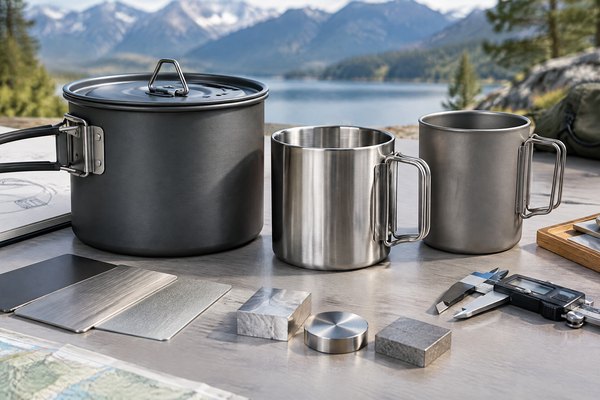
A useful sourcing decision starts with a written requirement that can be challenged, sampled, inspected, and approved.
Direct answer (quick summary)
For most commercial camping cookware lines, stainless steel offers higher long‑term corrosion resistance and scratch durability, while aluminium delivers lighter weight and faster heating but usually needs design or coating strategies to match longevity. The right choice depends on your product position (lightweight backpacking vs base‑camp or RV use), private‑label target price, and the sourcing strategy you plan to use. This guide focuses on stainless steel vs aluminium camping cookware durability for B2B buyers and describes workflows for product specification, sampling, testing, packaging and supplier qualification.
Quick Comparison: Durability, Weight and Use Cases
Below is a concise decision table to help match material to buyer priorities.
| Primary Buyer Priority | Recommended Material | Durability Pros | Primary Tradeoffs |
|---|---|---|---|
| Maximum long‑term corrosion and scratch resistance; premium finish | Stainless steel (18/8 or 18/10) | Hard surface, resists warping, long lifecycle | Heavier, costlier thermal management |
| Lowest weight for backpacking or ultralight private label | Aluminium (anodized or hard‑anodized) | Lightweight, fast heat response | Softer metal, can dent/scratch, requires surface treatment |
| Ultra‑light plus durability where weight is critical | Titanium (select models) | Extremely light, corrosion‑proof | High cost, lower thermal conductivity |
Material Durability: What Drives Longevity
Understanding durability requires separating mechanical, chemical and functional durability.
Corrosion & Surface Wear
- Stainless steel: Good resistance to rust and acidic foods when using 304/18‑8 or 316 grades. Durability is high for public‑use or rental gear where ease of cleaning matters. However, thin gauge stainless can dent under impact.
- Aluminium: Native aluminium oxidizes quickly to a protective layer, but raw aluminium is softer and vulnerable to abrasion and deformation. Anodized or hard‑anodized surfaces are significantly more wear‑resistant and are common in commercial cookware.
Mechanical Strength and Dent Resistance
- Stainless steel (thicker gauges) resists denting and maintains stiffness; ideal for base camp cookware manufacturer lines where repeated heavy use is expected.
- Aluminium should be engineered with higher gauge or reinforced rims/rolls to reduce denting; designers sometimes combine aluminium cores with stainless cladding.
Thermal Cycling and Warping
Repeated heating and cooling can warp thin pans. Stainless steel with an encapsulated aluminium or copper core balances thermal performance with structural stability. Pure aluminium heats quickly but will warp sooner if too thin.
Performance Details Buyers Test During Sample Review
When you receive development samples from a supplier, prioritize these checks:
- Visual and dimensional inspection: flatness, seams, finish quality, welds or rivets.
- Functional heat test: time to boil, evenness across the cooking surface, hot spots.
- Mechanical durability: controlled drop tests, rim compression and dent tests.
- Corrosion and cleaning: simulate acidic food contact and repeated dishwasher cycles if applicable.
- Coating adhesion (if nonstick/anodized): cross‑hatch adhesion and abrasion testing.
Document all acceptance criteria in the product specification before sample review to avoid scope creep.
Private‑Label Decisions: Titanium vs Stainless Steel
If you’re evaluating titanium vs stainless steel camping cookware for private label, ask what your customer values most and what price point you target.
- Titanium: Best for ultralight private‑label collections aimed at backpackers. It resists corrosion and is nearly maintenance‑free. Downsides are high material cost, noisy surface (food sticks more without a coating), and inferior heat distribution compared with stainless with an aluminium core.
- Stainless steel: Better perceived value for general camping and RV use. Easier to finish with polished or brushed looks, receptive to branding, and compatible with induction bases if needed.
Private‑label note: specify exact alloy, wall thickness, handle design and branding tolerances in the product specification. For private label, tooling and design change control are essential; plan a formal ECO (engineering change order) process with the supplier.
How to Source: From Initial Search to Factory Qualification
Many buyers ask how to source camping cookware from China without common pitfalls. Below is a pragmatic sourcing path.
-
Requirements and specification
- Create a clear product spec: dimensions, materials (e.g., 304 stainless, hard‑anodized aluminium), thickness (gauge), tolerances, finish, intended end‑use (backpacking, RV, base camp), packing and labelling.
- Include required tests and documentation (material certificates, test standards to apply) and whether you require PFAS‑free coatings.
-
Shortlist suppliers
- Request a camping cookware wholesale catalog and OEM/ODM capabilities: tooling, sample lead times, MOQ ranges, and case studies.
- Include categories such as an entry‑level pot set, nonstick frying pan, and heavy‑duty base camp stock pots.
-
Sample order and review
- Order engineering samples, prototypes and pre‑production samples. Compare against your specification checklist.
-
Factory audit and inspection
- Plan a technical audit and on‑site inspection of production lines, welding quality, finishing stations and final packing.
-
Pilot production and testing
- Approve a small pilot run, run in‑house or third‑party lab testing per your market requirements, then move to full production with agreed inspection plans.
CampLume is an OEM/ODM camping gear manufacturer and can support these stages; confirm the applicable requirement and standard with your compliance team for each destination market.
Coatings, PFAS and Surface Chemistry
If your brand position requires PFAS‑free marketing or if some markets restrict PFAS, you must state that explicitly in the specification. Search for a PFAS free camping cookware supplier early in vendor conversations because coating procurement impacts lead times, tooling cleanliness and clean‑room handling in extreme cases.
- For nonstick: ask suppliers for the exact coating chemistry and whether they provide third‑party test reports for PFAS (PFOA, PFOS and short‑chain alternatives) or can guarantee absence via formal declarations.
- For anodized aluminium: hard‑anodizing is an electrochemical surface treatment that creates a ceramic‑like layer; it does not require PFAS but must meet abrasion requirements.
Specify acceptable test methods and limits in your buy‑spec and ask for a sample test report. Do not accept verbal assurances alone.
Product Application & Channel Considerations
Match cookware construction to the intended retail channels:
- Backpacking retail: prioritize weight, packability and high perceived value per gram — aluminium or titanium, foldable handles, nestable sets.
- Mass retail and e‑commerce: balance cost and durability — stainless with an encapsulated base or hard‑anodized aluminium with tested nonstick coatings.
- RV and outdoor kitchen: buyers often want robust, easy‑clean surfaces and larger sizes. Search for an RV camping kitchen equipment supplier that can produce heavier gauges and larger lids.
- Base camp gear: large pots and kettles should be specified for repeated heavy usage. If you’re building a full line, evaluate a base camp cookware manufacturer early in supplier conversations for capacity.
Packaging, Shipping Preparation and Documentation
Packaging decisions affect perceived value and damage rates in transit.
- Packaging spec: internal protection, individual retail cartons vs bulk club packaging, polybagging and humidity controls for metal finishes.
- Shipping prep: palletization pattern, corner protection, and unit stacking limits. Specify the minimum acceptable carton strength and required markings for customs.
- Documentation: specify required export documentation, material certificates, MSDS for coatings, and buyer label artwork proofs.
Include package acceptance criteria in the contract and require pre‑shipment photos and a final inspection report against those criteria.
Factory Testing, Inspection and Change Control
Practical elements to include in your supplier contract and supplier qualification plan:
- Factory tests: define in‑process checks — dimensional control, weld strength, coating thickness, adhesion and thermal tests.
- Pre‑shipment inspection (PSI): agree on sample size and AQL for cosmetic and functional defects.
- Third‑party lab testing: list tests required for the destination market (e.g., migration tests, heat resistance, coating chemistry). Confirm which party orders the tests.
- Change control: require a formal ECO process for tooling or process changes. Define notification timelines and re‑approval samples if changes affect fit, finish or compliance.
Supplier Qualification Checklist (Practical Items)
- Confirm supplier is an OEM/ODM camping gear manufacturer and can show similar product runs.
- Request a camping cookware wholesale catalog and discuss lead time ranges and MOQ tiers.
- Ask for recent sample images and engineering drawings plus material certificates for metals.
- Confirm capacity for required finish (polishing, anodizing, nonstick application) and whether PFAS‑free options are available.
- Verify QC capabilities: in‑line testing, final inspection, and customized packaging.
- Request references for RV or base camp projects if evaluating an RV camping kitchen equipment supplier or base camp cookware manufacturer.
Mid‑Article CTA: What to Send When You Need a Quote
Email our product development team at productbrief@camplume.com with this brief to get a formal response:
- Product category and example SKUs (pot set, frying pan, kettle)
- Preferred material (stainless, aluminium, titanium) and exact alloy if known
- Target end‑use (backpacking, RV, base camp)
- Expected MOQ and target COGS or FOB price band
- Required markings, packaging format and private‑label artwork
- Any mandatory tests or PFAS‑free requirements
- Target lead time and launch date
Provide CAD files or photos when available. A clear brief shortens quoting and sample timelines.
FAQ
Q: How thin is too thin for aluminium cookware intended for rental or heavy use? A: Avoid very thin gauges that deform under impact; specify reinforced rims and confirm a minimum wall thickness in millimetres in your spec. Exact values depend on pot diameter and use case.
Q: Can stainless steel cookware be made induction‑compatible? A: Yes—use a ferromagnetic base or encapsulated base construction. Specify induction compatibility and required flatness tolerances for your induction models.
Q: Does anodized aluminium guarantee nonstick behavior? A: No. Hard‑anodized aluminium improves abrasion resistance and reduces sticking compared with raw aluminium, but many brands add a dedicated nonstick coating if true nonstick is required.
Q: What paperwork should I insist on when importing cookware from China? A: Require material certificates, declaration of conformity for surface chemistries (if applicable), packing list, commercial invoice and agreed inspection reports. Confirm specific local regulatory requirements with your compliance team.
Q: How do I validate a PFAS free camping cookware supplier? A: Ask for written declarations tied to batch numbers and, where necessary, third‑party test reports that cover the relevant PFAS compounds. Include this requirement in your purchase order and reject coatings that lack documentation.
Conclusion and Next Steps
Stainless steel vs aluminium camping cookware durability is a practical decision tied to your product positioning: choose stainless steel for durability and finish, aluminium for weight and thermal response, and titanium selectively where weight premium is acceptable. For private label collections, compare titanium vs stainless steel camping cookware for private label with clear spec sheets and an ECO process. When sourcing, follow a structured path from specification to sample testing, factory inspection, packaging and documented change control.
If you need a camping cookware wholesale catalog, or want to evaluate CampLume as your OEM/ODM partner — including PFAS‑free finish options, RV camping kitchen equipment supplier capabilities or base camp cookware manufacturer discussions — email productbrief@camplume.com with the brief items listed above. Our team will confirm next steps and required lead times.
Final CTA: Email info@camplume.com with your product category, target market, estimated quantity, current specification and packaging stage. Request a documented response that identifies assumptions, open evidence and the next approval gate.
Related CampLume resources
-
Read: How to Choose Camping Cookware Materials for a Private-Label Range for a connected sourcing decision.
-
Explore CampLume cookware options to compare a relevant product platform.
-
See the CampLume buyer FAQ for concise guidance on samples, MOQ, quality control, compliance and shipment preparation.
-
Discuss an OEM or ODM brief with CampLume when product configuration, custom branding or packaging needs to be scoped.
Project discussion
Need to apply this guide to a product programme?
Send your product category, target market, estimated quantity, current specification and packaging stage. CampLume will continue the discussion by email.
Email info@camplume.comSources and further reading