A useful sourcing decision starts with a written requirement that can be challenged, sampled, inspected, and approved.
What Should Buyers Check Before Ordering Wholesale Camping Chairs?
Module 1 — Why a wholesale camping chair needs a technical buying brief
A folding camping chair is a load-bearing assembly, not simply a textile item with a metal frame. A customer’s weight moves through fabric, webbing, fasteners, hinges, tubes, feet, and ground contact points. A defect at one interface can create a complaint, collapse, pinch-point issue, damaged packaging, or a difficult supplier claim.
For a US or European brand, the question is not whether a sample “feels sturdy.” It is whether the ordered configuration is defined well enough to be repeated, inspected, packed, transported, and documented. A wholesale camping chairs quality checklist turns visual approval into measurable construction requirements and release evidence.
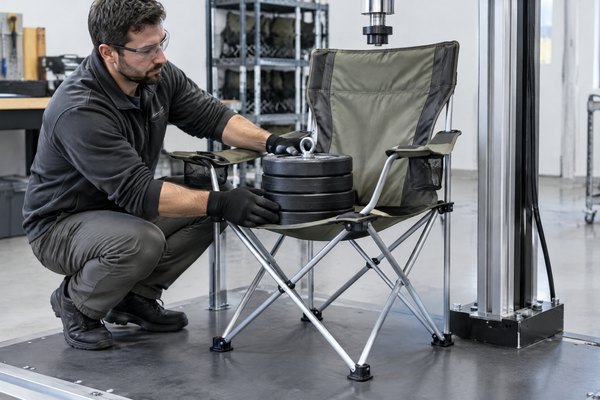
ISO 7173:2023 specifies strength and durability methods for seating structures without regard to end use, material, or construction method; it does not assess upholstery-material durability or ageing and degradation. [1] Use structural testing within a broader plan that separately verifies fabric, corrosion resistance, folding safety, labeling, and packaging.
This guide is a technical procurement framework rather than legal advice. Product obligations, test methods, labels, and import requirements depend on the chair’s design, customer, destination, and sales channel. Confirm the final requirements with qualified compliance, testing, and customs professionals before release.
Module 2 — Quick Answer: the pre-order quality checklist
Before issuing a purchase order, require the supplier to identify the exact chair model and revision, then check the following eight areas against an approved sample and written specification:
- Frame: tube material, outside diameter, wall thickness, bends, finish, and drainage or venting details where relevant.
- Joints: rivets, screws, welds, pivots, locking parts, clearances, and protection from sharp edges.
- Textile system: fabric construction, coating, colour standard, seam construction, webbing, buckles, and stitch pattern.
- In-use behavior: stability on the intended surface, stated user mass, load-test protocol, folding action, and entrapment or pinch risks.
- Claim control: the evidence supporting each capacity, material, weather-resistance, or performance claim used on the product or package.
- Pack-out: retail carton design, inner protection, carton marks, barcode placement, compression performance, and container loading plan.
- Inspection: a pre-production approval, in-process checks, final random inspection plan, defect definitions, and a controlled rework process.
- Documentation: commercial, packing, origin, safety, test, labeling, and shipping records that match the goods actually shipped.
A capacity number printed on a carton is not a substitute for a defined load case and a current report. Likewise, an attractive factory sample is not proof that production tubes, fasteners, fabric lots, or packaging will match it. The buyer’s objective is traceable agreement: specification, sample, test evidence, inspection record, and shipment documents should identify the same model, revision, materials, and order quantity.
Module 3 — Set the buyer context and risk threshold before comparing quotes
Start with the intended user and product architecture. A beach chair, quad-fold chair, director-style chair, and recliner distribute load differently. Decide whether it is for occasional recreation, rental fleets, festival use, heavier users, or a premium retail line. Those choices affect tests, packaging, spare-parts planning, and cosmetic tolerances.
Define the critical-to-quality (CTQ) characteristics: features whose failure affects safety, function, statutory information, or a core consumer promise. Examples include the locking geometry of a folding hinge, a rivet that carries the seat load, a webbing loop that supports the seat, a leg-foot insert that can detach, or an origin mark required for import. Separate CTQs from ordinary cosmetic attributes such as a minor non-visible paint speck. This prevents factories and inspectors from treating every discrepancy as equally important.
Create a risk register before requesting prices. List failure mode, customer consequence, prevention control, verification method, and release evidence. In the EU, the General Product Safety Regulation addresses intended and reasonably foreseeable use, product characteristics, presentation, and user groups; manufacturers must perform an internal risk analysis and prepare technical documentation before placing products on the market. [2] Apply this discipline elsewhere: document abrupt sitting, one-arm carrying, uneven ground, and fingers near a folding joint.
| Buying question | Why it changes the specification | Evidence to request before order release |
|---|---|---|
| Who will use the chair and on what surface? | It defines relevant stability, comfort, and loading cases. | Intended-use statement and risk review. |
| Which exact configuration is being bought? | A fabric, frame, or hinge change can invalidate an earlier result. | Revision-controlled drawing, bill of materials, and golden sample. |
| What will the consumer see and claim? | Capacity, care, material, and origin statements must be supportable. | Approved artwork, claim substantiation, and labeling proof. |
| Where will it be sold? | Safety, chemical, language, traceability, and import requirements can differ. | Destination-market checklist reviewed by the buyer’s specialists. |
| What is the commercial tolerance for defects? | It determines inspection sampling, defect grading, and rework rules. | Signed defect classification and inspection plan. |
Do not use “heavy-duty frame” as an acceptance criterion. Replace it with controlled attributes: tube alloy or steel grade where applicable, outside diameter, wall thickness, surface preparation, coating type, and permitted tolerance. Define “black” textile through a signed color standard and viewing conditions, not an email description.
Module 4 — Check the frame and joints as one load path
Frame material, geometry, and finish
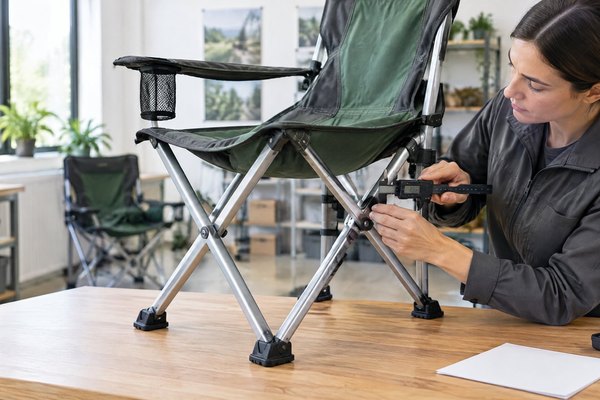
Ask for a dimensioned frame drawing and material declaration for each load-bearing tube. Verify outside diameter, wall thickness, cross-section, bend radii, end closures, leg geometry, and reinforcing sleeves. Measure several production pieces at defined locations and confirm that a finish has not been mistaken for base-metal thickness. Treat a material substitution as an engineering change requiring written approval and, where performance may change, renewed verification.
Examine bends and tube ends. Flattening, wrinkling, cracking, or a sharp lip can reduce strength or abrade textile. Open tubes may admit water or debris. Foot inserts should fit securely, sit squarely, and remain attached under agreed checks. For outdoor chairs, define the appearance standard after appropriate humidity, salt, or corrosion testing; do not call a chair corrosion-proof without a defined basis.
Specify the finish, color, gloss range if important, coverage around joints and welds, and allowed blemishes. Check hidden surfaces and sharp frame intersections; a flawless front view can conceal poorly covered locations exposed as the chair folds.
Welds, pivots, rivets, and locks
A folding chair’s joint is the interface that transfers load or controls motion. Map each joint: welded cross member, riveted scissor point, bolt-and-nut joint, plastic hinge, locking bracket, fabric sleeve anchor, and foot connection. The supplier should identify the fastener type, size, material, head style, washer arrangement, locking method, and installation equipment for each critical joint.
Inspect weld continuity, penetration appearance where assessable, spatter, undercut, sharp edges, distortion, and coating coverage. A weld should not be judged only by paint appearance. For pivoting joints, check that the rivet or fastener is neither loose enough to rattle nor over-compressed enough to bind. Repeated folding can reveal burrs, metal-on-metal abrasion, cracked plastic, or migration of a washer that a static check misses.
Use a golden sample with measurable records. It is the signed, protected master sample for approved construction and appearance; it does not authorize undocumented substitutions. Require a first-article record for a new tool, hinge, material, or assembly sequence, showing dimensions, component identities, critical-joint images, functional findings, and disposition.
ISO 7173:2023 is a useful reference point for structural strength and durability methods across seating types, but it is not a universal approval stamp. [1] Ask the laboratory or supplier to state the exact test method, test configuration, loading cycles or force, conditioning, observations, and pass/fail criteria. Then make sure the tested sample genuinely represents the ordered chair, including frame dimensions, joints, fabric support arrangement, and any accessory that affects the load path.
Module 5 — Verify fabric, webbing, stitching, and chemical-control evidence
The seat fabric is structural when it suspends the user. Specify fiber content, construction, nominal mass per unit area, coating or backing, color, print method, and care. Confirm attachment: full sleeve, stitched pocket, webbing loop, bolt-on panel, or combination. Failure can occur through torn fabric, an opened seam, a pulled eyelet, a slipping webbing loop, or a sharp frame edge.
Request a seam map for each load-bearing stitch line. Define thread material, stitch type, seam allowance, bartacks or reinforcement, and acceptable skipped or broken stitches. Webbing is the narrow woven strap used to suspend or reinforce a chair. For each structural piece, identify width, construction, fiber, nominal thickness, attachment, and test direction. An isolated-strap tensile result does not prove the sewn assembly will perform; assess seam, buckle, and anchor geometry too.
Use lot traceability for fabric and webbing: supplier lot, color lot, incoming-inspection result, and chair production date or code. This allows quarantine of an affected run. For branded colors, approve a retained fabric swatch with viewing conditions and tolerances. Compare printed artwork on a folded chair as well as a flat panel.
For European distribution, include a market-specific chemical review. REACH is the EU’s primary chemicals framework and assigns industry responsibility for chemical-risk management and safety information; it can restrict substances where necessary. [3] Ask which components were evaluated, which restrictions or customer list applied, which laboratory and methods were used, and whether results cover the final article. A generic fabric declaration may not cover coatings, inks, foam, plastic feet, adhesive, or metal treatments.
Buyer action: Build a component matrix before bulk production. For each fabric, webbing, thread, coating, plastic part, and metal part, record the approved specification, supplier, lot-control method, change-notification requirement, and evidence required for release.
Need a specification review before you commit tooling or bulk materials? Send the chair’s drawings, target market, expected use, and current acceptance criteria through CampLume’s site RFQ form or email info@camplume.com. Ask for a project-specific confirmation of which construction details, samples, tests, packaging checks, and documentation can be quoted and verified; do not rely on generic chair claims.
Module 6 — Validate stability, claimed capacity, and folding action
Stability is a system behavior
Stability is resistance to unintended tipping, sliding, or collapse during intended and reasonably foreseeable use. Review base footprint, seat height, center of mass, leg spread, cross-brace geometry, feet, and ground condition. A chair stable on concrete can behave differently on grass, sand, decking gaps, or a slope.
Put stability checks in the test plan: surface, configuration, load position, force direction, leaning assumption, and failure definition. Test both sides where asymmetry is possible. Confirm whether recliner, cup-holder, side-table, or detachable accessories create an asymmetric load case. Do not claim all-terrain suitability without relevant evaluation.
Treat the capacity label as a controlled engineering claim
A claimed capacity is the stated maximum user mass or load. It should match the ordered configuration, intended use, instructions, label, carton, listing, and evidence file. Ask which load distribution, dynamic action, conditioning, sample count, and safety factor where relevant established it; clarify whether it is a test condition, recommended user limit, or both.
Do not convert a laboratory result into a marketing promise without review. Failure consequences change with surface, posture, folding state, textile condition, and wear. If capacity is central to the proposition, evaluate the final branded configuration, retain the report, and control changes to load-bearing elements. GPSR safety assessment recognizes physical and mechanical characteristics, presentation, and foreseeable use. [2]
Folding action and finger safety
Cycle the chair through opening and closing. Check set-up force, symmetry, lock engagement, fabric snagging, pinch or shear zones, snap-back, hand clearance, and safe folded carrying. Record the number and type of cycles rather than using “durable” without a threshold.
Provide clear instructions and warnings where the risk assessment indicates they are needed. Review their accuracy on the production chair: a diagram that shows a lock absent from the delivered revision is a control failure. Instructions should also cover seat positioning, secure locking where applicable, intended capacity, supervision limitations where relevant, cleaning or storage precautions, and a prohibition on standing or other uses that the risk assessment identifies as unsafe.
Module 7 — Turn the design into a supplier test plan
A test plan should state what to test, when, on which sample, by which method, and which result permits release. It should distinguish type testing—a design or configuration evaluation—from production testing, which verifies repeated output remains within the approved design. Neither replaces the other.
| Control stage | What a buyer should verify | Useful evidence | Example release question |
|---|---|---|---|
| Design and sample approval | Dimensions, load path, fabric attachment, locks, and user instructions. | Signed drawing, bill of materials, golden sample, risk review. | Does the sample represent every load-bearing component proposed for bulk production? |
| Pre-production | Raw-material identity and first assembled units. | First-article inspection, material declarations, color and component approvals. | Are tube, textile, webbing, and fastener lots traceable to approved sources? |
| In-process | Repeatability at critical assembly points. | Check sheets for rivet setting, joint movement, seam construction, and dimensions. | Are critical measurements recorded at defined intervals and reacted to when out of tolerance? |
| Finished goods | Appearance, function, stability, folding, labeling, and pack-out. | Functional test record, final inspection report, retained samples. | Does each inspected unit open, lock where applicable, fold, and sit as specified? |
| Change control | Any revised component, process, or source. | Change notice, comparison, engineering approval, retest decision. | Has the buyer approved the change before material is consumed? |
For independent test reports, verify the report number, laboratory identity, test date, sample description, chair photographs, method edition, conditions, results, and conclusion. Compare the sample description against the purchase order and approved bill of materials. A report for a similar chair is not automatically evidence for the ordered chair. Ask whether any test was completed before or after a design change, and whether all load-bearing features were represented.
Use a clear defect taxonomy in the quality agreement. A critical defect is one that can create an unacceptable safety or regulatory risk. A major defect materially reduces function, durability, appearance, or saleability. A minor defect does not materially reduce use or value within the agreed standard. The specific classification must be agreed per product; for example, a sharp burr near the seat fabric may be critical or major depending on its location and risk, while a small hidden coating blemish may be minor. Specify how the supplier segregates defects, investigates root cause, and verifies corrective action.
Module 8 — Inspect finished chairs, packaging, and container readiness
Pre-shipment inspection is useful when anchored to the purchase order and golden sample. Check model, color, construction, dimensions, approved artwork, function, accessory count, labels, carton marks, and packaging. Decide sampling standard or size, inspection level, acceptable quality limit if used, defect classifications, reinspection rule, and whether a critical defect fails the lot before booking inspection.
Include a functional check: remove the chair from its retail package, unfold it as a consumer would, observe locks and fabric alignment, operate it to the agreed protocol, then fold and repack it. Inspect chair and pack-out afterwards. Cosmetic approval can miss snagging, binding, uneven standing, or carton damage on repacking.
Packaging is part of product quality. Define retail carton style, material, inner protection, instruction placement, weight marks, barcode scan requirement, and master-carton pattern. Use selected compression, drop, vibration, or transit simulation appropriate to the route and retailer. If testing reveals fabric tears or rubbed coating, revise separators, bagging, folding position, or carton dimensions rather than merely tightening the carton.
| Pack-out check | Common failure it helps prevent | Evidence or practical check |
|---|---|---|
| Correct folded dimensions and restraint | Fabric abrasion, hinge damage, or carton bulge. | Packed-unit measurement and opening review. |
| Internal separators and orientation | Metal-to-metal rubbing and crushed accessories. | Carton cut-open photos and shake/handling check. |
| Carton strength and sealing | Crushed retail boxes or open cartons in distribution. | Approved carton specification and selected transport tests. |
| Shipping marks and labels | Warehouse receiving, barcode, or destination errors. | Artwork proof matched to carton sample and order data. |
| Pallet pattern and stretch wrap, if used | Overhang, unstable stacks, and moisture exposure. | Pallet photograph, dimensions, and load plan. |
Ask for a container-loading plan showing carton count, orientation, palletization choice if applicable, void management, load distribution, and securing approach. The IMO/ILO/UNECE CTU Code identifies inadequate securing, overloading, and incorrect content declaration as causes of transport incidents and provides non-mandatory guidance for packing containers across sea and land modes. [4] For a chair shipment, this means the factory and forwarder should agree who checks carton condition, distributes the load, records seals where relevant, and photographs the completed load. The buyer should receive that evidence before or alongside shipping release.
Module 9 — Release the shipment only when documents reconcile
A shipment dossier is a reconciliation package. The commercial invoice, packing list, transport document, carton marks, labels, inspection report, and test or material documents should agree on seller and buyer, product, model, quantity, origin, weights where stated, package count, and shipment reference. Resolve discrepancies before final payment or cargo release where terms allow.
For US imports, country-of-origin marking requires careful product-level and container review. CBP states that every foreign-origin article entering the United States must be legibly marked with the English name of its country of origin unless an exception applies, and explains that marking must be conspicuous and sufficiently permanent for the product. [5] A buyer should decide, with appropriate customs guidance, whether the chair itself, its retail container, or both need specific marks for the planned import and sales route. Do not use “EU” as an origin country; CBP notes it is not an acceptable abbreviation because it does not identify the individual country of origin. [5]
For ocean shipments into the United States, CBP explains that Importer Security Filing requirements apply to cargo arriving by vessel and that the importer of record remains ultimately responsible for correct entry documentation even when a broker is used. [6] Confirm document cut-off dates with the forwarder early. A late or inconsistent manufacturer, seller, container-stuffing location, or commodity description can create avoidable delays. For EU imports, confirm the applicable customs and product-information requirements with the importer and their customs adviser before dispatch.
| Dossier item | What to reconcile | Buyer release question |
|---|---|---|
| Purchase order and specification | Model revision, approved artwork, quantities, terms, and inspection rule. | Are the goods built to the signed revision rather than an earlier sample? |
| Commercial invoice and packing list | Product description, unit count, package count, values, weights, and origin. | Do totals and package identifiers match the physical shipment? |
| Transport document | Shipper, consignee, port or airport, package count, and shipment reference. | Does it match the agreed delivery and booking details? |
| Inspection and test records | Sample identity, date, results, defects, corrective actions, and approval. | Is the production lot released with no unresolved critical or major issue? |
| Label, carton, and origin proofs | Final artwork, language, safety information, barcodes, and origin presentation. | Are the photos from the actual production run, not a sample run? |
| Materials and traceability file | Component sources, lots, declarations, and change approvals. | Can the buyer identify affected units if a component issue is discovered? |
Keep controlled final documents and representative production and packaging samples where practical. In the EU, manufacturers must keep technical documentation available to market-surveillance authorities for 10 years after the product is placed on the market. [2] Set the brand’s retention period, owner, version-control process, and retrieval method before launch.
Module 10 — Frequently Asked Questions
1. Is an approved sample enough to order wholesale camping chairs?
No. An approved sample is useful only when it is linked to a revision-controlled specification, bill of materials, color standard, test plan, inspection criteria, and approved packaging. Bulk output must be verified against those controls.
2. What should a capacity claim be based on?
It should be based on a defined, documented evaluation of the final chair configuration and intended use. Confirm the method, loading conditions, sample identity, observations, and the connection between the result and the printed claim.
3. Should fabric testing be separate from frame testing?
Usually, yes. Structural chair testing does not assess upholstery-material durability or ageing, according to the scope of ISO 7173:2023. [1] Evaluate fabric, seams, webbing, and coatings with methods that fit the construction and intended use.
4. What are the highest-risk areas on a folding camping chair?
Common priorities are scissor pivots, locks, rivets, welds, seat-webbing anchors, seams at load transitions, foot inserts, and finger-accessible folding gaps. The actual risk ranking should follow the design-specific load path and use case.
5. When should a third-party inspection occur?
Plan it before the purchase order. Finished-goods inspection is often scheduled when enough goods are complete and packed to represent the lot, but the timing, sample plan, functional checks, and release authority should be agreed in writing.
6. Which shipment documents should match the physical chairs?
At minimum, reconcile the purchase order, packing list, commercial invoice, transport document, carton marks, labeling proofs, inspection release, and relevant test or material records. Country-of-origin information needs particular care for US imports. [5]
Module 11 — Conclusion: buy the controlled configuration, not the generic chair
The strongest procurement decision is not the lowest quoted unit price or the most impressive showroom sample. It is a chair configuration that is defined as a load path, verified as a folding product, controlled as a textile-and-metal assembly, protected in distribution, and supported by reconcilable records. Frame dimensions, joint design, seams, webbing anchors, stability behavior, capacity evidence, folding action, cartons, inspections, and documents should reinforce one another.
Use this wholesale camping chairs quality checklist as the agenda for supplier qualification and purchase-order release. Ask direct questions, keep revisions controlled, and treat material or process changes as decisions requiring approval rather than normal production variation. That approach gives a US or European brand a clearer basis for comparing OEM/ODM quotations and investigating issues if they occur.
For a project-specific chair specification or RFQ review, email info@camplume.com or submit the chair details through CampLume’s site RFQ form. Include your target market, intended use, drawings or reference sample, claim requirements, packaging route, and the evidence you need before shipment.
Related CampLume resources
Use these related pages to turn What Should Buyers Check Before Ordering Wholesale Camping Chairs? into a more complete, supplier-ready decision:
- Read: Camping Chair Load Testing: What Wholesale Buyers Should Specify and Inspect for the next connected sourcing decision.
- Explore CampLume camp furniture options to compare a suitable CampLume product platform.
- See the CampLume buyer FAQ for concise guidance on samples, MOQ, quality control, compliance and shipment preparation.
Project discussion
Need to apply this guide to a product programme?
Send your product category, target market, estimated quantity, current specification and packaging stage. CampLume will continue the discussion by email.
Email info@camplume.comSources and further reading
References
- 1ISO 7173:2023 Furniture — Chairs and stools — Determination of strength and durability
- 2Regulation (EU) 2023/988 on general product safety
- 3REACH Regulation
- 4IMO/ILO/UNECE Code of Practice for Packing of Cargo Transport Units (CTU Code)
- 5Marking of Country of Origin on U.S. Imports
- 6Tips for New Importers and Exporters