A useful sourcing decision starts with a written requirement that can be challenged, sampled, inspected, and approved.
Direct Answer
For most private-label and OEM buyers the correct choice between an aluminum vs steel camping chair comes down to a trade-off between weight and corrosion resistance (favoring aluminum) versus cost, rigidity and impact resistance at joints (favoring steel). Aluminum wins on packability and rust resistance for festival camping chair models and mountain-use director-style chairs with side tables, while steel often wins where lower unit cost or heavy-duty load ratings are prioritized. The final decision should be driven by the target use case, price-position, destination market requirements, and the product development constraints you set with your manufacturer.
Key Performance Differences: Aluminum vs Steel Camping Chair
When evaluating frame materials, buyers need objective comparisons tied to real product decisions.
Weight and Portability
- Aluminum: Typical aluminum alloys used in camping furniture (6000- or 7000-series or tuned extrusions) reduce chair weight 20–50% versus similar steel designs, improving carry comfort and packing volume. This is often decisive for a festival camping chair or backpack adjunct.
- Steel: Heavier per linear meter but allows thinner sections for similar stiffness in some designs; heavier overall product weight affects freight cost and perceived value.
Strength, Stiffness and Fatigue
- Steel offers higher elastic modulus and can deliver a stiffer feeling seat for equivalent tube diameters. It also tolerates higher impact loads at localized joints.
- Aluminum requires larger cross-sections or optimized profiles to match stiffness, and designers must address fatigue life at welds and clamps.
Corrosion and Surface Finish
- Aluminum is naturally corrosion-resistant but may require anodizing or powder coating for abrasion resistance and color matching.
- Steel needs galvanizing, zinc plating, or powder coating. In wet or coastal markets, steel requires more aggressive corrosion protection and maintenance instructions.
Repairability and Life Cycle
- Steel frames are easier to field-repair (weld or bend back in many cases); aluminum repair is more complex and often uneconomic for small consumer chairs.
Camping Chair Frame Material Comparison: Technical Variables to Specify
When preparing a specification, include these frame-level details rather than only saying “aluminum” or “steel.” This reduces iterations during camping chair product development.
Material Grade and Form
- Specify alloy (e.g., 6061-T6, 6063 for aluminum; cold-rolled low-carbon or DOM steel tubing) and whether the tube is welded, extruded, or swaged.
Tube Geometry and Wall Thickness
- Provide outer diameter, wall thickness, and any crimp/swage/joint dimensions so load-bearing calculations and sample tooling can be exact.
Surface Treatment and Coating System
- State the coating system and thickness (e.g., anodize 15–20 microns + dyed, or powder coat 60–80 microns over phosphate pre-treatment).
Jointing and Fasteners
- Define whether joints are welded, riveted, pinned, or use inserted connectors. For aluminum, mechanical joints or gusseted rivets are common choices to avoid brittle weld zones.
Aluminum vs Steel Camping Table: When To Choose Which
Buyers supplying bundled campsite setups often source matching materials for chair and table to simplify production and packing.
- If your product line emphasizes low weight and portability (picnic sets, festival camping chair + table combos), aluminum table frames typically reduce carry weight and shipping cost.
- If the table will be used as a stable cooking or gear platform (hot cookware, heavy loads), steel gives higher localized strength and simpler, lower-cost fixtures.
Remember: tabletop surface choice (aluminum plate, laminate, MDF with coating) interacts with frame choice — heavier tabletop negates frame weight savings.
Product Types and Use Cases: Director Camping Chair With Side Table to Festival Camping Chair
Not all chair applications require the same frame decisions.
-
Director Camping Chair With Side Table: These are often marketed as premium lounge chairs. Buyers should expect larger frames, wood or reinforced armrests and integrated side surfaces. Aluminum models appeal where user wants portability without bulk; steel variants favor perceived durability and lower price.
-
Festival Camping Chair: Prioritize light weight, quick-fold geometry, and low-cost finishes. Aluminum alloys with screw-pin joints or pop-lock systems reduce weight and speed assembly at the cost of higher component tolerances.
-
Heavy-Duty / Utility Chairs: Steel frames with thicker walls and reinforced welds are common when load rating or rental/fleet durability is critical.
Camping Chair OEM vs Private Label: How That Changes Your Workflow
The choice between camping chair OEM vs private label affects timelines, IP, tooling, and cost.
-
OEM (original equipment manufacturing): The factory provides an existing design or minor variants under your brand. Lead time is shorter, tooling and NPI cost are lower, and minimum orders can be smaller. Confirm ownership of tooling and future price terms in writing.
-
Private Label / ODM: You’ll typically engage in more product development, custom cosmetics, or unique features (for example, a director camping chair with side table tailored to your brand). There are higher upfront costs (molds, injection tooling for plastic parts, or custom bending dies) but stronger product differentiation.
Action points for buyers: request an engineering change control process in the contract, confirm who holds IP for custom drawings, and define expected sample rounds and approval gates.
Practical Product Development Workflow (Camping Chair Product Development)
Below is a typical workflow CampLume follows with B2B customers; adapt each step to the exact product and destination market.
- Specification and Design Freeze
- Buyer sends a specification sheet: frame material (grade, OD, wall), fabric spec (denier, coating), folding mechanism, target retail price, and destination market (EU, UK, US, etc.).
- Quotation and DFM
- Supplier provides costed BOM, target lead time, and design-for-manufacturing recommendations (e.g., switching to a standard tube size to reduce tooling cost).
- Proto / Pre-Production Sample
- First physical samples for fit, feel, and load testing. Expect 1–3 rounds for new models.
- Sample Review and Testing
- Conduct buyer inspections and bench tests: seat load, ARM/hinge cycle testing, corrosion salt-spray for steel variants, and pack/transport testing.
- Factory Testing or Inspection
- Agree on factory acceptance tests and third-party inspections if required. Define sampling plans and failure criteria.
- Packaging Specification
- Decide inner/outer pack, protective materials, and palletization. For festival camping chair SKUs, compact folded dimensions and ICC-optimized packing are critical to freight cost.
- Pre-Shipment Inspection and Shipping Preparation
- Final inspection, consolidate documents (commercial invoice, packing list), and confirm containerization plan.
- Documentation and Compliance
- Provide test reports and a product technical file; confirm requirements for batteries or flame-retardant fabrics if applicable and check destination market rules.
- Change Control
- Any post-launch changes to material, supplier substitutes, or manufacturing method should follow a written change-control process with sample sign-off.
Factory Testing, Inspection and Quality Controls
Practical inspection and test steps buyers should include in a purchase order or development contract:
- Dimensional Inspection: Verify tube OD, wall thickness, and critical joint locations on every pre-production run.
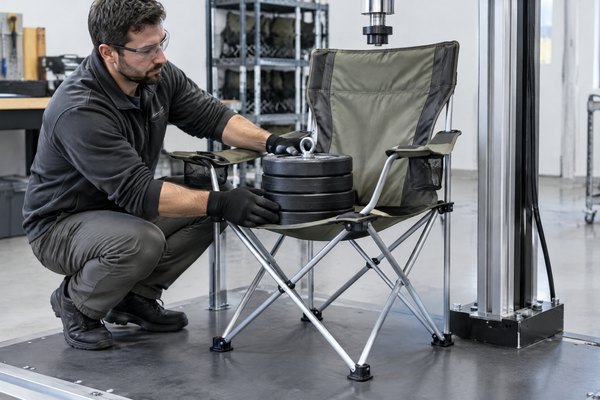
- Mechanical Testing: Seat load testing to 110–150% of rated capacity, cyclic hinge tests to a defined number of cycles (e.g., 5,000 cycles) for camping chair product development validation.
- Surface Adhesion & Corrosion: Salt spray or cyclic humidity for steel + coating systems; adhesion and abrasion tests for anodized aluminum.
- Functional Tests: Folding/unfolding tolerances, locking mechanism engagement, and side-table stability for director camping chair with side table variants.
- Packaging & Transit Simulation: Drop tests and vibration simulation for finished cartons.
Ask your factory for a written AQL (Acceptable Quality Level) and pre-shipment inspection checklist. For export to specific markets confirm the applicable requirement rather than assuming a universal standard.
Pricing, MOQ and Lead Time Considerations
- Material costs: Steel raw coil is generally cheaper than aluminum billet per kg, but aluminum’s lower weight can reduce freight and packing costs.
- MOQ: Off-the-shelf designs have lower MOQ. Custom frames, new tooling, or anodized finishes usually increase MOQ and unit cost until amortized.
- Lead Time: Allow 6–12 weeks for initial prototypes and 12–20 weeks for a first bulk order on custom designs, but confirm with your factory.
Buyer Decision Table (Quick Comparison)
| Decision Factor | Aluminum Recommendation | Steel Recommendation | When to Choose Neither Immediately |
|---|---|---|---|
| Weight / Portability | Best — choose aluminum alloys with wall-thickness optimization | Heavier | Use composite frames if ultra-light is required |
| Corrosion Resistance | Best for coastal/festival use (anodize or coated) | Needs robust coating; higher maintenance | Consider stainless options for extreme environments |
| Unit Cost | Higher material cost but lower shipping | Lower material cost, cheaper connectors | If price and durability both critical, redesign geometry |
| Stiffness / Perceived Stability | Requires larger section or reinforcement | Offers higher stiffness at similar diameter | Use hybrid design (steel legs + aluminum back) |
| Repairability | Low (seldom field repaired) | High (weldable) | Choose based on rental vs consumer lifetime |
Mid-Article CTA — Send a Clear Brief
To evaluate your SKU and get a tailored quotation, email procurement@camplume.com with a short brief including:
- Target frame material (aluminum or steel) and any specific alloy
- Intended product type (e.g., festival camping chair, director camping chair with side table)
- Target retail price and target MOQ
- Destination market(s) and any certification needs
- Desired lead time and sample requirements CampLume will respond with recommended DFM changes, expected costs, and a sample schedule. Exact recommendations depend on the product details and destination market.
Packaging, Shipping Preparation and Documentation
- Packaging: For lightweight aluminum chairs, buyers often choose compact folding and bulk-carton packaging with protective corner guards. For steel chairs, consider inner plastic film to prevent coating abrasion.
- Shipping Prep: Request a confirmed CBM and palletization diagram. For consolidated shipments, specify stacking orientation to prevent frame distortion.
- Documentation: Ensure the factory provides an itemized packing list, commercial invoice, and any required test certificates. For EU or UK markets, confirm labeling, CE marking requirements (where applicable), and textile care labels.
Common Manufacturing & Change-Control Issues Buyers Face
- Hidden Cost of Surface Finish Changes: Switching from standard powder coat to a specialty textured paint may change curing parameters and require paint screening trials.
- Connector Compatibility: Small tolerances at hinge pins cause creak or early wear; specify tolerances and material pairing (bushings, washers).
- Late Specification Changes: Changes after tooling release trigger rework and potential MOQ resets. Always implement an engineering change control with sign-off gates.
FAQ
Q: Which is better for a lightweight festival camping chair, aluminum or steel? A: Aluminum is generally better for festival camping chair models because it reduces carry weight and resists corrosion. Verify alloy and wall thickness with your supplier to reach the desired pack weight and cost target.
Q: Can a director camping chair with side table be made in aluminum without losing stability? A: Yes — but the frame geometry and connector system must be optimized. Expect larger tube diameters or cross-bracing and insist on prototype load and wobble tests during sample review.
Q: What should I include in a sample request to avoid back-and-forth? A: Include material grade, tube OD/wall, fabric spec, finish, target retail price, required load rating, destination market, and whether you want assembly or packed-flat samples.
Q: How do MOQ and tooling costs differ between camping chair OEM vs private label projects? A: OEMs using standard designs often have lower MOQ and tooling cost. Private-label or ODM projects with custom features require higher upfront tooling and typically higher MOQ until tooling is amortized.
Q: How do I manage change control after production starts? A: Require all proposed changes be submitted in writing with impact analysis on cost, lead time, and quality. Require a pre-production sample for any change that affects form, fit, or function.
Q: Are aluminum frames better for corrosion performance than steel? A: In many environments yes, but aluminum still benefits from protective coatings (anodize or clear coat) for abrasion resistance. For aggressive chemical or marine exposure, discuss specific alloy and coating strategies with your supplier.
Conclusion and Next Steps
Choosing between aluminum vs steel camping chair frames is a decision that should be made in the context of the product’s intended use, price point, and destination market. For lightweight festival camping chair lines and portable director-style chairs with side tables, aluminum often provides the best user experience but requires attention to stiffness, joint design, and fatigue. Steel is a pragmatic choice for lower-cost or heavy-duty applications but needs robust corrosion protection and different logistics for weight and shipping.
If you have a specification or an initial brief, email procurement@camplume.com with the details listed in the Mid-Article CTA. CampLume can provide a DFM review, cost estimate, and sample timeline tailored to your chosen frame material and target market. Exact recommendations and compliance guidance will depend on the specific product and destination market requirements specified in your brief.
Conclusion: Turn the Brief Into a Controlled Buying Decision
The practical aim of a aluminum vs steel camping chair programme is not to collect broad assurances; it is to connect the approved product configuration, sample, evidence, packaging, inspection and shipment release to the same buyer brief. That record helps the product, sourcing, quality and logistics teams resolve assumptions before they become a production or delivery problem.
Final CTA: Email info@camplume.com with the product category, target market, estimated quantity, current specification and packaging stage. Request a response that identifies assumptions, open evidence and the next approval gate.
Related CampLume resources
-
Read: What Should Buyers Check Before Ordering Wholesale Camping Chairs? for a connected sourcing decision.
-
Explore CampLume furniture options to compare a relevant product platform.
-
See the CampLume buyer FAQ for concise guidance on samples, MOQ, quality control, compliance and shipment preparation.
-
Discuss an OEM or ODM brief with CampLume when product configuration, custom branding or packaging needs to be scoped.
Project discussion
Need to apply this guide to a product programme?
Send your product category, target market, estimated quantity, current specification and packaging stage. CampLume will continue the discussion by email.
Email info@camplume.comSources and further reading