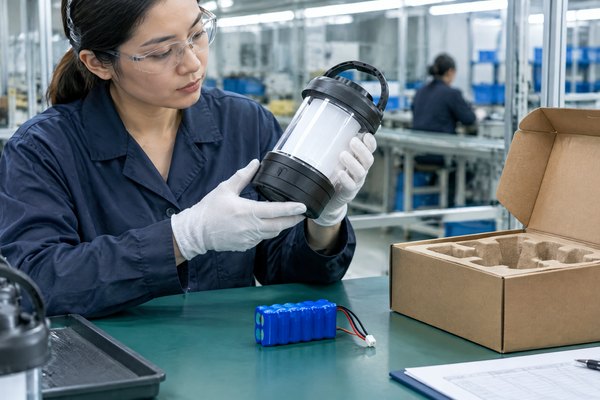
A useful sourcing decision starts with a written requirement that can be challenged, sampled, inspected, and approved.
Direct Answer Intro
If your priority is getting a private-label lantern to market with correct labeling, compliant packaging and reliable field performance, this guide explains the practical steps you need. It covers packaging and barcode layout, how to size the camping light master carton dimensions for transport, what to include in the camping light multilingual manual, inspection checkpoints for a rechargeable lantern pre-shipment inspection, battery trade-offs (18650 vs lithium polymer camping lantern battery), and special considerations for disaster relief lighting bulk orders or 12V accessories.
Why Barcode Packaging and Packaging Specs Matter to Buyers
A well-planned camping lantern barcode packaging solution is not just about sticking a barcode on a box. For importers and retailers it affects scanning accuracy at the DC, shelf-ready packaging, compliance with retailer requirements, and protection during shipping. Key buyer impacts:
- Warehouse efficiency: correct barcode placement and label size reduce decode failures at receiving.
- Retail compliance: UPC / EAN placement, quiet zones, and secondary packaging matter for shelf-ready displays.
- Logistics cost and damage risk: poor carton sizing increases volumetric freight and product damage.
As an OEM/ODM camping gear manufacturer, CampLume recommends packaging plans early in the specification phase so tooling, label frames and dielines are aligned with production.
Product Specification Checklist (What You Must Decide Up Front)
Before requesting samples, specify these items in your brief. The clearer your spec, the fewer change orders during development.
- Intended markets and GTIN type (UPC, EAN). This determines barcode symbology and human-readable text.
- Product configuration: battery type and capacity, whether a 12V camping light accessory or USB-only charging.
- Primary materials and IP rating expectations for outdoor use.
- Expected order volume and any disaster relief lighting bulk needs that affect lead time.
- Required documentation: test reports, user manual languages, safety labels.
Include a sample bill of materials in your initial spec so the factory can estimate weight, dimensions and master carton requirements.
Designing Packaging and Master Cartons
A good packaging plan balances protection, unit cost and retailer requirements.
Barcode Label Placement and Artwork
- Place the barcode on a flat, non-gloss panel that is the first visible surface during DC receiving.
- Reserve quiet zone margins and include human-readable GTIN and item description near the barcode.
- If you supply retail-ready display packs, provide dielines for label placement so the factory can pre-print UPC/EAN boxes.
Choosing Camping Light Master Carton Dimensions
Provide the factory with pack type (retail box, polybag + hang tag, bulk inner pack) and expected palletization. For buyer planning, list the exact camping light master carton dimensions you require (L×W×H in cm or inches) and maximum units per carton. That lets procurement evaluate freight density and choose the right carton strength rating (ECT rating).
Palletization and Transit Protection
Specify stacking pattern and whether cartons should be stretch-wrapped with corner boards. For disaster relief lighting bulk shipments, buyers often specify double-boxing or extra void-fill to reduce return rates after long-haul sea transport.
Documentation: Manuals, Labels and Compliance
Clear documentation speeds customs clearance and reduces after-sale support.
What To Include In The Camping Light Multilingual Manual
- Safety warnings, battery handling and disposal instructions, and troubleshooting in the markets’ primary languages.
- Charging instructions and runtime examples for each power mode.
- Short parts list and serviceable components (bulb, diffuser, charging port) and how to obtain replacement parts.
If a buyer needs a camping light multilingual manual, provide the target languages and any retail or regulatory phrasing required (CE/UKCA disclaimers, WEEE instructions where applicable). The factory can produce a draft manual with translated text for buyer review; if you require certified translations or legal wording, add that to your spec.
Labeling: Regulatory and Retail
Labels may include safety icons, battery warnings, and country-of-origin statements. Confirm the applicable requirement for each destination market rather than assuming a uniform rule.
Sampling, Factory Testing and Pre-Shipment Inspection Workflow
A disciplined sample and inspection workflow reduces surprises at receiving.
Sample Review: Functional and Packaging Samples
Request two sample stages:
- Engineering sample — to confirm fit, basic function, and battery choice.
- Production sample — after tooling and packaging are finalized, to verify final artwork, carton print, and packing method.
Evaluate samples for light output, beam uniformity, charging behavior with the intended charger, and mechanical fit of accessories such as a 12V camping light accessory socket or adapter.
Factory Testing Protocols
Discuss and agree what the factory will test on each production batch. Typical tests for lanterns include: run-time verification, charge/discharge cycles (sample-based), IP ingress checks if specified, and battery protection circuit verification. For OEM/ODM buyers, request test records tied to lot numbers so you can trace issues.
Rechargeable Lantern Pre-Shipment Inspection
For a rechargeable lantern pre-shipment inspection, include these checkpoints in your AQL-based PSI checklist:
- Visuals: carton print and barcode verification, label accuracy, and multilingual manual inclusion.
- Functional: charge time vs spec, LED output and mode switching, and accessory fit (including 12V ports or adapters).
- Batteries: ensure batch labeling, correct cell type, and proper insulation for transportation.
- Packaging: verify camping light master carton dimensions, units per carton, and palletization.
Document PSI results and require corrective action plans for failures. If you plan disaster relief lighting bulk shipments, require the PSI to include extra sample drop tests and stacking tests representative of long-haul shipments.
Battery Choices: 18650 vs Lithium Polymer — Practical Trade-offs
Understanding 18650 vs lithium polymer camping lantern battery options is central to product performance, cost and transport compliance.
18650 Cells — Advantages and Constraints
Pros:
- Mature supply chain and broadly available cell models.
- Usually higher energy density per cylindrical cell weight for given chemistries and easier pack assembly.
- Often easier to replace for end-users if the design uses removable cells.
Cons:
- Cylindrical cells need robust mechanical retention to avoid movement in drop events.
- Individual cell handling requires careful labeling and protection for transport.
Lithium Polymer (LiPo) Packs — Advantages and Constraints
Pros:
- Can be manufactured into thin, space-efficient shapes that enable slimmer lanterns or integrated flat battery modules.
- Fewer internal connectors when supplied as a finished pack, reducing assembly time.
Cons:
- Typically more expensive per Wh and may have stricter supplier minimums.
- Damage during handling can be harder to detect visually.
Compliance and Handling Considerations
- Transport: Both cell types may be subject to dangerous goods regulations for air transport. For large disaster relief lighting bulk shipments you may be shipping by sea or land, but always confirm classification and labeling with your freight forwarder.
- Factory testing: ensure battery overcharge, short-circuit and thermal protection tests are recorded for the supplied battery configuration.
Shipping, Logistics and Special Cases
Disaster Relief Lighting Bulk Orders
When planning disaster relief lighting bulk consignments, consider accelerated lead times, alternate packing (non-retail bulk cartons or cartons with quick-deploy displays), and extra documentation for donor or government procurement. Buying in bulk changes many variables: you will likely need pallet-level labeling, consolidated master carton markings, and possibly consolidated certificates for customs clearance.
12V Camping Light Accessory Integration
If your design includes a 12V camping light accessory or DC input, specify pin-outs, polarity markings and recommended cable lengths. For OEM/ODM production, confirm that accessory designs are compatible with in-field replacement and that the manual describes safe use with vehicle or solar systems.
Buyer Decision Table
| Decision Point | Recommendation for Small Retail Orders | Recommendation for Disaster Relief / Bulk |
|---|---|---|
| Battery Type | 18650 packs or removable cell design for lower per-unit cost and field serviceability | Pre-assembled LiPo packs if space and weight premium; ensure larger safety stock and stricter packing |
| Packaging | Retail box with UPC, camping light multilingual manual inside; single-unit retail-ready cartons | Bulk inner packs with clear pallet labels and camping light master carton dimensions specified; extra cushioning |
| Pre-shipment Checks | Standard PSI focused on functionality and barcode verify | Expanded PSI including stacking/drop tests and full battery handling audit |
Mid-Article CTA — Send a One-Page Brief
If you want a fast, specific quote and packaging plan, email a one-page product brief to sourcing@camplume.com. Include:
- Target market(s) and GTIN type (UPC/EAN).
- Finalized product spec: battery choice (18650 or lithium polymer), whether a 12V camping light accessory is required, expected runtimes.
- Packaging requirement: retail box or bulk, and target camping light master carton dimensions (L×W×H and units/carton).
- Estimated first-order quantity and required delivery window, and whether orders will include disaster relief lighting bulk shipments.
We will reply with lead-time ranges, recommended packaging dielines and a suggested PSI checklist that you can incorporate into your purchase order.
Change Control, Lot Traceability and After-Sales
Implement a change-control process so electrical, mechanical or packaging changes are captured before production. A recommended workflow:
- Engineering Change Request (ECR) documents proposed change and reasons.
- Factory prepares an impact assessment (cost, lead time, tooling changes) and provides updated sample or photograph.
- Buyer approves via written confirmation and provides updated purchase order revision.
- Factory marks affected lots with a revision code and includes the code in the packing list.
For lot traceability, require batch numbers on both batteries and finished product packing lists. This helps when troubleshooting field issues and is especially important for large disaster relief lighting bulk deployments.
FAQ
Q: How should I specify UPC/EAN placement so it meets retailer requirements?
A: Provide retailer artwork guidelines and a dieline for the retail box. If you don’t have retailer-specific rules, specify barcode on a primary flat face, with the quiet zone intact and human-readable GTIN below. Request a print-ready mockup and a production sample for barcode scanning verification.
Q: What are reasonable camping light master carton dimensions for quoting freight?
A: Dimensions depend on your unit size and units per carton. As a guideline, calculate by multiplying retail box cubic volume by units/carton and add 3–5% void for internal protection. Provide the exact L×W×H you require to get accurate freight estimates from the factory.
Q: Can the factory produce a camping light multilingual manual for me?
A: Yes, CampLume can produce a multilingual manual draft if you provide target languages and any mandatory phrasing. If you need certified legal translation, specify that upfront—those services are usually handled by a specialist and billed separately.
Q: What should I expect in a rechargeable lantern pre-shipment inspection report?
A: The report should include visual checks of barcode packaging, pass/fail for functional tests (charging, runtime), battery verification (type and markings), and packaging checks against the specified camping light master carton dimensions. Non-conformances should come with photos and a corrective action plan.
Q: For disaster relief lighting bulk shipments, how do I reduce customs delays?
A: Provide complete documentation (commercial invoice, packing list with carton dimensions, GTINs, and origin statements). If donations are involved, coordinate with the receiving agency for any required certificates. Early communication with your freight forwarder helps identify market-specific requirements.
Q: How do I decide between 18650 vs lithium polymer camping lantern battery for my product?
A: Choose 18650 cells if you want easy replacement and broader cell availability; choose lithium polymer if you need thin, space-efficient pack shapes and are willing to pay a premium for integrated packs. Factor in transport classification, protection circuits, and how users will service the product.
Conclusion and Final CTA
For buyers preparing an order, early decisions on the camping lantern barcode packaging, exact camping light master carton dimensions, and battery chemistry will materially reduce costs and delivery risk. Confirm in your specification whether you require a camping light multilingual manual, a 12V camping light accessory, or whether you’ll be placing disaster relief lighting bulk orders—these choices change packing, testing and lead times.
To move from concept to quote, email a one-page brief with the items listed above to sourcing@camplume.com. Include any required sample approvals or timeline constraints and we will respond with a tailored packaging plan, PSI checklist and preliminary lead times.
Related CampLume resources
-
Read: What Should Buyers Check When Sourcing Rechargeable Camping Lanterns? for a connected sourcing decision.
-
Explore CampLume lighting options to compare a relevant product platform.
-
See the CampLume buyer FAQ for concise guidance on samples, MOQ, quality control, compliance and shipment preparation.
-
Discuss an OEM or ODM brief with CampLume when product configuration, custom branding or packaging needs to be scoped.
Project discussion
Need to apply this guide to a product programme?
Send your product category, target market, estimated quantity, current specification and packaging stage. CampLume will continue the discussion by email.
Email info@camplume.comSources and further reading