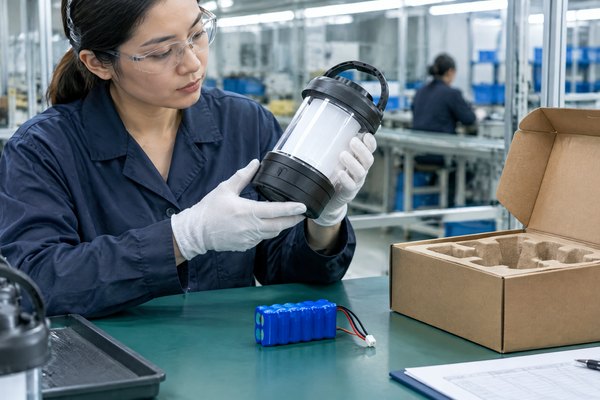
A useful sourcing decision starts with a written requirement that can be challenged, sampled, inspected, and approved.
Direct answer (quick): Choose a waterproof rechargeable camping lantern by defining target markets and use-cases, setting minimum ingress (IP) and battery-safety criteria, verifying regulatory requirements for each destination, and qualifying an OEM camping lantern manufacturer through sample review, factory testing and documented change control. The rest of this guide explains the specific tests, documentation and supplier workflows you’ll need to evaluate and qualify a supplier for commercial production.
What Buyers Typically Need From A Waterproof Rechargeable Camping Lantern
A B2B buyer chooses a waterproof rechargeable camping lantern to meet a set of functional, regulatory and commercial requirements. Typical buyer must-haves include:
- Runtime targets at specified lumen levels (e.g., 200 lm for 8+ hours). Define lumen tiers and run-times in your spec sheet.
- Battery chemistry, capacity and protection (Li-ion vs LiFePO4, overcharge/discharge protection, cell sourcing traceability).
- Ingress protection level (IPX4 is splash-resistant; IP65 or higher for dust + water jets). See the testing section below for differences.
- Durable enclosure materials, UV resistance, and impact resistance for outdoor use.
- Charging options: USB-C PD, micro-USB, wireless charging, or solar recharging.
- Weight, packability, hanging options and lighting modes (flood, spot, SOS, dimming).
- Certifications and market approvals appropriate to the destination (e.g., CE/ROHS/REACH for EU; FCC for US if device contains RF or intentional emissions).
Specify these items explicitly in a Product Specification Document (PSD) so the supplier and your quality team are aligned. Specifications are the starting point for sample review and factory testing.
Regulatory and Compliance Checklist
Regulatory needs depend on destination market and the lantern’s features. A few buyer notes:
- EU Market: For electrical safety and electromagnetic compatibility, work with a CE RoHS camping lantern supplier EU who understands the EU’s conformity assessment flow and can provide technical files. Ask about material compliance — buyers often request REACH compliant outdoor lights where chemical restrictions apply to substances in plastics, finishes and cables.
- US Market: If the lantern includes wireless features (Bluetooth, Wi‑Fi) or a transmitter, you will need FCC compliance. Even if it is only a rechargeable lamp, confirm whether the product is classified in a category that requires FCC testing (example: integrated radio module vs. none). Request documentation from the supplier for an FCC rechargeable camping lantern where applicable.
- Battery Safety: Cell-level reports and UN38.3 shipping approvals are essential for air transport. Request supplier-provided cell certificates and packaging test evidence for battery carriage.
Always ask suppliers to confirm the applicable requirement set for your product and market rather than assuming a single checklist will fit every destination.
Mechanical, Environmental And Electrical Testing You Must Specify
What to test, and how, should be in your PSD and test plan.
Water Ingress Tests
IP ratings describe protection against solids and liquids. Common buyer choices:
- IPX4 camping lantern test covers splashing water from any direction (good for sheltered campsites).
- IP65 outdoor light testing covers dust tightness plus water jets — needed when you expect heavy spray, rain or exposure to dusty environments.
Specify the exact test standard (e.g., IEC 60529 test method) and the test level you require. Ask for test reports with test conditions, dates, and sample IDs.
Mechanical Durability Tests
Include drop testing (height and surface), hinge/cap cycle tests for handles and switches, and vibration where the product will be transported frequently. Define acceptance criteria: no cracks, retained IP rating, continued operation.
Battery & Charging Tests
Battery testing must include charge/discharge cycles, over-temperature, short-circuit protection, and thermal runaway mitigation where relevant. Define pass/fail criteria: capacity retention after X cycles, no venting or fire during abuse tests.
EMC, Light Flicker And Photobiological Safety
If your lamp uses LED drivers or switching power supplies, include EMC tests appropriate to the market (again, consult the supplier). If the lamp is intended for close human use, consider photobiological safety (blue light hazard) checks.
Supplier Qualification Workflow (Practical Steps)
This section outlines an end-to-end workflow you can follow to qualify an OEM outdoor lighting supplier and a specific part.
Product Specification & NPI
- Draft a clear Product Specification Document (PSD): target lumen, battery chemistry and capacity, IP rating, material requirements, color temperature, dimming steps, expected shelf life and warranty.
- Include component acceptance criteria: LED binning, driver efficiency, cell supplier and safety standards.
- Request a DFM (design for manufacturability) review from the OEM camping lantern manufacturer to identify cost, assembly and testing implications.
Sample Review & Inspection
- Start with engineering samples for fit, function and appearance. Follow with a pre-production sample that has production tooling, moulded parts and final BOM.
- Conduct incoming inspection on critical components (cells, LED boards, PCBs, seals) and a final inspection on assembled units.
- Define AQL levels for cosmetic and functional defects in your inspection plan.
Factory Testing & Third‑Party Reports
- Require factory test plans for electrical, thermal and IP tests. These are separate from third-party lab reports; both are useful.
- For market approvals, ask the supplier to provide third-party test reports for the applicable standards (not all suppliers will have every report—confirm what exists and what the factory can arrange).
Change Control & Traceability
- Ensure the supplier maintains a written change control process for BOM, components and firmware. Small changes (e.g., LED bin) can affect photometrics.
- Request traceability: batch codes for cells and driver IC, and serial numbers or lot IDs for assembled units when required.
Mid-Article CTA: Send Your Requirements
If you are evaluating waterproof rechargeable camping lantern, email info@camplume.com with your product category, selling market, estimated quantity, current specification and packaging brief. Ask for a documented reply that separates assumptions and deviations from the quotation.
Packaging, Labeling, Documentation And Shipping Preparation
Packaging impacts customs clearance, transit damage protection and shelf presentation.
- Protective Packaging: Define internal supports, cushioning, and shock indicators if necessary. Include instructions for battery isolation during transport.
- Labeling & Documentation: Specify mandatory labels (CE mark where relevant, country-of-origin, voltage/rating labels) and user manual content (safety warnings, disposal instructions). For EU imports, manuals should satisfy language requirements in the member states you will sell in.
- Shipping Preparation: For air shipments with lithium batteries, require the supplier to follow IATA/ICAO packing instructions. For sea or ground, specify palletization and fumigation requirements if needed.
Commercial & Production Planning Considerations
- Lead Times: Tooling and NPI increase lead time. Expect sample and tooling iterations; plan product launches with buffer time for regulatory testing.
- Minimum Order Quantity (MOQ): MOQs vary with complexity and tooling costs. Discuss staged production runs: pilot lots, then scaled production.
- Cost Drivers: Battery capacity, IP-rated sealing (gaskets, silicone), and certified components drive cost. Balance performance requirements with target price.
Buyer Decision Table (Concise)
| Use Case | Minimum IP | Battery Type | Key Tests to Require |
|---|---|---|---|
| Car-camping / picnic (sheltered) | IPX4 | Li-ion or low-capacity LiFePO4 | IPX4 camping lantern test, drop 1m, charge cycling |
| All-weather basecamp | IP65 | High-capacity Li-ion with protection | IP65 outdoor light testing, UN38.3, thermal abuse, ingress retest |
| Backpacking (lightweight) | IPX4 with sealed connectors | Lightweight cells, efficient driver | Vibration, drop, runtime verification, battery cycle test |
Mid-Article Action: Request A Tailored Brief
If you want a supplier quote or sample plan tailored to your SKU, email a short brief to sourcing@camplume.com with the following fields:
- Product name / working title
- Target markets (countries)
- Required IP rating (e.g., IPX4 or IP65)
- Battery chemistry and target runtime (e.g., 3,000 mAh, 8 hrs at 200 lm)
- Desired charging method (USB‑C PD, solar, wireless)
- Target annual volume and preferred order cadence (pilot + production)
- Any mandatory certifications (CE/RoHS/REACH, FCC)
Expect a clarifying reply asking for your PSD and any reference samples. CampLume is an OEM/ODM camping gear manufacturer and will respond with capability details, typical lead-time ranges, testing paths and an NPI checklist rather than legal advice.
FAQ (Practical Buyer Questions)
Q: What IP rating should I choose for a general-purpose camping lantern? A: It depends on exposure. IPX4 is acceptable for sheltered use and occasional rain. Choose IP65 or higher for dusty environments or where heavy rain and water jets are expected. Specify the exact test method in your PSD (e.g., IEC 60529 test conditions).
Q: Does a rechargeable lantern automatically need FCC testing? A: Not always. FCC testing is required when the product contains intentional or unintentional radio frequency emissions above thresholds (e.g., Bluetooth). If your lantern integrates RF modules or wireless charging that emits RF, plan for FCC testing. Confirm applicability with your compliance team and the supplier.
Q: How do I verify REACH and RoHS compliance for outdoor lights? A: Ask the supplier for material declarations and third-party test reports for restricted substances. For the EU, work with a CE RoHS camping lantern supplier EU who can supply a technical file showing conformity. For chemical restrictions beyond RoHS, request statements or test results that support REACH compliant outdoor lights claims.
Q: What documentation should the supplier provide for batteries? A: Request manufacturer certificates for cells, UN38.3 test evidence for transport, charge/discharge cycle test data, and details on protective circuitry. Also request recommended shipment methods and packaging instructions for battery-containing consignments.
Q: When should I require independent third-party testing vs. factory testing? A: Use factory testing for production control and incoming inspections. Use accredited third-party labs when you need market-accepted certification reports (e.g., CE, FCC) or when you require an independent test record for product launch or for a retailer’s compliance program.
Q: How do I manage design changes after production starts? A: Insist on a written change control process from the supplier that includes notification timelines, sample revalidation requirements, and updated documentation. Maintain versioned PSDs and sample archives to support traceability.
Final Checks Before First Production Run
Before authorizing production, ensure you have:
- Approved pre-production samples with signed inspection reports.
- A completed test matrix showing passed IP, mechanical, battery and EMC tests as required for your market.
- A mutually agreed inspection plan (incoming, during production, final) and AQLs.
- Pack and shipping specs that meet your sales channels’ requirements and the transporter’s lithium-battery handling rules.
- A documented change-control agreement and traceability expectations for components.
Conclusion (clear CTA): For a practical quote, sample plan and initial NPI checklist tailored to your waterproof rechargeable camping lantern project, send a 1-page brief to sourcing@camplume.com with the bullet points listed above. CampLume is an OEM outdoor LED lights and camping gear manufacturer experienced in working with international buyers — we will provide a capability summary, recommended test paths (including IP65 outdoor light testing or an IPX4 camping lantern test where appropriate), and a proposed sample & qualification timeline. Remember: specific requirements depend on the exact product design and destination market, so start with a clear product specification.
Conclusion: Turn the Brief Into a Controlled Buying Decision
The practical aim of a waterproof rechargeable camping lantern programme is not to collect broad assurances; it is to connect the approved product configuration, sample, evidence, packaging, inspection and shipment release to the same buyer brief. That record helps the product, sourcing, quality and logistics teams resolve assumptions before they become a production or delivery problem.
Final CTA: Email info@camplume.com with the product category, target market, estimated quantity, current specification and packaging stage. Request a response that identifies assumptions, open evidence and the next approval gate.
Related CampLume resources
-
Read: What Should Buyers Check When Sourcing Rechargeable Camping Lanterns? for a connected sourcing decision.
-
Explore CampLume lighting options to compare a relevant product platform.
-
See the CampLume buyer FAQ for concise guidance on samples, MOQ, quality control, compliance and shipment preparation.
-
Discuss an OEM or ODM brief with CampLume when product configuration, custom branding or packaging needs to be scoped.
Project discussion
Need to apply this guide to a product programme?
Send your product category, target market, estimated quantity, current specification and packaging stage. CampLume will continue the discussion by email.
Email info@camplume.comSources and further reading