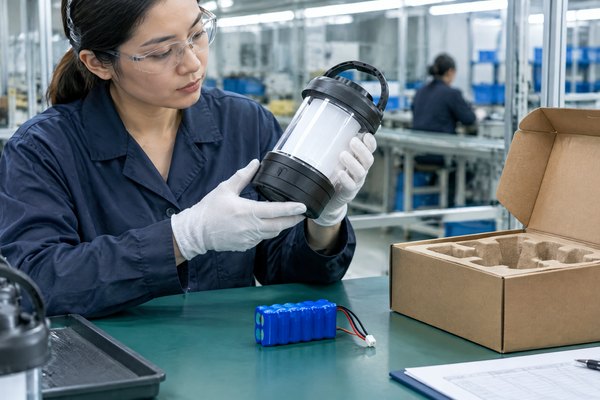
A useful sourcing decision starts with a written requirement that can be challenged, sampled, inspected, and approved.
Direct answer — what this guide helps you decide
If you need a USB-C rechargeable camping lantern for an import or private-label program, prioritize lumen and runtime targets, battery chemistry and capacity, USB-C power delivery and pass-through, durability (IP rating and impact resistance), and the factory QA and documentation needed for your destination market. This guide explains the specification choices, how to compare camping lantern lumen and runtime comparison figures, what to require in sample review and factory testing, and the packaging, labeling and shipping preparation steps that minimize surprises for product managers and quality teams.
Why a USB-C Rechargeable Camping Lantern Leads Most B2B Specs
USB-C rechargeable camping lanterns are now standard in consumer expectations because USB-C simplifies charging, supports faster recharge, and integrates with modern portable power banks. For many buyers a rechargeable camping lantern replaces both battery operated camping lantern options and single-function LED torches. However, “replace” depends on use case: some retail channels still prefer inexpensive battery-operated camping lanterns for low-price SKUs or where battery availability is a selling point.
Key commercial advantages of USB-C models:
- Familiar interface for end customers and easier accessory bundling.
- Rechargeable battery reduces lifetime cost of ownership compared with disposable cells.
- Enables lanterns to act as a power bank for small devices when designed with output ports.
Key Specifications To Define Before You Ask For Samples
Define these core choices in writing before briefing suppliers. Clear specs speed sample review and reduce costly change-control rounds.
Lumens, Beam Pattern and Runtime
Specify required max lumen output, distribution (wide flood vs focused), and minimum useful-output thresholds (e.g., 200 lm bright, 20 lm nightlight). Insist on a camping lantern lumen and runtime comparison across modes in the technical datasheet — don’t accept a single runtime figure without specifying output level. For example, request: High (400 lm) runtime, Medium (120 lm) runtime, Low (20 lm) runtime, and strobe/eco modes with corresponding measured hours.
Battery Chemistry, Capacity and Life Cycles
Choose a safe, durable cell chemistry (typically lithium-ion or lithium-polymer) and specify usable capacity in mAh and Wh. State cycle-life expectations (e.g., retain ≥80% capacity after X cycles) and thermal management requirements. This feeds factory cell sourcing and protective circuit design.
Charging, Ports and Power Delivery
USB-C is the baseline. Decide whether you require USB-C PD (power delivery) for fast charging, bidirectional charging (lantern as a power bank), or optional DC input for solar integration. If you expect the lantern to act as a power bank, specify the maximum output (e.g., 5V/3A) and whether pass-through charging is required.
Mechanical, Durability and Weather Resistance
Specify IP rating targets (e.g., IPX4 vs IP67), drop height, material choices, and UV resistance. For camping, rugged ABS/PC housings with silicone seals are common; be specific about gasket locations and door designs for ports.
Certification and Market Requirements
List the destination market and ask the factory to confirm which tests and certificates will be provided (e.g., LVD/EMC, FCC, RoHS, UN38.3 for lithium cells). As an OEM/ODM manufacturer, CampLume can design to help meet those requirements, but buyers should confirm the applicable requirement for their market and product variant.
Power and Portability: Sizing Batteries and Banks
Battery capacity affects weight and runtime. For multi-night use or for powering other devices, buyers need to evaluate the portable power bank capacity for camping alongside the lantern battery.
- For single-person overnight car camping: 5,000–10,000 mAh (18–36 Wh).
- For multi-day backcountry: lithium cells with higher energy density or supplementary solar charging; consider 10,000–20,000 mAh power banks.
If your SKU needs to be sold as a system, specify the combined portable power bank for camping and lantern solution (e.g., 10,000 mAh power bank + 3,000 mAh lantern battery, or one unit with 20,000 mAh internal capacity). Also confirm pass-through charging and conversion losses when using the lantern to charge phones: typical conversion reduces usable output by 10–20%.
Practical phrase to include in your RFP: “Please state the usable Wh, end-to-end charge/discharge efficiency, and the recommended portable power bank capacity for camping to achieve 24 hours of mixed-mode lighting plus one smartphone charge.”
Use Cases and Product Variants
Different retail channels and OEM projects require different features. Outline target applications in your brief so the factory can match component choices.
- Emergency kits: prioritize long shelf life, high-efficiency low-power modes, and simple controls for less technical users. Describe as an emergency rechargeable lantern with battery preservation features and optional SOS modes.
- Car and family camping: prioritize higher lumen output and rechargeable capability with integrated power bank functions.
- Backcountry and bikepacking: prioritize weight, packability, and solar rechargeable camping lantern compatibility (an integrated or clip-on solar panel) with IP67 protection.
Sample Review, Factory Testing and QA Workflow
Before production sign-off, follow a structured sample and testing process. CampLume, as an OEM/ODM camping gear manufacturer, typically supports buyers through these stages but will adapt to your QA plan.
Product Specification and Initial Sample
Provide a detailed spec sheet that includes mechanical drawings, BOM-level component lists (cells, LEDs, optics), target weight, labeling text, carton specification, and the camping lantern lumen and runtime comparison table you expect. The initial engineering sample checks fit, form, and basic function.
Sample Review and Functional Testing
During sample review, test all charging modes, measure lumen output with a calibrated light meter, and verify runtime at specified output levels. Have your lab or a third-party measure battery capacity and verify the power path if the lantern is intended to act as a power bank.
Factory Testing and Inspection
Request a factory test plan that includes 100% functional testing of charge circuits, over-voltage/over-current protection checks, LED driver thermal tests, and a batch-level cell test report. For lithium batteries, UN38.3 compliance testing is typically relevant for air transport—confirm the applicable requirement.
Change Control and Documentation
Require a written change-control process: no material or component substitutions without documented approval. Ask for updated BOM, revised test reports, and re-sampled units after any change. Maintain an approval log for aesthetics, firmware and hardware modifications.
Packaging, Labeling and Shipping Preparation
Packaging is often where projects fail to meet retailer or customs requirements. Include these items in the specification:
- Retail carton artwork and dielines, inner packaging to protect lens and PCB during drops, and master-carton quantity.
- Country of origin, import labels, and safety warnings required by your destination market. CampLume can produce labels per your copy but confirm legal language with your compliance team.
- Shipping prep: palletization, box strength (ECT), and whether air, sea or express freight will be used; these determine packing density and battery shipping classification.
For battery shipments, specify whether cells will ship fully assembled in the product or separately and confirm the factory’s experience with the relevant transport classification.
Comparison / Buyer Decision Table
Choose the variant that matches your channel and margin targets. Use this concise table to present options to stakeholders.
| Buyer Priority | Basic SKU (Budget) | Mid SKU (Best Seller) | Premium SKU (Full-Feature) |
|---|---|---|---|
| Typical retail price | Low | Mid | High |
| Lumen range | 100–250 lm | 250–700 lm | 700–1200 lm |
| Battery capacity | 2,000–4,000 mAh | 5,000–10,000 mAh | 10,000–20,000 mAh |
| Power bank function | Optional | 5V USB output | USB-C PD bidirectional |
| Solar option | Not included | Optional clip-on | Integrated solar rechargeable camping lantern variant |
| Target channel | Value / discount | Big box / e-commerce | Premium outdoor / specialty |
Mid-Article CTA: How to Brief CampLume for Precise Samples
If you want a precise engineering sample and MOQ quote, email a one-page brief to briefs@camplume.com with:
- Target SKU name and POS price band
- Required lumen and runtime per mode (use the camping lantern lumen and runtime comparison format)
- Battery capacity in mAh or Wh and whether lantern must act as a portable power bank for camping
- Destination market(s) and expected certifications
- Preferred packaging format and target launch date
CampLume will respond with an initial BOM checklist, estimated tooling and lead times, and a sample quote.
Common Product Application Notes
- Tactical placement: For group camping, choose lanterns with a hanging loop and 360° flood. For reading or focused tasks, include a directional output or a detachable task light.
- Emergency use: An emergency rechargeable lantern should have low-power preservation, a visible charge indicator, and a user-friendly charging port cover.
- Solar-enabled variants: If you want a solar rechargeable camping lantern, specify solar panel wattage, expected recharge hours under defined insolation, and whether the unit should accept external panels.
FAQs (Practical Buying Questions)
Q: How do I compare lumen claims between suppliers? A: Ask for measured lumen output at the LED driver’s rated voltage using an integrating sphere measurement or a calibrated lux-to-lumen conversion. Require a camping lantern lumen and runtime comparison for each mode. Beware of peak lumens measured for a brief flash; request sustained lumen figures.
Q: Should the lantern also act as a portable power bank for camping? A: That depends on use case and margin. If your customer expects to charge phones and headlamps, include at least one high-current output and specify the required portable power bank capacity for camping. Remember to adjust battery cycle-life expectations.
Q: What battery warnings or transport constraints should I expect? A: Lithium batteries have transport classification implications and require accurate documentation. Confirm whether cells ship installed vs. separately and confirm appropriate labeling with your freight forwarder and compliance team. CampLume will provide packing lists and cell test reports on request.
Q: How many production samples should I approve before mass run? A: Approve at least: one engineering sample, three pre-production samples (for function, drop and packaging), and a pilot production run (small batch) for QC. For complicated electrical designs, include firmware verification and burn-in tests.
Q: Can you add solar charging later in development? A: Yes, but adding solar affects enclosure design, battery sizing and charge circuitry — include solar integration in early specs to avoid late change control.
Final Conclusion and Clear CTA
Selecting the right USB-C rechargeable camping lantern requires clear, measurable specifications for lumen output, runtime, battery capacity and charging behavior; a documented sample and factory test plan; and packaging and shipping instructions aligned to your destination market. For a reliable OEM/ODM partner who can convert your functional brief into engineering samples and production-ready documentation, email briefs@camplume.com with the short brief described above. CampLume will return a sample plan, BOM checklist and estimated lead times to help you move from evaluation to production with fewer revisions.
FAQ
What should be defined before sourcing a rechargeable camping light?
Set the intended use, brightness and runtime expectations, charging interface, battery configuration, ingress-protection target, accessories, retail packaging, target markets and documentary requirements in one controlled brief.
Can one battery document cover every lantern variation?
Only if its scope clearly matches the battery, electronics, configuration and shipment arrangement in question. Confirm document applicability before using it in a market or freight decision.
What should a pre-production lighting sample prove?
It should represent the proposed bulk configuration and allow review of operation, charge behavior, controls, labeling, accessories, pack-out and the documentation plan. Record approved and open points before mass production.
What is useful at final shipment inspection?
Verify the approved configuration, visible appearance, functional checks, packaging, barcodes and carton markings. Where batteries are involved, confirm that the agreed shipment documents and handling assumptions are in place.
Final CTA: Email info@camplume.com with your product category, target market, estimated quantity, current specification and packaging stage. Request a documented response that identifies assumptions, open evidence and the next approval gate.
Related CampLume resources
-
Read: What Should Buyers Check When Sourcing Rechargeable Camping Lanterns? for a connected sourcing decision.
-
Explore CampLume lighting options to compare a relevant product platform.
-
See the CampLume buyer FAQ for concise guidance on samples, MOQ, quality control, compliance and shipment preparation.
-
Discuss an OEM or ODM brief with CampLume when product configuration, custom branding or packaging needs to be scoped.
Project discussion
Need to apply this guide to a product programme?
Send your product category, target market, estimated quantity, current specification and packaging stage. CampLume will continue the discussion by email.
Email info@camplume.comSources and further reading