A useful sourcing decision starts with a written requirement that can be challenged, sampled, inspected, and approved.
Direct answer (short): For a buyer, "camping lantern runtime testing" means specifying the test conditions (initial charge state, brightness level, ambient temperature), getting measured runtimes from controlled laboratory or in-factory tests, and verifying those results on your production samples before release. The most actionable deliverable is a runtime report tied to a clear product specification and an agreed sample-test protocol you can reproduce during incoming inspection.
What "Camping Lantern Runtime Testing" Should Deliver For Your Project
Runtime is only useful when paired with test context. A runtime number without test conditions is meaningless for sourcing or marketing claims.
Key pieces every runtime report must include
- Test conditions: battery state of charge, brightness mode (lumens), measurement interval, test cutoff condition (e.g., 10% of initial lumen output or low-battery shutoff).
- Ambient conditions: temperature and humidity. Cold temperature reduces effective runtime.
- Hardware details: battery chemistry and capacity, driver type (constant-current or PWM dimming), firmware settings that affect power draw.
- Test results: elapsed time to cutoff, discharge curve (preferably a CSV), and variance across samples.
How buyers use runtime data
- Compare competing suppliers on apples-to-apples basis.
- Validate marketing claims on label copy.
- Set acceptance criteria for incoming inspection and warranty thresholds.
Tests You Should Specify To A Portable Lighting OEM Supplier
When you brief a portable lighting OEM supplier, be explicit about the test scope. Different use cases (camping, fishing, overlanding) require different emphases.
Electrical and battery tests
- Continuous runtime at defined lumen levels (high/medium/low).
- Cycle charge/discharge testing to estimate early degradation.
- Ask for a lithium battery test summary camping lights so you have documented evidence of cell-level testing and safety limits.
Mechanical and environmental tests
- Drop and impact tests (see "rechargeable lantern drop test" expectations below).
- Water ingress testing appropriate to the market (e.g., IPX4 vs IPX7) — confirm the applicable requirement for your destination market.
- Vibration and thermal shock if the product will ship frequently or be used in vehicles for overlanding.
Production and compliance checks
- EMC/EMI checks if the light contains wireless features. Confirm the list of applicable standards for each target market rather than assuming a single universal test.
Sample Review And Factory Testing Workflow
A well-documented workflow reduces rework and supplier disputes. Provide this to suppliers as part of your specification pack.
Product specification (what you deliver)
- Mechanical drawings and BOM with material callouts.
- Target runtime by mode and the test protocol you expect.
- Label/packaging artwork and any claim language tied to runtime.
Sample review (what you expect)
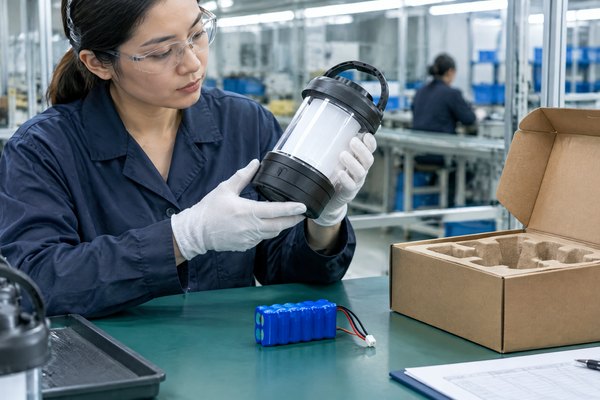
- Proto sample sign-off: run the runtime protocol in your presence or under video and accept/reject based on the agreed cutoff.
- Pilot run: 20–100 units for performance verification and to test packaging durability in transit.
Factory testing and inspection
- Factory test reports: include sample discharge curves and device serial numbers for traceability.
- Incoming inspection: measure 5–10% of incoming batches for runtime and visual defects; adjust sampling plan to your risk tolerance.
- Change control: require supplier notification and re-test if changes affect battery, LED, driver, or firmware.
Physical Durability: Drop, Water, And Impact Considerations
Outdoor lighting is subject to real-world abuse. Clarify durability expectations early in the quote stage.
Rechargeable lantern drop test (what to request)
- Define drop height (commonly 1m, 1.5m, 2m depending on product class), surface type, number of drops, and orientation.
- Ask for functional verification after drops (light operates at rated output), plus evidence of no sharp edges or exposed wiring.
Water and sealing tests
- Specify ingress protection level you need and the test protocol (e.g., spray test, immersion time and depth). Confirm market expectations rather than assuming a single IP rating.
Application-specific durability
- If you plan to sell to campers who fish from boats, mention this to the supplier and request tests similar to those a fishing camp light supplier would provide—tight seals, corrosion resistance, and secure mounting.
- For overlanding accessories, ask your overlanding camp light manufacturer candidates for additional vibration and thermal-cycle evidence.
Mid-Article CTA: Send Your Requirements
If you are evaluating camping lantern runtime testing, email info@camplume.com with your product category, selling market, estimated quantity, current specification and packaging brief. Ask for a documented reply that separates assumptions and deviations from the quotation.
Battery Safety And Test Summaries: What To Ask For
Lithium battery information is a frequent gating item for acceptance and shipping.
- Ask for a lithium battery test summary camping lights that lists cell model, manufacturer, nominal capacity, C-rating, and safety test outcomes that the supplier can legally provide. This summary helps you plan transport and warranty policy.
- Request test evidence for charge protection, over-current protection, and thermal behavior at low temperatures if you intend to market to cold-weather users.
- For cross-border shipping, discuss battery packing and documentation early—some carriers require specific test data or UN38.3 documentation from the cell or pack manufacturer. Confirm the applicable requirement for your target logistics route.
Supplier Qualification Checklist For OEM/ODM Lighting Partners
Use this checklist when you evaluate a new portable lighting OEM supplier. It combines practical production checkpoints with commercial terms.
Facility & capability
- Production lines that can assemble and test the number of units you require.
- In-house test jigs for runtime measurement and mechanical durability.
- A record of supplying categories such as portable lanterns, fishing lights, or overlanding lights; ask for sample references (not customer names) and typical product specs.
Quality management & change control
- Written incoming inspection and final inspection plans.
- A documented change-control process: all design or supplier-part changes should trigger risk assessment and re-test if relevant to runtime or safety.
Commercial terms
- Ask for camping lantern OEM MOQ and confirm whether MOQ applies per SKU or per color/packaging variant.
- Lead times for samples vs mass production and the supplier’s policy for tooling amortization and minimum batch sizes.
Mid-article CTA — Ready To Get A Quote And Test Plan? Email a short brief to sourcing@camplume.com with these items and we will reply with a tailored test and sample plan within 2 business days:
- Product title and target market(s)
- Target runtime by mode (lumens + cutoff condition)
- Battery chemistry and preferred cell supplier (if any)
- Expected camping lantern OEM MOQ and target annual volume
- Specific tests required (e.g., rechargeable lantern drop test, IP rating, lithium battery test summary camping lights)
Packaging, Shipping Preparation, And Documentation
Packaging and shipping planning must be part of the specification, not an afterthought.
- Protective packaging: specify cushioning and orientation labels to reduce damage during transit; indicate if you require bulk or retail-ready packaging.
- Shipping preparation: include palletization, carton markings, and whether you need mixed pallets.
- Documentation: request final test reports, batch-level runtime data, and any battery-related shipping documents prior to loading. Ensure the supplier includes serial or batch IDs on test reports to link samples to production runs.
Buyer Decision Table: Quick Comparison
| Decision Factor | In-House Proto Focus | Small ODM Supplier | High-Volume OEM | Best For |
|---|---|---|---|---|
| Typical MOQ | 1–10 | 500–2,000 | 5,000+ | Proto vs mass-buying |
| Runtime Test Detail | Full control (video) | Standard factory report | Automated long-run logs | Validating claims |
| Mechanical Tests | Custom (drop proof) | Basic drop/IP | Full environmental testing | Harsh-use products |
| Lead Time | 1–4 weeks | 6–12 weeks | 12+ weeks | Speed vs scale |
FAQ
How long should runtime testing be for marketed claims?
Define runtime per mode with a standardized cutoff (e.g., 10% of initial output or firmware low-battery off). For marketing claims, require at least three sample runs and report mean and standard deviation. For safety and warranty, require batch-level spot checks during production.
What is a reasonable camping lantern OEM MOQ to expect?
Expect variation by supplier: small ODMs may quote a camping lantern OEM MOQ of several hundred per SKU while larger factories usually expect thousands. MOQ is negotiable based on tooling, packaging variants, and annual volume commitments.
How do I interpret a lithium battery test summary camping lights?
Use the summary to confirm cell identity, nominal capacity, cycle-life expectation, and that basic safety tests were performed. If you need deeper assurance, ask for cell manufacturer certifications or additional independent testing for your market.
What should I require for a rechargeable lantern drop test?
Specify drop heights, surface, number of drops, and functional acceptance criteria. Ask the supplier to provide photos and a pass/fail checklist for each sample. Require re-test if supplier makes material, supplier, or process changes.
How often should I perform change control re-testing?
Trigger re-tests whenever a change affects the battery, LED, optic, driver, firmware, or mechanical housing material. For process changes that don't affect these systems, consider a reduced verification protocol with clear acceptance limits.
Conclusion And Clear Next Step
If runtime performance, battery safety, and durability are critical to your brand, lock these requirements into the product specification and sample-test protocol before you place a tooling order. Provide suppliers with a clear test matrix (modes, cutoff rules, environmental conditions) and require batch-level traceable reports.
Request a customized quote and sample/test plan: email sourcing@camplume.com with the brief listed above. CampLume is an OEM/ODM camping gear manufacturer and can prepare a tailored proposal that includes test protocol suggestions, sample timelines, packaging options, and MOQ scenarios to match your market strategy.
Final CTA: Email info@camplume.com with your product category, target market, estimated quantity, current specification and packaging stage. Request a documented response that identifies assumptions, open evidence and the next approval gate.
Related CampLume resources
-
Read: What Should Buyers Check When Sourcing Rechargeable Camping Lanterns? for a connected sourcing decision.
-
Explore CampLume lighting options to compare a relevant product platform.
-
See the CampLume buyer FAQ for concise guidance on samples, MOQ, quality control, compliance and shipment preparation.
-
Discuss an OEM or ODM brief with CampLume when product configuration, custom branding or packaging needs to be scoped.
Project discussion
Need to apply this guide to a product programme?
Send your product category, target market, estimated quantity, current specification and packaging stage. CampLume will continue the discussion by email.
Email info@camplume.comSources and further reading