A useful sourcing decision starts with a written requirement that can be challenged, sampled, inspected, and approved.
Direct answer (short): To qualify a camping table factory, verify factory capabilities and capacity, lock a clear product specification, run representative samples through a camping table stability test and relevant outdoor furniture durability testing, review factory and third‑party QC records, confirm packaging and shipping preparation, and set contractual change control and re‑qualification triggers before volume production.
Why supplier qualification matters for camp furniture
Buying from a campsite furniture supplier is not the same as buying finished indoor furniture. Outdoor use adds variable loads (people leaning, uneven ground, wind), abuse (collisions, moisture, UV) and logistics stress (compression in cartons, pallet loads). Qualifying a camping table factory or outdoor folding furniture supplier up front reduces rework, warranty exposure and retailer chargebacks.
This guide focuses on the supplier‑qualification stage: the tasks a product manager, importer or quality manager should complete before placing a production order.
What you must define before you contact suppliers
A clear internal brief speeds qualification and prevents misunderstandings.
Core elements of the product specification
- Functional requirements: load capacity (static and dynamic), top size and edge geometry, stowed size for your packing plan.
- Materials: specific alloy or steel grade, tube wall thickness, tabletop core and surface finish (e.g., high‑pressure laminate spec), fastener grades and coatings.
- Assembly method: riveted, brazed, welded, screw‑and‑nut, or snap‑fit; and whether the product will be supplied assembled or in kits.
- Intended end use and user: family picnic table, backpacking ultralight, car camping. Different use cases change testing and materials.
Performance and test acceptance criteria
Define measurable acceptance criteria you will use at sample review: maximum deflection under X kg, pass/fail for camping table stability test, lifecycle cycles for outdoor furniture durability testing, and allowable corrosion after accelerated exposure. Avoid vague phrases like “robust” without numbers.
Destination market and compliance
List the exact destination(s) and confirm the applicable requirement rather than assuming one test covers all markets. Different retailers and countries may require different documentation or restricted‑substance declarations.
How to evaluate factory capabilities and capacity
Not every metal‑fabrication shop is suited to foldable outdoor furniture. Qualification should verify processes, tooling and quality systems.
Manufacturing processes to confirm
- Tube bending, end‑forming and punching capacity for leg frames.
- Weld methods and weld validation (for welded frames) or reliable rivet and fastener assembly lines.
- Surface finishing: anodizing, powder coat, wet paint — check typical batch sizes, oven capacity and curing controls.
Equipment, throughput and lead times
Confirm whether the camping table factory can meet your MOQ and lead time. Ask for cycle time examples for comparable models and for bottlenecks such as CNC punches or manual welding stations.
Documentation and traceability
Ask how the supplier traces raw material batches (mill certificates), fastener lot numbers and paint lots. For large runs, require retention samples and a traceability plan tied to your PO.
Sample review: what to request and how to test
A staged sample program is essential: prototype/design sample, pre‑production sample (PPS), and production sample (PS). Each stage has a different role in qualification.
Prototype vs pre‑production vs production samples
- Prototype: validates design intent and user ergonomics. Expect hand‑built tolerances.
- Pre‑production sample (PPS): built on production tooling and processes; used for final adjustments and first stability/durability tests.
- Production sample (PS): representative of the first lot and used as the golden sample for inspection.
Stability and functional tests to perform
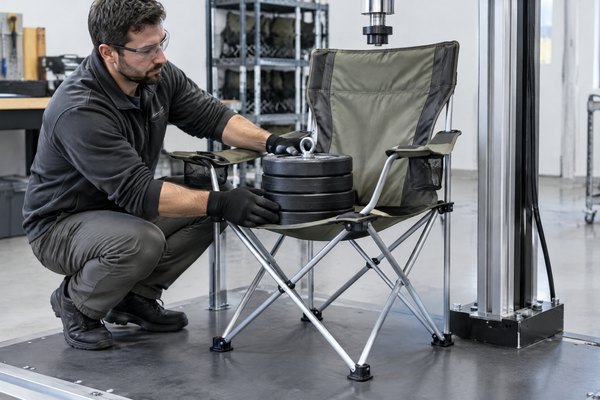
- Camping table stability test: replicate real use — load a corner and center, apply lateral forces, and check for tipping/wobble. Measure residual tilt and permanent deformation.
- Folding chair stability test (if you also source seating): perform seat‑pan roll tests, rear‑tipping tests and hinge locking checks.
- Outdoor furniture durability testing: include repeated opening/closing cycles, hinge fatigue, tabletop impact, and any abrasion tests appropriate to the surface finish.
Field‑use assessment
Use human testers to simulate common misuse — uneven ground, jump loads, and carrying while folded. Document issues and feed them back for design or process changes.
Factory testing, inspections and third‑party verification
A camping table factory will have internal QC checks; your qualification should combine those with targeted independent verification.
In‑factory versus third‑party testing
- In‑factory testing: useful for production control and quick triage. Confirm test protocols, calibration records for test rigs and retest policy after failures.
- Third‑party labs: use them for final certification or when your retailer requires independent evidence. For outdoor furniture durability testing, a lab report is stronger during negotiation but will add time and cost.
Inspection checkpoints and sample sizes
Define inspection points: incoming material check, first article inspection, in‑line checks for critical dimensions, and final random lot inspection (AQL). Request the factory’s inspection checklists and witness the first lot if possible.
What test documentation to request
- Test fixtures, test protocols and raw data for the camping table stability test and folding chair stability test.
- Calibration certificates for load cells and meters used in tests.
- Failure modes and corrective actions (FMEA or root‑cause reports) where tests uncovered nonconformities.
Packaging, labeling and shipping preparation
Packaging is part of product qualification when shipping and handling stresses could damage the item or void retailer compliance.
Packaging spec and transit testing
Define carton size, internal protection, and palletization. Perform a drop test and compression check on your sample carton. Confirm if the supplier can perform weak‑stack and vibration tests or if you will commission them externally.
Documentation for customs and retailers
Prepare pack‑list templates, carton dimensions and weight, labeling requirements (country of origin, barcodes) and required shipping documentation. Confirm the factory’s ability to include retailer insert cards or private‑label logos in production.
Shipping preparation and sea freight considerations
If items are large (tables) you may pack multiple units per crate; work through cube optimization with the factory to reduce per‑unit freight cost while protecting product integrity.
Mid-Article CTA: Send Your Requirements
If you are evaluating camping table factory, email info@camplume.com with your product category, selling market, estimated quantity, current specification and packaging brief. Ask for a documented reply that separates assumptions and deviations from the quotation.
Supplier systems, change control and long‑term quality management
Qualification is the start of an ongoing relationship. Define processes for changes and nonconformance handling.
Change control and re‑qualification triggers
Require written change notices for tooling revisions, material substitutions, process changes and subcontracting. Define when a design or process change requires a new camping table stability test or outdoor furniture durability testing.
Nonconformance management and warranty handling
Agree on timelines for NCR resolution, root‑cause analysis, and containment actions. Define financial responsibility for failed lots and a warranty framework for retail returns.
Continuous improvement and KPIs
Set supplier KPIs: on‑time delivery, first‑pass yield, and field failure rate. Schedule periodic reviews and sample audits tied to these KPIs.
Choosing between supplier types: quick comparison
Deciding whether to work with a general campsite furniture supplier, an outdoor folding furniture supplier, a custom folding chair manufacturer or a camping table factory depends on your product scope and priorities.
| Decision Factor | General Campsite Furniture Supplier | Outdoor Folding Furniture Supplier | Custom Folding Chair Manufacturer | Camping Table Factory (OEM/ODM) |
|---|---|---|---|---|
| Best for broad SKUs | Good for mixed assortments | Strong on folding mechanisms | Focus on seating | Best for table design and integrated systems |
| Engineering support | Limited | Moderate | High for chairs | High for tables and combined systems |
| Faster turnaround | Yes for stocked SKUs | Moderate | May be slower (custom work) | Moderate—depends on tooling |
| Stability & durability focus | Varies | Good | Excellent for chairs (folding chair stability test) | Strong when specified (camping table stability test, outdoor furniture durability testing) |
| Custom tooling ability | Limited | Good | Excellent | Excellent |
Use the table to match suppliers to your priority: if your SKU is a foldable table designed to OEM specs, a camping table factory or an OEM/ODM with table experience is usually the efficient route.
Mid‑article CTA — prepare a short email brief
To get a fast, accurate qualification quote and sample plan from CampLume (OEM/ODM camping gear manufacturer), send a single email to sourcing@camplume.com with this brief:
- Product: model type (e.g., 4‑leg folding camping table) and intended use-case
- Key dimensions and target packed carton size
- Materials preference and finish (example: 6061‑T6 aluminum frame, HPL top)
- Performance targets: static load, camping table stability test criteria, and outdoor furniture durability testing cycles
- Target annual volume and desired lead time
- Destination market(s) and retailer compliance notes
A concise brief like this lets a factory provide tooling needs, sample timelines, and an estimated cost to perform initial stability and durability checks.
Typical timelines and cost considerations during qualification
- Prototype → 2–6 weeks depending on complexity.
- PPS (pre‑production sample) on production tooling → 3–6 weeks after tooling is ready.
- Third‑party testing and reports → 1–3 weeks depending on lab backlog.
Cost items to budget: tooling, sample builds, third‑party tests, inspection fees, and potential packaging/transport tests.
Practical checklist for the supplier‑qualification kickoff
- Confirm product spec and test acceptance criteria in writing.
- Review factory process maps and material traceability plan.
- Agree sampling plan and witness points for first production lot.
- Specify required tests (camping table stability test, folding chair stability test where relevant, and outdoor furniture durability testing) and who performs them.
- Define packaging spec, labeling and shipping preparation process.
- Agree change control, KPI targets and warranty terms.
FAQ
- How many samples do I need for a meaningful camping table stability test?
- At minimum, use one PPS from production tooling and one PS from the first production lot. For statistical confidence, include 3–5 units sampled from different sub‑lots or production days.
- Can the factory perform outdoor furniture durability testing in‑house?
- Some factories have in‑house rigs for lifecycle and hinge fatigue tests. Ask for test protocols, calibration certificates and raw data. If your buyer requires third‑party validation, commission an external lab.
- What triggers re‑qualification after a factory change?
- Tooling changes, material substitution (even a different coating), process changes that affect assembly, or a change of subcontractor should all trigger at least targeted re‑testing; the exact trigger depends on the change’s potential impact on stability and durability.
- How do I judge stability test results objectively?
- Use pre‑defined pass/fail criteria such as maximum permanent deflection, allowed wobble under specified lateral force, and whether locking mechanisms fully engage under test loads.
- What packaging tests are most relevant for camping tables?
- Compression (stacked cartons), drop testing for corner impacts, and vibration or transit simulation tests help identify packaging failures before they reach retail distribution.
- What minimum documentation should I require from the supplier?
- A product specification, first article inspection report, test reports for stability and durability, inspection checklists, and a written traceability plan for materials.
Conclusion and next steps
Supplier qualification for camp furniture is a structured process: set measurable specifications, validate prototypes and production samples through camping table stability test and relevant outdoor furniture durability testing, verify the factory’s processes and documentation, and lock packaging and change‑control terms before production. Whether you choose a campsite furniture supplier, outdoor folding furniture supplier, custom folding chair manufacturer or a dedicated camping table factory depends on your SKU mix and engineering needs.
To start a qualification conversation with CampLume (OEM/ODM camping gear manufacturer), email sourcing@camplume.com with the brief in the mid‑article CTA. Include your target arrival date for the first production run and the key test acceptance criteria so we can propose a realistic sample and test schedule.
Final CTA: Email info@camplume.com with your product category, target market, estimated quantity, current specification and packaging stage. Request a documented response that identifies assumptions, open evidence and the next approval gate.
Related CampLume resources
-
Read: What Should Buyers Check Before Ordering Wholesale Camping Chairs? for a connected sourcing decision.
-
Explore CampLume furniture options to compare a relevant product platform.
-
See the CampLume buyer FAQ for concise guidance on samples, MOQ, quality control, compliance and shipment preparation.
-
Discuss an OEM or ODM brief with CampLume when product configuration, custom branding or packaging needs to be scoped.
Project discussion
Need to apply this guide to a product programme?
Send your product category, target market, estimated quantity, current specification and packaging stage. CampLume will continue the discussion by email.
Email info@camplume.comSources and further reading