A useful sourcing decision starts with a written requirement that can be challenged, sampled, inspected, and approved.
What Should an Inflatable Tent Repair Kit Include? A Buyer Specification Guide
Quick answer: start with a controlled requirement, not a generic request
A buyer should treat an inflatable tent repair-kit specification as a controlled sourcing decision rather than a sales conversation. The key question is which repair components are genuinely compatible with the approved materials, valves, seams, and user instructions, and how the kit will be packed and controlled. The most reliable starting point is a written requirement that tells the supplier what is included, what performance or user scenario matters, which markets are intended, what evidence is required, and which changes need written approval.
For an air-beam shelter or inflatable tent sold with an expectation of field repair and maintenance, the buyer should make the acceptance path visible before requesting a firm quotation. That means defining the configuration, target market, sample purpose, packaging level, inspection basis, document owner, and delivery assumption. A supplier can then return a price together with questions, deviations, and evidence gaps. This makes a quotation comparable rather than merely attractive.
The central principle is simple: a claim, price, sample, test record, label, and shipment document should refer to the same approved configuration. This guide gives a practical way to create that chain of evidence. It is procurement guidance, not legal, customs, or product-compliance advice. Requirements can vary by product and destination, so buyers should obtain qualified advice for their own programme.
Why this decision matters before a purchase order is issued
The main commercial risk is that a repair kit may create false confidence if its patch, valve, adhesive, or instructions do not match the actual tent material, product revision, or field conditions. Outdoor products move through multiple decision layers: product concept, component choice, prototype, test or assessment, artwork, consumer packaging, export carton, inspection, and freight handover. A weakness at one layer can surface as a costly delay at another. The most common problem is not that a buyer did not ask a question. It is that the answer was never tied to a controlled product version.
A usable buyer brief separates product intent from acceptance criteria. Words such as premium, rugged, weatherproof, compact, or retail-ready may help describe the brand position. They are not sufficient technical instructions. Convert the intent into observable requirements: what the user does, what components are included, what physical condition matters, what normal use or handling is expected, and what result would count as acceptable.
The target market also belongs at the beginning of the process. For products within scope of the EU General Product Safety Regulation, manufacturers must carry out an internal risk analysis and maintain technical documentation that is proportionate to the product and its risks. [1] That does not mean every outdoor product needs the same document set. It means buyer, supplier, and responsible market operator need to agree on the exact product, market, risks, evidence, and retention responsibilities.
Build the buyer decision framework in layers
Before a supplier develops or quotes an air-beam shelter or inflatable tent sold with an expectation of field repair and maintenance, create one project record with the following layers. Each layer should have a named owner and revision date.
1. Programme and customer-use context
State the product family, intended user, launch channel, countries, expected quantity, launch timing, and price position. Explain the actual use environment. A product used for occasional family camping creates different questions from one used frequently by overlanding customers, outdoor rental fleets, or specialist retailers. The use context influences materials, instructions, service expectations, packaging, and the strength of evidence the buyer needs.
2. Product configuration
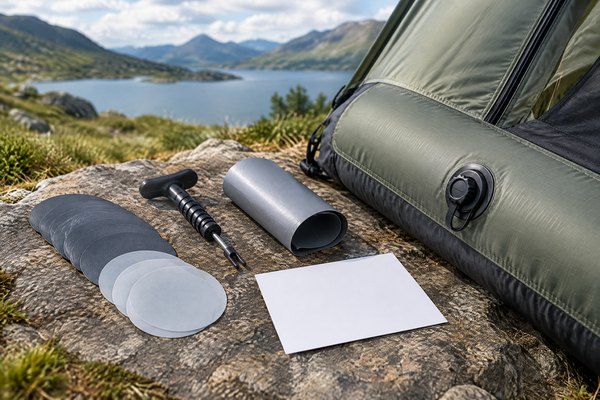
List every included part and variation. For this topic, control: fabric or patch material, adhesive or repair method where appropriate, valve tool, valve insert, patch shapes, cleaning preparation, instructions, safety warnings, storage limits, kit packaging, compatibility codes, and spare-part availability. If information is not final, label it as open and ask the supplier to price a defined baseline plus clearly identified alternatives. Do not allow an open decision to become an unstated substitution.
3. Market and information controls
Define the target countries, language needs, consumer-facing claims, product and packaging labels, origin marking approach, warnings, and document owner. For United States imports, foreign-origin articles generally need a legible English country-of-origin mark unless an exception applies; the marking should be conspicuous and as permanent as the product permits. [2] The exact origin determination can be complex, especially when materials and assembly occur in different countries, so confirm the final approach with appropriate trade advisers.
4. Commercial and execution controls
Ask for quantity tiers, currency, one-time charges, recurring unit price, packaging scope, sample charge, test or inspection charges, delivery term, named place, price validity, and every exclusion. Then ask for a separate deviation schedule. A lower price is not a usable comparison if it refers to different materials, accessories, packaging, or delivery assumptions.
Translate the topic into measurable specifications
A specification works when a factory, quality team, and buyer can all inspect the same point in the same way. Use a component map, drawings, photos, dimensions, and a short acceptance note for every critical feature. If you cannot set a final value, specify the decision needed and request a supplier proposal with its assumptions.
For an inflatable tent repair-kit specification, start by asking four practical questions. First, what is the end user expected to do with the product? Second, what component or process could cause the product to fail that use? Third, what visible, measurable, or documented evidence would show that the requirement is met? Fourth, what change would require the buyer to review the decision again?
Avoid using one headline number as a proxy for overall performance. A product normally performs through a system of material, geometry, assembly, user interaction, labels, and pack-out. A tent rating does not explain seam construction. A chair load claim does not show the locking mechanism. A lantern capacity does not prove the pack, charge system, and shipping data are aligned. A packaging drawing does not prove the product is restrained in the carton.
Where tents are involved, ISO 5912:2020 describes requirements and test methods relating to camping-tent safety, performance, and fitness for use. [4] The standard can be a useful reference when it is selected for the programme, but the buyer should not treat any standard title as proof for an unspecified configuration. Where rechargeable batteries are involved, transport requirements and test-summary availability need to be linked to the exact battery design and shipment arrangement. [5]
| Buyer question | What to define | Evidence to request | What triggers a review |
|---|---|---|---|
| Product purpose | Intended user, environment, channel, and use limits | Buyer brief and sample request | New market, user, or marketing claim |
| Critical construction | Material, component, assembly, tolerance, or protection | BOM, drawing, sample photos, supplier deviation sheet | Material, supplier, or process substitution |
| Functional acceptance | What the product must do and under what condition | Agreed sample check, test proposal, inspection point | Failure, design change, or new performance claim |
| Consumer information | Labels, warnings, instructions, origin and packaging content | Artwork proof and placement drawing | Market, language, or artwork revision |
| Shipment readiness | Pack-out, carton data, documents and release gate | Packing photos, carton specification, inspection report | Carton, quantity, routing, or freight-mode change |
Apply the framework to the real product and sales channel
A product decision should be made with the final channel in mind. A specialist retailer may need display-ready packaging, staff-facing product information, and service parts. An e-commerce programme may need stronger internal protection, accurate dimensions, barcode control, and photographed pack-out proof. A distributor may need documentation and carton data earlier because it must plan its own compliance and warehouse processes.
For this topic, buyers should also account for the conditions that happen after the product leaves the factory. Products are folded, packed, stacked, handled, transported, unpacked, stored, and used by people who did not take part in the product-development conversation. The supplier brief should therefore state the normal handling path and the limits of the intended use. If a claim depends on a condition, disclose that condition in the consumer information and internal approval record.
Packaging is a product system, not an afterthought. The consumer pack must communicate the approved product. The internal packaging must protect vulnerable areas. The export carton must support the agreed handling and shipping plan. For wood pallets, crates, or dunnage entering or transiting the United States, importers must ensure the wood packaging is compliant with the relevant ISPM 15 conditions; non-compliant material may prevent entry. [3] The final choice of pallet or dunnage should be documented in the freight plan, not assumed from a supplier photograph.
Ask for factory evidence that answers the buyer brief
A strong supplier response gives the buyer evidence that can be checked. For this programme, request repair-kit BOM, material compatibility statement, trial repair photos, valve and patch part numbers, step-by-step instructions, pack-out proof, storage or shelf-life information where relevant, and an approved link to the exact tent revision. Ask the supplier to identify what is not available, what applies only to a previous project, what has to be developed, and what changes the price or timing. A transparent limitation is more useful than an unsupported assurance.
Keep evidence linked to a revision. A report without the product configuration, a photo without a sample number, or an artwork file without a product and packaging link is difficult to use at production release. A simple document index can reduce confusion. It should show the document name, revision, date, owner, product or SKU scope, and status. Maintain the index from the sample stage through the shipment handover.
The factory conversation should also distinguish in-house work from subcontracted work. Ask which production steps, materials, testing, artwork, printing, packaging, and logistics activities are controlled directly and which are sourced externally. Then decide what proof is needed for each critical step. The purpose is not to demand exhaustive disclosure. It is to understand where a change can occur and where the buyer needs a release gate.
Mid-project CTA: If you are preparing a new camping product, email info@camplume.com with the product category, target market, expected quantity, current specification, and packaging brief. Ask for a response that lists assumptions and deviations separately from the quotation.
Use sample, test, and shipment inspection as connected gates
Sampling is the lowest-cost time to find a mismatch between the brief and the physical product. Define the purpose of each sample. A development sample explores feasibility. A pre-production sample represents the proposed bulk configuration. A golden sample is a dated, controlled reference only when the buyer and supplier agree on its identity and storage. Do not allow the words to be used interchangeably.
The recommended workflow is to define the repairable cases; test the proposed components on the actual material; document preparation and cure or handling steps; have a non-engineer follow the instructions; revise for clarity; then approve the kit with the tent sample and maintain compatibility control through production changes. Each step needs an exit criterion. For example, a sample should not move forward only because it looks acceptable in photographs. The review should state whether materials, construction, dimensions, functionality, packaging, labels, and documents match the approved record or contain accepted deviations.
Use inspection to verify a defined specification, not to invent one. The inspection plan can include product appearance, function, measurements, accessories, labels, consumer packaging, cartons, barcode or shipping marks, and carton count. If a sampling-inspection method is used, agree the standard, inspection level, defect classification, sample basis, and decision authority beforehand. ISO 2859-1 is one recognised sampling-by-attributes reference; the buyer still needs a product-specific defect guide and inspection checklist. [7]
A useful shipment release pack contains a final inspection report, photographs of product and packaging, carton count and dimensions, packing list, approved label or artwork proof, document index, and a clear release or hold decision. It should show the result against the agreed product version, not against an informal description.
Common mistakes and how to correct them
The recurring mistakes are including generic patches, not testing the kit on production material, omitting a valve tool or instruction, placing the kit loose in packaging, failing to state what damage should not be field-repaired, and changing tent material without reviewing the kit. Each can be corrected by returning to one principle: record the requirement, connect it to the product version, ask for objective evidence, and use a written change gate.
A buyer should also avoid overloading a supplier with unstructured requests. A long email that mixes design feedback, market questions, carton changes, and price negotiation makes it easy to lose critical decisions. Use a short change request with the affected SKU, revision, reason, requested action, price or timing effect, evidence required, and approval owner.
Do not make consumer claims earlier than the evidence supports. Market suitability, safety, performance, sustainability, and shipping claims may depend on a specific configuration and target country. Keep marketing, product, quality, and logistics teams aligned through one current claim and document matrix. If a claim changes, the buyer should review whether labels, instructions, testing, packaging, and freight documents are also affected.
Run a cross-functional buyer review before production release
The strongest sourcing decision is normally made by a small cross-functional group, not by one person forwarding a quotation. The product owner should confirm the customer use case and the approved configuration. The quality owner should confirm the inspection points, defect definitions, and evidence that will be retained. The packaging or logistics owner should confirm the consumer pack, carton data, handling assumptions, and shipment handover. The commercial owner should confirm the price basis, quantity, one-time costs, and supplier deviations. Where a product is sold into regulated markets, the responsible compliance or market operator should confirm that the document plan is appropriate for the target country and product scope.
For an air-beam shelter or inflatable tent sold with an expectation of field repair and maintenance, hold the review against the latest controlled brief rather than against a memory of earlier meetings. Start with the project purpose and walk through the physical product, materials, test or sample evidence, labels, packaging, and shipment requirements. Record an answer for each item: approved, approved with condition, open, or rejected. A condition should name the evidence required, the person who owns it, and the decision date. This is more useful than a generic meeting summary because it creates a practical release record.
A buyer review should also make trade-offs explicit. A lower packed weight may change material selection. A more protective carton may increase cube. A new color may create a material minimum. An accessory may affect documentation, pack-out, or inspection time. None of these choices is automatically wrong. They become risky when they are made in one department and not reflected in the BOM, quotation, artwork, inspection sheet, and logistics instructions.
Use a supplier scorecard that rewards evidence, not promises
Build a simple scorecard that compares suppliers on the same scope. The score does not need false precision. Its purpose is to show where decision-makers have evidence and where they still have an assumption. The best scorecard separates technical alignment from commercial attractiveness so a low price cannot hide a product or execution gap.
| Review area | Buyer prompt | Acceptable evidence | Escalation signal |
|---|---|---|---|
| Scope alignment | Does the quote map to the approved configuration and pack-out? | Line-item quotation, BOM link, written deviations | Unpriced substitute or omitted accessory |
| Product readiness | Can the supplier show how critical components and functions are controlled? | Sample record, process or inspection plan, photos | Unsupported performance statement |
| Document readiness | Do labels, reports, declarations, and instructions map to the chosen market and version? | Document matrix and artwork approval | Report or label refers to another SKU or material |
| Delivery readiness | Is the cargo-ready date tied to materials, approvals, inspection, and pack-out? | Critical-path schedule and carton data | One date with no stated prerequisites |
| Change control | Is there a clear route for substitutions, rework, or late commercial changes? | Change-request template and approval owner | Verbal agreement or unexplained production change |
Use the scorecard after quotation, after the pre-production sample, and before cargo release. A supplier may improve its score by closing an evidence gap. The record is not a punishment tool. It is a way to keep the decision based on current information. If two suppliers receive similar commercial scores, the supplier that identifies limitations clearly and proposes a traceable control plan is often easier to manage through the rest of the programme.
Decide when the programme is ready to move forward
Before production release, check that the approved sample or its controlled equivalent matches the final product definition; open deviations are resolved or explicitly accepted; artwork and labels are approved; packaging is tied to the product version; the quality and shipment plans are ready; and the commercial document still reflects the chosen scope. If one of those conditions is missing, the buyer should not hide the risk by calling the product "nearly ready." Create a precise next gate instead.
This discipline also protects future reorders. Once a project reaches cargo release, retain the approved brief, BOM, golden sample reference, artwork, inspection checklist, carton specification, supplier quotation, and shipment record in one accessible file set. When a new buyer, factory engineer, or logistics provider joins the programme, the team can understand what was approved without reconstructing decisions from email threads.
Related CampLume resources
Use these related pages to turn What Should an Inflatable Tent Repair Kit Include? A Buyer Specification Guide into a more complete, supplier-ready decision:
- Read: Inflatable Tents vs Pole Tents: Which Format Fits Your Camping Product Range? for the next connected sourcing decision.
- Explore CampLume tents and shelter options to compare a suitable CampLume product platform.
- See the CampLume buyer FAQ for concise guidance on samples, MOQ, quality control, compliance and shipment preparation.
FAQ
What is the first document I should send to a supplier?
Send a concise buyer brief containing the product purpose, target market, expected quantity, product configuration, packaging scope, sample objective, required evidence, and requested quotation format. Add drawings, photos, color references, and known constraints as controlled attachments.
Can I approve a product from photographs or a video call?
Photographs and video are useful for early review, but they rarely replace a physical sample, measured report, pack-out check, and documented deviation list. Use remote review to decide what must be checked on the sample rather than as the only approval method.
How should I treat a supplier statement that a product is compliant?
Ask what product, configuration, market, requirement, test method, laboratory report, label, and document owner the statement refers to. A broad statement should be converted into a specific evidence request before it is used in a buyer decision or consumer claim.
When should I finalise retail packaging?
Finalise it after the product configuration, label information, barcode data, instructions, and shipping configuration are stable, but before production release. Approve a physical or clearly documented pack-out, not only the visual artwork.
What should happen when the supplier proposes a substitution?
Require a written deviation request stating the original requirement, proposed alternative, reason, cost effect, timing effect, visual or functional effect, testing or document effect, and sample requirement. Do not treat a substitution as approved until the buyer signs off on that record.
Can one test report support every product variation?
Only if the report scope, product configuration, materials, and intended claim support that conclusion. The buyer should check the report details with the relevant technical or compliance advisers instead of assuming that visually similar variants are covered.
Conclusion: make the decision traceable from brief to shipment
The practical objective is not to create paperwork for its own sake. It is to make an inflatable tent repair-kit specification traceable from the buyer brief through samples, controlled changes, evidence, inspection, and shipment release. When every step refers to the same approved configuration, teams can compare quotes fairly, resolve risks earlier, and avoid late surprises in packaging, documentation, or delivery.
For a structured review or quotation discussion, email info@camplume.com with your product category, intended market, estimated quantity, current specification, and packaging stage. Request a documented response that identifies assumptions, deviations, open evidence, and the next approval gate.
Project discussion
Need to apply this guide to a product programme?
Send your product category, target market, estimated quantity, current specification and packaging stage. CampLume will continue the discussion by email.
Email info@camplume.comSources and further reading
References
- 1Regulation (EU) 2023/988 on general product safety
- 2Marking of Country of Origin on U.S. Imports
- 3Import ISPM 15-Compliant Wood Packaging Material into the United States
- 4ISO 5912:2020 Camping tents — Requirements and test methods
- 5Transporting Lithium Batteries
- 6Food Contact Substances
- 7ISO 2859-1 Sampling procedures for inspection by attributes