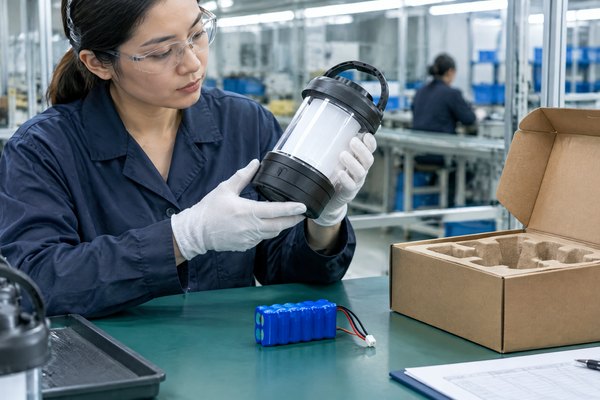
A useful sourcing decision starts with a written requirement that can be challenged, sampled, inspected, and approved.
Direct answer (short): For B2B buyers evaluating portable power station accessory cables for private label camping lighting, start by defining the power and connector requirements for every lighting product (voltage, peak current, connector type, polarity), then match cable gauge, length, and environmental protection. Confirm destination-market mandatory tests and label requirements, run a factory sample and in-line inspection plan, and plan packaging and spare-part logistics. CampLume is an OEM/ODM camping gear manufacturer and can advise on manufacturing trade-offs, but exact requirements depend on the product and the destination market.
Why portable power station accessory cables matter for private label outdoor lighting
Accessory cables are more than a convenience item. For a private label camping lantern, cable choice determines safety, reliability, perceived quality, and return rate in the field. A poor cable (wrong gauge, incorrect connector, or inadequate strain relief) causes voltage drop, heat, intermittent connections, and warranty claims. When you pair a rechargeable lantern with power bank or portable power station, the cable is the electrical and mechanical interface—specify it deliberately.
Key buyer outcomes you should target during evaluation:
- Safe and consistent power delivery with appropriate margin for peak loads.
- Connectors that match common portable power station outputs and consumer expectations.
- Environmental protection (IP, UV, temperature) for outdoor use.
- Clear spare-parts and repair strategy to reduce returns.
Typical product pairings and use cases
Understanding how end users will use the product narrows cable choices.
Recreational campsite lighting
Most campers want quick setup and a clean connection between power station and lighting. Typical loads: string lights, rechargeable work light for camping, or a small rechargeable camping string lights set.
Remote or extended trips
Long runs, higher currents, and exposure to weather require thicker gauges, sealed connectors, and clear field-repair instructions.
Commercial rental or event lighting
Rental fleets need heavy-duty connectors, replaceable pigtails, and serialized parts tracking.
Technical specification checklist (what to specify precisely)
A usable product specification reduces iteration during sample review. At minimum include:
- Electrical: nominal voltage, continuous and peak current, acceptable voltage drop, polarity, and inrush characteristics.
- Physical: cable length options, conductor gauge (AWG or mm²), strand count, jacket material, bend radius, and strain relief type.
- Connector: exact mating part number, IP rating when mated/unmated, locking mechanism, and color-coding or keying for polarity.
- Environmental: operating temperature range, UV resistance, salt-spray consideration for coastal markets.
- Regulatory and test expectations: confirm the applicable requirement for the destination market (safety standards, RoHS, REACH, battery-transport restrictions if integrated).
Connector types and buyer trade-offs
- Barrel DC plugs: inexpensive, common for low-power lanterns, but limited sealing and varied sizes—specify exact OD/ID and length.
- Anderson Powerpole / SB / XT60-style: reliable for higher current and repeated mate cycles; consider keyed housings for polarity control.
- USB-C PD cable: useful when the portable power station supports USB-C output and the lantern accepts PD; requires negotiation logic if the lantern charges directly.
- Custom waterproof couplers: necessary when maintaining IP68-level systems, but higher cost and longer lead times.
Cable gauge, length, and voltage drop
Match gauge to current and length to keep voltage drop within acceptable limits. For example, a long run to string lights may need thicker gauge to avoid dimming. Specify acceptable voltage drop (e.g., less than 3–5%) and include test method in the spec (load at 1x and 3x rated current, measure drop).
Environmental protection and mechanical durability
For private label outdoor lighting you will often want UV-stabilized jackets, rated flex life, and damp-heat resistance. If the cable will be coiled and stored, specify tension and bend testing. For commercial or rental use, add crush and abrasion resistance criteria.
Design considerations for private label camping products
Private label camping lantern and private label outdoor lighting lines should consider consistent user experience.
Product family decisions
Decide whether your lantern, string lights, and work lights use the same cable/connector family. Standardizing reduces SKU complexity, reduces consumer confusion, and simplifies spare-part inventory.
Branding and packaging integration
For a private label camping lantern, cable color, jacket texture, and connector finishes contribute to perceived quality. Coordinate cable design with packaging and instruction manuals so users understand polarity and safe connection steps.
Battery integration and power bank functions
When a rechargeable lantern with power bank feature is part of the product, the cable often serves dual roles: charging the lantern and drawing power to an external device. Specify charge/discharge current limits, thermal limits, and whether the cable must support data lines (e.g., for USB-C PD).
Rechargeable vs battery powered camping lantern for retail — evaluation points
When choosing between rechargeable vs battery powered camping lantern for retail, evaluate total cost of ownership, perceived convenience, and logistics.
- Retail positioning: Rechargeable lanterns often command higher retail price and lower SKU friction (no need for spare batteries). Battery-powered models may appeal in regions with cheap disposable batteries or where charging infrastructure is limited.
- Returns and service: Rechargeable units bring electronics and battery warranties—plan spares, replaceable cables, and clear RMA policies. Include spare portable power station accessory cables in repair parts lists.
- Packaging and compliance: Rechargeable units with batteries may have shipping restrictions and specific labelling for air transport. Confirm applicable requirement for market transport rules before committing to bulk shipments.
Sample review, testing, and factory inspection workflows
A rigorous sample and inspection workflow reduces surprises at scale. Below is a sequence you should adopt during evaluation.
-
Product specification (buyer): Provide a controlled spec document listing electrical, mechanical, environmental, and labeling requirements. Attach reference drawings and connector datasheets.
-
Pre-production samples (factory): Ask for both functional and production-intent samples. Functional samples let you confirm electrical behavior; production-intent samples show cable assembly and over-mold quality.
-
In-house and factory testing:
- Full-load electrical test (steady-state and inrush).
- Mechanical: pull test on connector termination, flex-life test, and strain-relief tension.
- Environmental: humidity, salt-spray if applicable, UV exposure for outdoor jackets.
-
Third-party or destination-market testing: For safety-critical or regulated markets, plan for third-party testing or certification. Confirm the applicable requirement for each destination before buying.
-
Inspection plan: Create an AQL or special inspection plan that includes continuity checks, polarity verification, connector fit, dimensional tolerances, and packaging verification. Include a go/no-go checklist for the final run.
-
Production samples and change control: Require a final production sample prior to mass production and document any approved deviations. Use a written change-control process for updates to cable materials, connector vendors, or mold tooling.
Packaging, spare parts, and shipping preparation
Packaging is part of the product experience and protects cables in transit. For private label outdoor lighting:
- Decide whether cables ship boxed inside the primary product or in a separate accessory pack.
- Include a spare portable power station accessory cables option for higher-tier SKUs.
- Labeling: Provide clear polarity, voltage, and safety markings on the cable or an attached tag per destination requirements. Confirm the applicable requirement for iconography and language.
- Shipping: For integrated battery systems, understand air-freight rules. For separate cables, pack to prevent kinking and connector damage — use coiling fixtures or cardboard inserts.
Cost, MOQ, lead time, and logistics trade-offs
Cable assemblies generally have lower unit costs than enclosures, but tooling (molds for over-molds) and connector MOQ can be significant.
- MOQ considerations: Connector vendors may have MOQ; ask factories about connector cross-compatibility to reduce MOQ impact.
- Lead time: Custom over-molds, custom jacket colors, or special plating increase lead time. Plan engineering and procurement lead time into your product launch schedule.
- Unit cost vs robustness: A thicker jacket, higher-strand count, or sealed connector increases per-unit cost but reduces warranty and replacement logistics.
Buyer-decision table (concise)
| Decision Factor | Lightweight Retail Lantern | Heavy-Duty Rental/Event Lighting | Integrated Power Bank Lantern |
|---|---|---|---|
| Typical current draw | Low (<=1A) | High (>=5A) | Medium (1–3A) |
| Recommended connector | Small barrel or USB-C | Anderson/XT60 or waterproof coupler | USB-C PD or robust barrel |
| Recommended gauge | 22–24 AWG | 14–18 AWG | 18–20 AWG |
| IP/Environmental rating | IP44 acceptable | IP67/IP68 preferable | IP54–IP67 depending on design |
| Spare cable strategy | Optional spare retail pack | Mandatory spares inventory | Spare sold as accessory |
Mid-article CTA — Request a technical brief
If you are evaluating cables for a new private label outdoor lighting product, email a short technical brief to oem@camplume.com. Include:
- Target market (US/UK/DE/FR or other)
- Product type (lantern, string lights, work light)
- Nominal voltage and estimated continuous/peak current
- Preferred connector or any required mating device
- Target MOQ and launch timeframe CampLume is an OEM/ODM camping gear manufacturer and will provide an initial feasibility summary and typical design trade-offs based on your brief.
Field support and after-sales planning
To minimize returns and improve customer experience, plan support around the cable as a consumable.
- Spare-parts SKUs: Define spare cable SKUs early and include them in your SKU planning and packaging options.
- Repair procedures: For rental fleets or commercial customers, provide replacement instructions and simple polarity-check steps.
- Warranty policy: Specify when a cable replacement qualifies as warranty versus user damage.
Documentation and labeling requirements
Create clear, product-specific documentation:
- Installation guide showing polarity, connector orientation, and maximum current.
- Safety labels on the cable or attached tags: voltage, polarity, and a concise safety warning in the destination-market language(s).
- Packaging artwork with UPC/GTIN and country-of-origin marking per importer responsibilities.
Frequently Asked Questions (FAQ)
Q: Can I standardize one cable across my entire private label lighting line? A: Often yes, but only after confirming the highest current, required connector, and environmental needs. Standardizing reduces SKUs but may force over-specification for low-power items.
Q: Do I need waterproof connectors for camping lighting? A: It depends on use case. For exposed outdoor string lights or work lights used in wet conditions, choose rated couplers. For sheltered campsite use, a splash-resistant solution may be sufficient.
Q: How should I test for real-world voltage drop? A: Test assemblies at continuous current and at expected peak/inrush. Measure voltage at the far end under load and compare to the supply. Specify acceptable % drop and test procedure in the spec.
Q: What inspection steps should be included at the factory? A: Continuity and polarity checks, connector mating tests, strain-relief pull tests, visual inspection of over-mold quality, and sample environmental tests where required.
Q: Are there transport restrictions for cables shipped with battery-powered products? A: Batteries introduce transport restrictions, not the cable itself. Confirm the applicable requirement for battery shipping and labelling in your destination market before final packing.
Q: How do I control changes once production starts? A: Use a written change-control process. Require production samples for any material or supplier change and update inspection plans accordingly.
Final considerations and next steps
When evaluating portable power station accessory cables for private label outdoor lighting, prioritize precise electrical and mechanical specs, an efficient sample and inspection workflow, and a clear spare-part strategy. If your product will include a rechargeable lantern with power bank feature or be positioned against rechargeable vs battery powered camping lantern for retail, capture the charging and discharge profiles early in the specification phase.
CampLume can support OEM/ODM manufacturing of cable-equipped camping lighting products and can outline realistic lead times, common cost drivers, and sample-test plans once you provide a short technical brief. To start, email oem@camplume.com with the bullet-point brief requested earlier (target market, product type, voltage/current, connector preference, MOQ, and launch date). We will respond with recommended specification templates and a proposed inspection checklist tailored to your product.
Conclusion Choosing the right portable power station accessory cables is a practical, technical decision that affects safety, user satisfaction, and total cost of ownership. Define electrical needs, choose connectors and cable construction to match the use case, validate through targeted testing and inspection, and plan packaging and spares ahead of production. For a custom evaluation or to request specification templates and an inspection plan, contact oem@camplume.com with your brief and CampLume will provide a focused feasibility reply.
Final CTA: Email info@camplume.com with your product category, target market, estimated quantity, current specification and packaging stage. Request a documented response that identifies assumptions, open evidence and the next approval gate.
Related CampLume resources
-
Read: What Should Buyers Check When Sourcing Rechargeable Camping Lanterns? for a connected sourcing decision.
-
Explore CampLume lighting options to compare a relevant product platform.
-
See the CampLume buyer FAQ for concise guidance on samples, MOQ, quality control, compliance and shipment preparation.
-
Discuss an OEM or ODM brief with CampLume when product configuration, custom branding or packaging needs to be scoped.
Project discussion
Need to apply this guide to a product programme?
Send your product category, target market, estimated quantity, current specification and packaging stage. CampLume will continue the discussion by email.
Email info@camplume.comSources and further reading