A useful sourcing decision starts with a written requirement that can be challenged, sampled, inspected, and approved.
Direct Answer — What To Choose And Why
Choose a solar charging cable portable power station solution that matches the power profile of your portable power station, the input requirements of the solar panel, and the field use of the lighting product. For buyers of camping lighting (warm white camping lanterns or portable LED tent light systems), the cable must match connector type, current capacity, and IP durability; the lanterns must meet market-specific battery and electrical compliance. Exact requirements depend on the product design and the destination market — specify the market early so the supplier can align materials, documentation, and testing.
Market Context: Why Cable, Power Station and Light Are An Integrated Purchase
Sourcing a solar charging cable portable power station is not just buying a cable. It affects charging speed, safety, warranty claims and how end users use warm white camping lanterns or a portable LED tent light inside a tent. Common buyer pain points:
- Mismatched connectors and voltages that prevent charging or damage equipment.
- Insufficient cable gauge causing overheating under real-world sun and load conditions.
- Weather exposure and poor sealing that cause early failures.
- Regulatory issues: the EU battery regulation rechargeable lantern rules differ from national importer expectations in France and Germany.
Deciding up front how the cable and power station integrate with the lighting product reduces late-stage engineering changes.
Key Technical Specifications To Specify Early
Specifying the right parameters in your product requirement document (PRD) saves time during sample review and factory testing.
Electrical and connector specs
- Nominal voltage and maximum input voltage supported by the portable power station.
- Continuous current rating and peak current; size the cable conductor (AWG / mm2) accordingly.
- Connector family (MC4, Anderson, DC barrel, USB-C PD, or custom). If you plan compatibility with commercial solar panels, choose a common connector.
Mechanical and environmental specs
- IP rating for in-field exposure (IP65, IP67, etc.), UV resistance of jacket material, and operating temperature range.
- Length and service loop allowances; folding and storage constraints with your product packaging.
Safety and performance
- Overcurrent and reverse current protection expectations (diodes, blocking circuits).
- Expected lifetime cycles and minimum insulation resistance after environmental aging.
Define these in the product specification so suppliers can send exact-match samples.
Lighting Choices: Lantern Types, Color Temperature And Application
Lighting product selection is driven by application. For campsite ambience and indoor tent use, color temperature and glare matter.
Warm White Camping Lantern: When It’s Right
A warm white camping lantern typically sits between 2,700K and 3,200K. Use cases:
- Social camp areas and family tents where color rendering and comfortable light are priorities.
- Product messages that emphasize mood and relaxation.
Battery management and heat dissipation are important when pairing with a solar charging cable and power station — sustained use can draw steady currents that stress both lantern battery and cable.
Warm White Vs Cool White Camping Lantern: Trade-offs
Warm white vs cool white camping lantern decisions depend on task and perception:
- Warm white creates a cozy atmosphere and hides skin imperfections; it usually uses LEDs with slightly lower luminous efficacy at the same CRI.
- Cool white (4,000K–6,500K) increases perceived brightness and contrast, useful for cooking, first aid, or reading.
For B2B buyers: offer SKUs with both temperatures or tunable CCT models if your target retailers demand versatility.
Portable LED Tent Light: Low Power, High Reliability
A portable LED tent light is often low-voltage and may draw power via the same portable power station through USB or DC outputs. Specify:
- Low EMI drivers and soft start for long battery life.
- Mounting options (clip, hanging loops) to match customer use cases.
Regulatory and Importer Compliance: EU, France, Germany And Beyond
Regulatory obligations vary by the product (cable, power station, lantern) and by market.
- EU battery regulation rechargeable lantern: Confirm the applicable requirement for batteries inside a rechargeable lantern under EU battery and waste rules, and ensure documentation for recycling, labeling and substance restrictions is provided by the supplier.
- French camping light importer battery compliance: French importers may expect additional documentation or national registration for battery collection schemes; confirm the French requirements for registration and producer responsibility obligations before shipment.
- German outdoor light importer CE RoHS: German outdoor light importer CE RoHS compliance typically expects CE marking where applicable and conformity with RoHS for restricted substances. The importer should confirm the standards that apply to the assembled product (cable, electronics and battery together) and request the supplier’s technical file.
For every market, confirm the applicable requirement rather than assuming universal coverage — CampLume can design to specific destination-market documentation requirements provided in the purchase brief.
Supplier Qualification And Factory Workflow
A structured supplier qualification minimizes surprises. Below is a practical workflow and checkpoints for CampLume as your OEM/ODM partner.
Product Specification (Buyer Action)
Provide a comprehensive specification sheet that includes:
- Electrical specs for cable and power station inputs.
- Mechanical drawings with tolerances for connectors and housings.
- Target color temperature and lumen output for lanterns and portable LED tent light.
- Expected compliance destinations (EU, UK, DE, FR) and requested documentation (e.g., Declarations of Conformity, safety test reports).
This specification becomes the baseline for sample production and change control.
Sample Review (Buyer + Supplier)
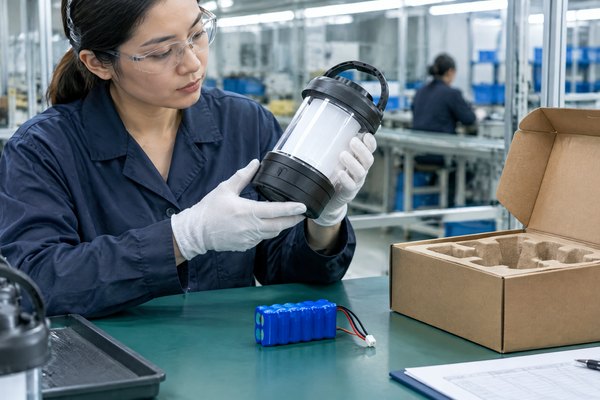
Request initial prototype samples that include the exact cable ends, power station input port, and a representative lantern. Review steps:
- Visual inspection for connector fit and jacket quality.
- Functional testing: charge the power station under standard test solar input and use the lantern across its dimming range.
- Field validation: outdoor sunlight charging cycle and overnight lamp usage to verify energy budgets.
Document non-conformances and issue a change order if needed.
Factory Testing And Inspection
Typical factory testing to request:
- Continuity and resistance tests for cables, plus pull-force tests on connectors.
- IP spray/immersion tests as required by the IP rating you specified.
- Battery cell verification (supplier data), cycle testing procedures, and final assembly functional checks.
Book a third-party pre-shipment inspection if required and include an agreed sampling plan and acceptance criteria.
Change Control
Define a change control process before production begins:
- Minor changes (component substitutions within agreed equivalence) require written approval.
- Major changes (different cell chemistry, connector family or revised charging IC) require new samples and a documented impact assessment on safety and compliance.
This prevents unexpected shipments that fail importer audit or regulatory checks.
Mid-Article CTA: Send Your Requirements
If you are evaluating solar charging cable portable power station, email info@camplume.com with your product category, selling market, estimated quantity, current specification and packaging brief. Ask for a documented reply that separates assumptions and deviations from the quotation.
Packaging, Shipping Preparation And Documentation
Packaging and shipping affect landed cost and product condition.
- Protective packaging: ensure cables and lanterns are packaged to avoid connector damage and crushing. Include clear instructions on folding or coiling to avoid conductor kinks.
- Labeling: comply with the importer’s label requirements (batch codes, country of origin, compliance marks). For EU shipments, include waste/battery labels if applicable.
- Shipping documents: commercial invoice, packing list, bill of lading, and any certificate of conformity or test reports requested by customs or the importer.
For high-volume orders include a packing verification checklist in the purchase order so the factory can prepare accurate shipping manifests.
Sample Tests And On-Site Field Checks (Buyer Checklist)
When you get samples, run the following practical checks before approving mass production:
- Connector Interoperability: Use the target solar panel and power station to confirm fit and current flow.
- Thermal Run Test: Run a full-day charging cycle in strong sun with the cable under load, then check for hot spots.
- Lantern Burn Test: Run the warm white camping lantern (and any cool white variants) across advertised dim levels for a full discharge cycle to confirm run-time claims.
- IP Test Simulation: Spray and dust tests to ensure seals hold up under expected field conditions.
Record results in a structured sample review form and include photos and video where relevant.
Quick Buyer-Decision Table
| Decision Factor | When To Choose A Standard Cable | When To Choose A Custom Cable |
|---|---|---|
| Connector Compatibility | Using common MC4/Anderson/USB-C ecosystem | Proprietary system or brand lock-in |
| Current Capacity | ≤15A typical portable power stations | >15A or long cable runs requiring thicker conductor |
| Environmental Toughness | Indoor/garage use or occasional outdoor | Full outdoor exposure, sand/UV/immersion resistance expected |
| Regulatory Needs | Single market with known rules | Multiple markets (EU, FR, DE) requiring custom labels/docs |
Mid-Article CTA — Brief To Request Samples
Email our product team at info@camplume.com with a short brief: include target market(s), expected annual volume, required connectors, voltage/current specs, target color temperature (K) for lanterns, required compliance documents (e.g., CE, RoHS, EU battery regulation rechargeable lantern expectations), and an expected timeline. Attach any sketch or reference product photos. We will respond with a sample plan and estimated tooling or NRE costs.
Pricing, Lead Times And Scaling Considerations
- Pricing starts with BOM cost (cable conductor, connector, jacket material), tooling or connector molds, and testing/documentation costs for regulated markets. Ask suppliers to separate unit cost from one-time NRE so you can model scaling.
- Lead times often include sample lead time (2–6 weeks), small pilot runs (4–8 weeks) and full production runs (8–16 weeks), depending on component availability and testing schedules.
- Scaling: confirm supply chain resilience for battery cells and key connectors to avoid long lead-time surprises.
Practical Notes For Importers In France And Germany
- French camping light importer battery compliance: start by asking your supplier for evidence of battery chemistry, labeling, and recycling chain details. French obligations for producer responsibility can impose additional administrative steps.
- German outdoor light importer CE RoHS: German importers typically expect a clear technical file demonstrating conformity; confirm which harmonized standards were used and that your supplier can supply a Declaration of Conformity on request.
CampLume can produce documentation packages aligned to buyer-specified markets — include the final destination in your initial brief.
FAQ
Q: What information should I include in the initial purchase brief? A: Include target market(s), intended retail use (camping, rental, emergency), electrical specs (voltage, max current), connector type, desired cable length, ambient/environment specs (IP rating, UV exposure), target color temperature for lanterns, forecast volumes and requested compliance documents.
Q: How do I verify the EU battery regulation rechargeable lantern requirements are met? A: Ask the supplier for the battery data sheet, labeling plan, and the recycling/provenance statements they will include. Confirm whether additional national registration is needed in the destination country.
Q: Can the same cable serve multiple power station models? A: Yes if the connector, voltage and current match. For cross-compatibility, choose a common connector (e.g., USB-C PD for low-power systems) or provide adapter options.
Q: What factory tests should I require before shipment? A: Continuity and resistance, pull/push force on connectors, IP verification, functional charge/discharge cycles, and a visual inspection checklist. For batteries, request cell-level vendor data and functional cycle test plans.
Q: If I’m selling in Germany, what does CE RoHS mean for me? A: It means your assembled product should follow the relevant EU directives and restricted substances rules; German importers often expect a complete technical file and a clear Declaration of Conformity. Confirm the applicable standards for your exact product.
Q: How do I control design changes during production? A: Implement a written change control clause in the purchase order that defines minor vs major changes, approval timelines, and sample/retest requirements. Require the factory to notify you of any component substitutions in writing.
Conclusion — Next Steps And Clear CTA
Specifying the solar charging cable portable power station properly at the start avoids common field failures and regulatory headaches. For a practical next step, prepare a short brief and email info@camplume.com with: destination market(s), target annual volume, connector and electrical specs, requested compliance documents (CE, RoHS, battery info for EU), and a target timeline. CampLume will respond with a sample plan, estimated costs, and a suggested test and inspection checklist tailored to your product.
If you already have a draft spec or reference photos, attach them in the brief to speed the sample phase. A clear specification and early discussion about EU battery regulation rechargeable lantern expectations or German outdoor light importer CE RoHS needs will reduce iterations and launch time.
Conclusion: Turn the Brief Into a Controlled Buying Decision
The practical aim of a solar charging cable portable power station programme is not to collect broad assurances; it is to connect the approved product configuration, sample, evidence, packaging, inspection and shipment release to the same buyer brief. That record helps the product, sourcing, quality and logistics teams resolve assumptions before they become a production or delivery problem.
Final CTA: Email info@camplume.com with the product category, target market, estimated quantity, current specification and packaging stage. Request a response that identifies assumptions, open evidence and the next approval gate.
Related CampLume resources
-
Read: What Should Buyers Check When Sourcing Rechargeable Camping Lanterns? for a connected sourcing decision.
-
Explore CampLume lighting options to compare a relevant product platform.
-
See the CampLume buyer FAQ for concise guidance on samples, MOQ, quality control, compliance and shipment preparation.
-
Discuss an OEM or ODM brief with CampLume when product configuration, custom branding or packaging needs to be scoped.
Project discussion
Need to apply this guide to a product programme?
Send your product category, target market, estimated quantity, current specification and packaging stage. CampLume will continue the discussion by email.
Email info@camplume.comSources and further reading