A useful sourcing decision starts with a written requirement that can be challenged, sampled, inspected, and approved.
Direct Answer Introduction
If you need a reliable, stackable storage solution for outdoor gear, focus first on specification and logistics: define the exact internal usable volume, target material (hard plastic vs. fabric), lid and latch type, weight target, and your shipping route. Once those are set you can firm MOQ and pricing, confirm packaging (carton size and FBA variants), arrange sample review and factory inspections, and finalize a container loading plan. Requirements will vary by design and destination market — confirm the applicable requirement for CE marking, language, or chemical limits for each destination before final approval.
What Buyers Must Decide First
- Core product spec: external dimensions, internal usable volume (verify the 80 litre usable vs. nominal claim), max load, UV and abrasion resistance.
- Intended channel: general retail, private label, or marketplaces that use FBA (camping storage box FBA packaging is a common constraint).
- Shipping terms: FOB is typical, but many buyers choose camping storage box DDP shipping to simplify final delivery and duties.
- Target MOQ and price band: define your acceptable camping storage box MOQ and work from there.
Product Specification and Design Workflow
Define Volumes and Dimensions
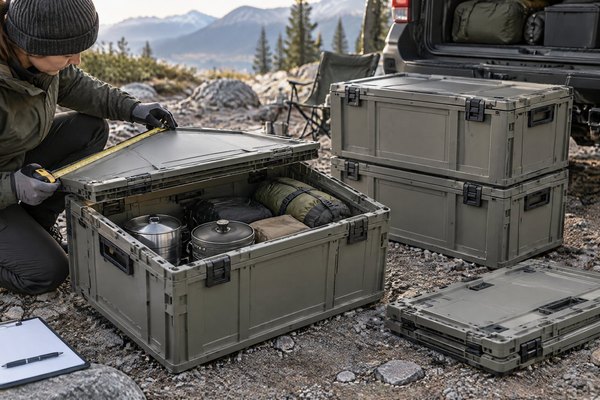
For an 80 litre camping storage box the difference between nominal and effective volume is material thickness and internal fittings. Ask suppliers for: internal usable volume (litres), external length/width/height, and net weight. These feed carton sizing and the camping storage box carton dimensions you’ll need to plan logistics.
Functional Requirements
List required features: stackability, drainage holes, reinforced bottom, lock points, hinges, weather seal, handles rated to X kg. Decide whether you need a double-lid or a single snap-fit lid — this affects tooling and cost.
Materials and Durability
Common choices are rotationally-moulded HDPE (rigid, durable) and polyester fabric (lightweight, foldable). HDPE will usually be heavier, require injection or roto tooling and produce more exact carton dimensions for container planning. Fabric systems may compress for denser container packing but often require internal frames.
Prototyping, Samples and Testing
Sample Types and Sequence
- CAD and specification confirmation. 2. Factory-made prototype (functional). 3. Pre-production sample (representative of mass production). 4. Production sample after first run.
Review samples for fit, finish, printed graphics, and functional tests (closure strength, handle pull, hinge cycles). When using CampLume as an OEM/ODM partner, expect iterative sample rounds tied to tooling or fabric adjustments.
Factory Testing and Inspection
Specify which factory tests you require: dimensional check, load testing, UV exposure, salt spray (if metal parts included), and drop testing. Arrange IQC (incoming material checks), IPQC (in-process), and a pre-shipment inspection. Confirm whether your buyer requires a third-party inspection or allows vendor-managed inspection.
Packaging, Labeling and FBA Requirements
Packaging Strategy
Packaging affects import costs and retail readiness. For retail cartons list the camping storage box carton dimensions and net/gross weight per carton. If you plan to ship direct to marketplaces, you’ll need to adapt packaging to their standards.
- For bulk retail: minimal inner packaging, carton with foam or corrugated partitioning.
- For display-ready: printed retail cartons or shelf-ready trays.
- For Amazon or similar: follow their specific camping storage box FBA packaging requirements — this includes suffocation warnings, poly bag thickness, and often individual barcode application.
Barcode Labeling and Compliance
Plan for camping storage box barcode labeling on both the retail carton and inner item as required. Confirm whether you need manufacturer (GS1) barcodes or marketplace-specific labels. Provide a labeling map for the factory showing placement, size, and print quality expectations.
Example Labeling Checklist
- Item barcode (EAN/UPC) on retail carton.
- FNSKU or marketplace label if using FBA.
- Country of origin statement.
- Safety and content labels per destination (confirm local rules).
Minimum Order Quantity and Cost Drivers
camping storage box MOQ depends on manufacturing method and tooling cost. For injection-moulded or rotational-moulded rigid boxes the MOQ is driven by tooling amortization — buyers will often see reasonable pricing at several hundred to a few thousand units. For fabric or welded options, MOQ can be lower but depends on accessory sourcing (zippers, buckles).
Price drivers to monitor:
- Tooling and mould cost.
- Material grade (UV-stabilised HDPE vs. commodity plastic).
- Secondary operations (printing, painting, metal fittings).
- Packaging customization and required tests.
- Logistics mode: DDP vs. FOB changes landed cost.
Quality Control, Change Control and Documentation
Document every approved sample and the associated spec sheet. Use a change-control log that records requested alterations, who approved them, and whether they require new samples or tooling updates.
Inspection plan elements buyers typically require:
- Acceptance criteria matrix (dimensional tolerances, visual AQL levels, functional pass/fail).
- Test reports and certs (material data sheets, flammability tests if needed). Confirm the exact documents needed for your destination market.
Logistics, Carton Planning and Loading
Carton Dimensions and Palletization
Provide accurate camping storage box carton dimensions to your freight forwarder early. Carton dimensions determine pallet stacking and the number of units per container. Example inputs you will request from the factory: cartons per pallet, cartons per 20’ or 40’ container, gross weight per carton.
Container Loading Plan
Create a camping storage box container loading plan that lists product cartons, pallet configuration, and sequence for loading and unloading. For rigid HDPE boxes that stack, you can maximize vertical stacking; for fabric boxes that compress, optimize by layering.
DDP vs. FOB and Transit Considerations
Many buyers choose camping storage box DDP shipping to simplify final delivery and customs, but DDP transfers import/responsibility costs to the supplier and will typically raise the per-unit landed cost. FOB keeps customs and inland delivery responsibility with the buyer. Decide based on your logistics capability and risk tolerance.
Mid-Article CTA: Send Your Requirements
If you are evaluating 80 litre camping storage box, email info@camplume.com with your product category, selling market, estimated quantity, current specification and packaging brief. Ask for a documented reply that separates assumptions and deviations from the quotation.
Factory Acceptance and Pre-Shipment
Set criteria for factory acceptance: production sample approval, passed inspections, full packaging confirmation (including camping storage box barcode labeling and carton printing), and completion of export documentation. Confirm that the factory will provide photos of packed pallets and a container loading list before loading.
Mid-Article CTA — Request A Short Email Brief
If you want a fast, specific price and feasibility check from CampLume, email a one-paragraph brief to sourcing@camplume.com. Include: target market, intended channel (retail/FBA), required external dimensions and weight, target camping storage box MOQ, preferred material, desired lead time, sample requirements, and whether you want DDP or FOB pricing.
Buyer Decision Table
| Decision Factor | Low-Cost Retail (High MOQ) | Premium Retail (Lower MOQ) | FBA Channel (Marketplace) |
|---|---|---|---|
| Typical MOQ | 500–2000+ | 200–1,000 | 100–1,000 (depends on label rules) |
| Material | Thin HDPE / Lower grade | Thick UV HDPE / Reinforced | HDPE or Fabric per weight limits |
| Packaging | Bulk cartons | Retail printed boxes | Strict FBA packaging & labels |
| Primary Cost Driver | Volume & tooling amortization | Material & finishes | Additional labeling & polybags |
| Logistics Focus | Maximize container density | Better product presentation | Compliance with FBA receiving rules |
Practical Examples of Common Buyer Requests
- A private label buyer asked for an 80 litre camping storage box with two locking points and a recessed lid for stacking. The workflow included CAD approval, two functional prototypes, and a 15-point QC checklist before first shipment.
- A marketplace seller needed camping storage box FBA packaging and barcode stickers applied at source. The factory pre-applied FNSKU labels to each item and provided carton-level label photos to approve before shipping.
- A distributor requested camping storage box DDP shipping to a European warehouse. The supplier priced DDP including duties and local delivery; the buyer compared that to FOB plus expected local lead time and customs handling costs.
Common Pitfalls and How to Avoid Them
- Undefined usable volume: Confirm internal usable litres rather than relying on nominal capacity claims.
- Missing label requirements: Provide label artwork and exact placement instructions early to prevent repacking delays.
- Underestimated carton sizes: Overly optimistic carton dimensions reduce fill rate and increase freight cost — insist on factory-measured carton dimensions.
- No change control: Small mid-run changes without documented approval lead to inconsistent batches.
FAQ
Q: How do I confirm the true internal capacity of an 80 litre camping storage box? A: Request a dimensional drawing with internal X, Y, Z measurements, and ask the factory to calculate internal cubic volume. Also request a physical internal-volume check using water or known-volume test where practical for prototypes.
Q: What is the typical camping storage box MOQ for roto-moulded boxes? A: Rotational moulding and injection moulding MOQs depend on tool cost recovery — often several hundred to a few thousand units. Confirm exact camping storage box MOQ with the factory once you provide final specs and required finishing.
Q: Can the factory apply marketplace barcode labels and meet FBA requirements? A: Yes, many factories will apply labels and prepare FBA-compliant packaging. Provide your exact marketplace label files (FNSKU) and packaging instructions; ask the factory to send photos of each labeled item and the final cartons before shipment.
Q: What documentation is typical for DDP shipments to Europe? A: DDP requires full export documentation, commercial invoice indicating DDP terms, packing list, and any destination-specific documents. Confirm the applicable requirement for your destination market and whether additional certificates (e.g., chemical compliance) are required.
Q: How should I plan carton dimensions for container loading? A: Use factory-measured camping storage box carton dimensions, decide cartons-per-pallet, and run a container loading simulation to determine the number of cartons per 20’/40’ or 40’ HQ container. Ask your freight forwarder or your CampLume sourcing contact to provide a camping storage box container loading plan.
Q: What level of inspection should I require before shipment? A: Common practice is a pre-shipment inspection with a reduced AQL for critical defects plus function tests. For first orders or new tooling, include IQC, IPQC checkpoints and consider a third-party pre-shipment inspection.
Final Steps Before First Production Run
- Lock the final approved pre-production sample and sign off the spec sheet. 2. Confirm tooling and sample timelines with milestone dates. 3. Agree packaging and labeling mockups including camping storage box barcode labeling and exact camping storage box carton dimensions. 4. Choose shipping terms (FOB or camping storage box DDP shipping) and request a container loading plan for your forwarder. 5. Define an inspection plan and sign-off procedure including change control rules.
Conclusion and CTA
An 80 litre camping storage box purchase hinges on clear specs, packaging and logistics planning. Start by finalizing internal volume, material, and channel (retail or FBA), then confirm camping storage box MOQ, packaging, labeling and your preferred shipping terms. To get a tailored feasibility and pricing quote from CampLume, email a concise brief to sourcing@camplume.com with: target market, dimensions, desired MOQ, material preference, FBA needs (if any), and whether you want DDP or FOB pricing. We will respond with next-step questions and a suggested sample and inspection plan.
Conclusion: Turn the Brief Into a Controlled Buying Decision
The practical aim of a 80 litre camping storage box programme is not to collect broad assurances; it is to connect the approved product configuration, sample, evidence, packaging, inspection and shipment release to the same buyer brief. That record helps the product, sourcing, quality and logistics teams resolve assumptions before they become a production or delivery problem.
Final CTA: Email info@camplume.com with the product category, target market, estimated quantity, current specification and packaging stage. Request a response that identifies assumptions, open evidence and the next approval gate.
Related CampLume resources
-
Read: How to Source Outdoor Storage Boxes for a Private-Label Camping Range for a connected sourcing decision.
-
Explore CampLume storage options to compare a relevant product platform.
-
See the CampLume buyer FAQ for concise guidance on samples, MOQ, quality control, compliance and shipment preparation.
-
Discuss an OEM or ODM brief with CampLume when product configuration, custom branding or packaging needs to be scoped.
Project discussion
Need to apply this guide to a product programme?
Send your product category, target market, estimated quantity, current specification and packaging stage. CampLume will continue the discussion by email.
Email info@camplume.comSources and further reading