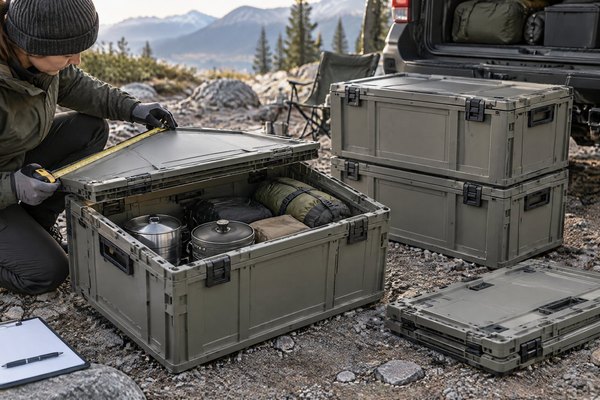
A useful sourcing decision starts with a written requirement that can be challenged, sampled, inspected, and approved.
Direct Answer — What This Guide Helps You Decide
If you're selecting an outdoor storage box manufacturer for private-label or wholesale programs, this guide gives the practical checklist and workflow you need: how to write product specifications, review samples, set pass/fail testing and inspection, prepare packaging for shipping, qualify suppliers, and maintain change control across production runs.
Why this matters: decisions about capacity (for example a 50 litre camping storage box vs a 60 litre camping storage box), stacking and lid fit, gasketing, material choice and labeling all change tooling needs, test plans, cost and shipping volume. Requirements also depend on the destination market (packaging, labeling, chemical limits and import documentation). Confirm the applicable requirement with your compliance team or local importer.
1. What To Define In Your Product Specification
A precise product specification is the single best risk reducer. Include measurable, testable requirements rather than vague descriptions.
Key fields to include
- Product overview and primary use (e.g., campsite gear storage; RV trunk organiser; outdoor deck storage). State whether you expect the product to serve as an RV camping storage organizer or general campsite box.
- Exact camping storage box dimensions (external and internal), lid height, wall thickness and tolerances.
- Capacity targets (e.g., 50 litre camping storage box or 60 litre camping storage box) and how you calculate capacity (ISO liters vs nominal).
- Materials and specific grade (e.g., UV-stabilized polypropylene, high-density polyethylene). Specify color, UV-additives or flame-retardant requirements only if you have test justification.
- Hardware and accessories: hinges, locks, padlock points, gasket type, handles and fasteners (stainless, zinc-plated, molded-in).
- Functional targets: weight capacity for stacking, IP rating for dust/water, load on lid when stacked.
- Surface and print: silk-screen, pad-print areas, private label requirements, and any adhesive backing for labels.
- Packaging and palletization: pieces per inner carton, cartons per pallet, carton dimensions, and sample carton weight.
- Documentation required: CO, packing list format, test reports requested, and customs HS code.
Sample specification excerpt (short):
- Product: 50 L camping storage box, external dims 540×360×260 mm ±3 mm, internal usable volume 50 L ±5%.
- Material: UV-resistant PP, 2.5 mm wall thickness nominal.
- Lid: snap-fit with EPDM gasket and 2 metal-reinforced padlock points.
Why dimensions and capacity must be explicit
'50 litre' or '60 litre' can be interpreted differently by suppliers. Provide both internal usable volume and external dimensions to avoid acceptance disputes. Add a simple volumetric test: fill to overflow with water to confirm internal capacity on the first article.
Packaging specification
Decide whether you'll accept bulk camping storage boxes packed loose in cartons or individually boxed with printed private label sleeves. Packaging affects landed cost and breakage rates during transit.
Labeling, barcodes and language
Specify barcode symbology, placement, language and statutory markings required for each destination market.
2. Capacity, Use Cases and Buyer Decision Table
How to match SKU capacities to buyer needs. Below is a concise comparison table to help you choose between common options.
| Use Case | Typical Capacity | Advantages | Notes for sourcing |
|---|---|---|---|
| Small kit / RV under-seat storage | 50 litre camping storage box | Fits many RV compartments; lower weight and freight volume | Verify exact camping storage box dimensions for RV fit |
| Family gear, tent and lines | 60 litre camping storage box | Higher volume for bulky items; good for basecamp | Check lid opening clearance and stacking strength |
| Retail multi-pack or wholesale | bulk camping storage boxes (mixed sizes) | Economies of scale; pallet optimization | Confirm MOQ, cartonization and labeling options |
3. Materials, Features and Product Application
Material choices and component details will drive performance and tooling needs.
Common materials and their trade-offs
- Rotationally molded polyethylene: good for one-piece, seamless boxes and high impact resistance; longer lead time for tooling and higher per-unit freight if boxes are large and hollow.
- Injection-molded polypropylene or HDPE: suited for precision tolerances and complex lids/molded-in hinges; tooling cost higher for multi-cavity molds but faster cycle times for large volumes.
- Fabric-based organisers (for RV use): lighter and pack flat for shipping, good for internal organizers inside an RV camping storage organizer system.
Features to request in the spec
- UV stabilization levels and expected outdoor lifetime in hours (buyer should request accelerated UV tests).
- Stack load rating (kg) and how stacking is achieved — interlocking lids vs flat surfaces.
- Drainage or ventilation options to avoid condensation for long-term outdoor storage.
Product application notes
If the product will be marketed as an RV camping storage organizer, specify corner radii and external dimensions that fit common RV lockers and under-seat areas. For rooftop uses or trailer mounts, call out tie-down points and wind-load considerations.
4. Quality, Factory Testing, and Inspection Workflow
Define the tests and inspection points required in the contract and include acceptance criteria. Testing can occur as part of sample review, pre-production, and final inspection.
Typical test plan items
- First Article Inspection (FAI): dimensional check against your camping storage box dimensions and visual checklist.
- Functional tests: lid open/close cycles, hinge durability cycles, gasket compression and water ingress tests for the first few samples.
- Material verification: vendor-supplied material certificates and, where required, random lab testing for chemical limits.
Inspection stages
- Pre-production sample approval: confirm visual, dimensional, print, and functional items before tooling release.
- During production: line checks and AQL inspections at agreed frequency (e.g., 2.5/4.0 for a first shipment) with photographic evidence for critical non-conformances.
- Final inspection and container loading: confirm carton counts, palletization, and shipping marks.
Factory testing and documentation
Request a documented test log and photos for each production run. For items claiming weather resistance, require lab test results before scale production; confirm the applicable requirement rather than assuming a universal standard.
5. Sample Review, Prototyping and Change Control
A disciplined sample and change-control workflow prevents surprises.
Sample workflow steps
- Concept prototype: low-cost mock-ups to verify dimension and fit for RV applications.
- Pre-production sample (PPS): manufactured on final tooling, used to approve production specifics such as lid fit, gasket compression and pad-print quality.
- Production sample: from initial production run to verify manufacturing stability.
Sample acceptance criteria
Include a sign-off form that lists the camping storage box dimensions, print color codes, hardware part numbers and packing configuration. Retain signed samples for future reference and dispute resolution.
Change control
Require written approval for any tooling or material changes. Establish a baseline Bill of Materials (BOM) and revision process: supplier must submit an ECO (Engineering Change Order) with samples and impact on cost/lead time for your review.
6. Packaging, Shipping Preparation and Import Documentation
Packaging affects both product protection and landed cost.
Packaging choices
- Individual retail carton with UPC and bespoke artboard (best for retail-ready private label camping storage boxes).
- Bulk cartons with pallet wrap for bulk camping storage boxes destined for fulfillment centers.
- Flat-pack fabric organizers shipped in polybags to reduce volumetric freight.
Cartonization and pallet strategy
Specify inner units per carton and cartons per pallet to calculate cubic meters for sea freight. Freight costs for large-volume plastic boxes can be driven by volume rather than weight; pack efficiently.
Shipping documentation
Provide the supplier with the exact documents you will require at shipping: commercial invoice format, packing list, country of origin declaration, HS codes, and any special documentation required by destination customs. Confirm labeling requirements for the destination market.
7. Pricing, Lead Time, MOQ and Wholesale Options
Understand the levers that affect price and timing.
- MOQ: tooling and mold amortization affect MOQ. Smaller MOQ options may be available but at higher unit price.
- Lead time: tooling (if needed), production cycles and inspection windows determine total lead time. Allow time for sample approvals and potential rework.
- Wholesale models: camping storage box wholesale pricing often requires fixed cartonization and consistent SKUs. Ask suppliers for FOB and CIF quotes and verify whether prices assume standard packaging or private label packaging.
If you need bulk camping storage boxes, obtain a price breakdown that separates material, tooling amortization, packaging and shipping assumptions.
8. Supplier Qualification Checklist (for Evaluation and Purchase Preparation)
Use this quick checklist when evaluating an outdoor storage box manufacturer:
- Do they provide clear manufacturing capability notes (injection, roto, thermoforming)?
- Can they produce the exact camping storage box dimensions you require and show measurement certificates from prior runs?
- Do they provide sample turnaround times and sample photos from tooling trials?
- Can they meet your requested MOQ and lead time, and provide a sample pack for retail-ready or bulk camping storage boxes?
- Are they willing to sign a quality agreement that includes FAI, AQL levels, and ECO/change-control procedures?
- Do they supply documentation required for import (commercial invoice templates, packing list, origin declarations)?
Evaluating private label capability
For private label camping storage boxes, confirm the supplier’s ability to silk-screen or apply labels and to manage color consistency across runs. Request a color standard (Pantone or PMS) and a print approval sample.
Logistics capability
Assess whether the supplier can prepare consolidated shipments or split pallets, and whether they offer DDP/DAP options or only FOB.
Mid-Article CTA — Send a Short Email Brief
If you'd like a concrete feasibility review from CampLume: email procurement@camplume.com with a short brief that includes your target SKU(s), required camping storage box dimensions, target volumes (annual and per-order), preferred material, and whether you need private label or retail-ready cartons. A one-page brief is sufficient to get a first feasibility reply.
FAQ
Q: How do I choose between a 50 litre camping storage box and a 60 litre camping storage box? A: Match interior usable volume to your customer's common items and confirm external dimensions against shipping and storage constraints (e.g., RV under-seat clearance). Also account for weight and freight volume differences.
Q: What are reasonable sample lead times? A: Prototype or concept mock-ups can be produced in 1–2 weeks; pre-production samples on new tooling typically take 3–6 weeks depending on complexity. Confirm with each supplier's lead-time calendar.
Q: Can I buy camping storage box wholesale with private label? A: Yes. Many manufacturers offer camping storage box wholesale pricing and private label services. Expect MOQ and minimum carton quantities for printed cartons or mold changes.
Q: How do I verify camping storage box dimensions during inspection? A: Use a dimensional check list tied to your spec. Randomly inspect samples with calibrated calipers/tapes and document deviations. Include photographed evidence in your inspection report.
Q: Are fabric organizers better for RV use than rigid boxes? A: Fabric organizers pack flatter and reduce freight costs but have different durability and water-resistance profiles. Choose based on application: rigid boxes for heavy-duty storage, fabric for flexible interior organization.
Q: What packaging details should be in the purchase order? A: Specify inner/outer carton quantity, pallet pattern, print and UPC details, pick-face instructions for downstream warehouses, and any export carton markings.
Conclusion and Next Steps
Selecting the right outdoor storage box manufacturer requires clear specifications, an agreed test-and-approval workflow, and defined change-control. Decide early on the capacities you need (for example a 50 litre camping storage box vs a 60 litre camping storage box), whether you will buy private label camping storage boxes or bulk camping storage boxes for wholesale distribution, and document camping storage box dimensions and packaging precisely.
If you want CampLume to review a brief and provide a feasibility response with typical lead times and cost drivers, email procurement@camplume.com with: target SKU name, required camping storage box dimensions, annual volumes, target price band and whether you need private label or RV camping storage organizer options. We will respond with suggested material options, likely tooling needs, and a proposed sample/test plan to move from evaluation to purchase preparation.
Note: requirements depend on the exact product and destination market. Confirm any regulatory or labeling specifics with your compliance team or local importer before ordering.
Final CTA: Email info@camplume.com with your product category, target market, estimated quantity, current specification and packaging stage. Request a documented response that identifies assumptions, open evidence and the next approval gate.
Related CampLume resources
-
Read: How to Source Outdoor Storage Boxes for a Private-Label Camping Range for a connected sourcing decision.
-
Explore CampLume storage options to compare a relevant product platform.
-
See the CampLume buyer FAQ for concise guidance on samples, MOQ, quality control, compliance and shipment preparation.
-
Discuss an OEM or ODM brief with CampLume when product configuration, custom branding or packaging needs to be scoped.
Project discussion
Need to apply this guide to a product programme?
Send your product category, target market, estimated quantity, current specification and packaging stage. CampLume will continue the discussion by email.
Email info@camplume.comSources and further reading