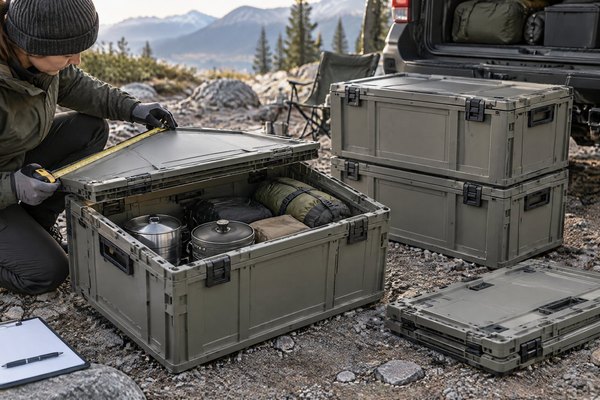
A useful sourcing decision starts with a written requirement that can be challenged, sampled, inspected, and approved.
Direct Answer Introduction
For product managers and private-label brands evaluating camping gear storage bins, the most important decision is aligning the storage system design and materials with the intended use case (car camping, backpacking, roof-rack, or base-camp storage), the destination market requirements, and your supply-chain constraints. This guide explains what to specify, how to qualify an OEM/ODM partner, what to expect during sample review and factory testing, and how to plan packaging and shipping so your first production run arrives with minimal surprises.
Why Storage Systems Matter for Outdoor Brands (Discovery)
Buyers start by defining where the product will be used and sold. A car camping storage system that sits in a vehicle differs in design and materials from an outdoor storage box for camping left at a campsite, or a modular storage solution sold for camper vans. Early decisions will determine tooling needs, minimum order quantities, and regulatory paperwork for the destination market.
Key discovery questions:
- Who is the end user (car campers, family campers, van builders)?
- What are the environmental conditions (sun exposure, water exposure, mud)?
- Will the product be sold retail boxed, shipped direct-to-consumer, or supplied as a B2B component?
Answering these guides the technical specification for camping storage boxes, camping storage containers, and integrated systems.
Define Function and Specification (Product Spec Workflow)
A rigorous specification reduces rework at sampling and production.
What to include in your product spec:
- Intended use case: e.g., foldable trunk organizer for a car camping storage system, stackable rigid storage bin for equipment, or weatherproof outdoor storage boxes for camping.
- Dimensions and weight limits: inside usable volume, load rating for stacking.
- Materials and finishes: e.g., fabric denier, coating (PU/PVC), rigid plastic grade, UV stabilizer requirement.
- Fastening and attachment: buckles, zippers, Velcro, reinforced handles, and vehicle anchoring points.
- Performance requirements: water resistance level, dust ingress level, UV resistance duration, temperature range.
- Packaging and presentation requirements: retail-ready hangtabs, barcode placement, inner polybag and master carton dimensions.
Include acceptance criteria for critical features (e.g., stitching count per inch, handle reinforcement method) and reference tests you want performed during factory testing or inspection.
Materials, Construction and Typical Designs
Choices here directly affect cost, weight and longevity.
Common designs:
- Rigid plastic storage bins: impact-resistant plastic with snap lids for organized camping storage boxes.
- Foldable fabric bins: collapsible fabric frames with reinforced bases for camp kitchen and vehicle use.
- Hybrid systems: rigid base plus foldable sides to save shipping volume.
Material considerations:
- Textile options (for camping storage containers and foldable boxes): 600–1680D polyester or oxford fabrics, PU or PVC coating, seam sealing.
- Thermoplastics (for rigid storage): PP or HDPE with UV packages and grades suitable for outdoor use.
- Hardware: corrosion-resistant zippers, stainless or zinc-plated buckles, and heavy-duty webbing.
Design trade-offs:
- Durability vs. packability: rigid bins are durable but cost more to ship; foldable bins minimize freight costs but may require more reinforcement.
- Weight vs. strength: thicker materials add strength at the expense of weight—important for roof-top or handled applications.
Sample Review, Testing and Inspection (Supplier Qualification)
A good supplier will accept a staged sample and testing workflow. Suggested steps:
- Prototype samples: review fit-and-function first — dimensions, lid fit, handle stitching, and intended feature operation.
- Pre-production (PP) sample: made on production tooling or production-equivalent materials; this is the sample you should use for testing and final approval.
- Factory testing and inspection checklist: the buyer should request visual checks (stitching, seams, mold marks), dimensional verification, load testing for handles and stacking, water resistance checks for outdoor storage boxes for camping, and UV exposure tests where relevant.
- Third-party or in-house testing: where a formal performance claim (e.g., waterproof for 24 hours) is made, request specific test methods. Confirm the applicable requirement for your market rather than assuming a single standard applies globally.
Document all test results, attach photos and batch numbers, and store them with your purchase order documentation.
Manufacturing Details and Change Control
When qualifying a camping storage box OEM manufacturer or a custom camping storage box manufacturer, ensure they provide:
- Clear part numbering and revision history for tooling and patterns.
- Sample records tied to injection mold numbers or cutting dies.
- A written change-control process that requires buyer sign-off for changes in material supplier, tooling, or color formulation.
Practical requests to the factory during qualification:
- Ask for a process flow chart for the chosen SKU: from cutting/molding to assembly to quality check to packing.
- Request photos of the proposed production line set-up and examples of internal quality records for similar products.
- Confirm tooling ownership terms: who owns molds, lead-times for rework, and expected tool life estimations rather than guarantees.
Packaging, Labeling and Shipping Preparation
Packaging choices affect freight costs and inbound handling.
Packaging steps to specify:
- Inner packaging: polybag, silica gel, or folded orientation to preserve shape for custom foldable storage box supplier designs.
- Master carton specification: carton strength (ECT rating), carton dimensions to optimize container cube.
- Palletization rules: units per carton, cartons per pallet, pallet height limit and strapping method.
- Labeling: include carton-level barcodes, country of origin statements as required by the importer, and any retailer-specific label requirements.
Logistics notes:
- For a car camping storage system sold in retail, specify retail-ready packaging and point-of-sale incl. UPC placement.
- For D2C shipments, specify any special packaging requirements for single-unit shipping to reduce returns and damage.
Supplier Qualification Checklist (H2)
Use a structured checklist to compare candidates. Below are three H3 subsections with practical criteria.
H3: Quality Systems and Records
- Do they maintain inspection records per shipment, including AQL results? Ask for examples of inspection checklists used for similar products.
- Confirm how they manage non-conforming parts and corrective actions. Require written documentation for rework procedures and scrap policies.
H3: Manufacturing Capacity and Lead Times
- Confirm realistic lead times for tooling, samples, and production runs at the MOQ you need.
- Query production capacity during peak seasons and how they prioritize orders.
H3: Customization and Tooling Policies
- For a custom camping storage box manufacturer, verify tooling ownership clauses, expected sample timelines after design sign-off, and costs for mold changes.
- If you need a custom foldable storage box supplier, get clarity on fold mechanics, reinforcement methods, and where cutting dies are produced.
Buyer-Decision Table (Quick Comparison)
| Feature / Use Case | Foldable Fabric Bin | Rigid Plastic Bin | Hybrid (Rigid Base + Foldable Sides) |
|---|---|---|---|
| Ideal For | D2C, space-saving inventory | Heavy-duty equipment, stacking | Balance of shipping cost and durability |
| Typical Materials | 600–1680D fabric, PU coating | PP, HDPE | PP base + 600D fabric sides |
| Shipping Volume | Low | High | Medium |
| Cost per Unit (relative) | Low–Medium | Medium–High | Medium |
| Recommended For | car camping storage system, trunk organizers | outdoor storage boxes for camping requiring durability | multipurpose camping storage containers |
Pricing, MOQ and Commercial Terms
Price will depend on tooling, materials, and quantity. Discuss these commercial items early:
- MOQ tiers and price breaks for 1k, 3k, 5k+ units.
- Tooling amortization: how tooling costs are allocated per unit and payment schedule.
- Sample charges and whether sample costs are refundable against production orders.
Ask suppliers to provide a clear quote with a breakout: unit price (FOB), tooling cost, sample cost, lead times, and payment terms. For importers, include landed-cost assumptions: freight, duties, and any required local compliance testing.
Mid-Article CTA: Requesting a Brief from CampLume
If you want a quick qualification response from CampLume, email info@camplume.com with this brief:
- Product name and short description (e.g., foldable trunk organizer for car camping storage system).
- Required dimensions, target weight capacity and preferred materials.
- Target annual volume and desired first production date.
- Any packing or retail presentation requirements. Include CAD files or sketches if available. CampLume will respond with typical lead times, a ballpark quote range, and a proposed sample timeline.
Contracting, Inspection and Final Acceptance
Before production begins, include these terms in the PO and contract:
- Approved pre-production sample (PP sample) must be approved in writing before mass production.
- Agreed inspection protocol and AQL level for critical, major and minor defects.
- Factory test requirements to be completed and shared with batch numbers (photos and reports).
On-site third-party inspection (or buyer-arranged inspection) is recommended for first production lots. Inspections should verify functionality (lid fit, buckle performance), dimensional tolerances, and packaging compliance. Keep a sample packet from the inspected batch for records.
Logistics and Documentation
Required shipment documents typically include commercial invoice, packing list, B/L or AWB, and any requested compliance statements for the destination market. For private-label brands, ensure your importer or customs broker confirms the required documentation for your region.
Plan for inbound QC: schedule a time window for receiving, inspect a first-case sample, and keep a clear defect reporting timeline to the supplier for any discrepancies.
Common Production Issues and How to Prevent Them
- Color matching problems: specify Pantone references and request a color approval sample under standard lighting.
- Weak handles or stitching failures: define stitch type, reinforcement count, and perform pull tests during factory testing.
- Dimensional variance causing stacking issues: include dimensional tolerances in the spec and require dimensional checks in the inspection checklist.
Insist on clear acceptance criteria and require the supplier to document corrective actions for any failures found during sampling or inspection.
FAQ (4–6 Practical Questions)
Q: How do I choose between a foldable and a rigid bin for car camping storage? A: Match the bin to the use case. If minimizing freight and retail shelf space is important, choose foldable fabric bins. For heavy equipment and frequent stacking, choose rigid plastic bins. Consider hybrid options when both are necessary.
Q: What minimum tests should I require from a camping storage box OEM manufacturer? A: At minimum, request dimensional verification, handle pull tests, lid fit/function tests, water resistance checks if marketed as weather-resistant, and visual inspections for finishing. Specify test methods where possible.
Q: How much information should I include in a request for quote to get an accurate answer? A: Provide intended use, target volumes, dimensions, preferred materials, required certifications or tests, packaging expectations, and desired lead times. The more detail, the more accurate the quote.
Q: Can CampLume do custom tooling and small production runs? A: CampLume is an OEM/ODM manufacturer and will discuss tooling and MOQ during qualification. Tooling needs, ownership and MOQ depend on the exact design, materials and destination market requirements.
Q: What documentation should I expect at shipment? A: Typically a commercial invoice, packing list, B/L or AWB, and any compliance documentation requested by the buyer or customs broker. Confirm specific document needs for your destination market.
Final Checklist Before Placing an Order
- Approved technical specification with tolerances and materials listed.
- Signed PP sample approval.
- Agreed tooling terms, unit price, MOQs and payment schedule.
- Inspection and testing plan defined, with AQL levels.
- Packaging and labeling requirements documented, including carton and pallet specs.
- Logistics plan and required shipment documentation confirmed.
Conclusion and Final CTA
Selecting the right camping gear storage bins is a series of choices that balance durability, packability, unit cost and logistics. For OEM/ODM brands, the strongest outcomes come from precise specifications, staged sampling and clear change-control language in contracts. If you are ready to qualify a camping storage box OEM manufacturer or evaluate options with a custom camping storage box manufacturer or custom foldable storage box supplier, email info@camplume.com with the brief outlined above. CampLume will provide a tailored next-step plan including sample timelines, estimated costs, and suggested material options.
If you want a one-page quote checklist instead of a full brief, request it in your email and specify whether your focus is retail, direct-to-consumer, or B2B distribution.
Conclusion: Turn the Brief Into a Controlled Buying Decision
The practical aim of a camping gear storage bins programme is not to collect broad assurances; it is to connect the approved product configuration, sample, evidence, packaging, inspection and shipment release to the same buyer brief. That record helps the product, sourcing, quality and logistics teams resolve assumptions before they become a production or delivery problem.
Final CTA: Email info@camplume.com with the product category, target market, estimated quantity, current specification and packaging stage. Request a response that identifies assumptions, open evidence and the next approval gate.
Related CampLume resources
-
Read: How to Source Outdoor Storage Boxes for a Private-Label Camping Range for a connected sourcing decision.
-
Explore CampLume storage options to compare a relevant product platform.
-
See the CampLume buyer FAQ for concise guidance on samples, MOQ, quality control, compliance and shipment preparation.
-
Discuss an OEM or ODM brief with CampLume when product configuration, custom branding or packaging needs to be scoped.
Project discussion
Need to apply this guide to a product programme?
Send your product category, target market, estimated quantity, current specification and packaging stage. CampLume will continue the discussion by email.
Email info@camplume.comSources and further reading