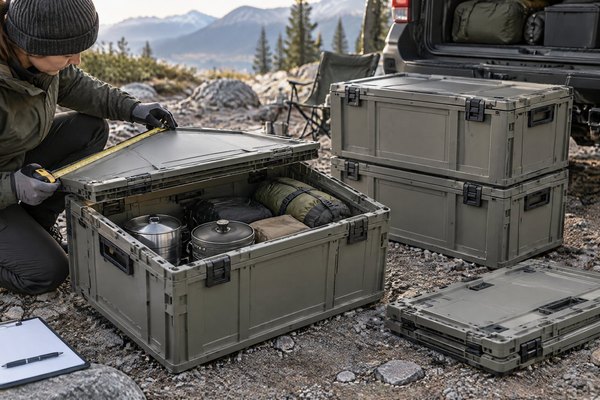
A useful sourcing decision starts with a written requirement that can be challenged, sampled, inspected, and approved.
Direct Answer Introduction
If you need a durable, lightweight container for camp kitchens, cookware and general outdoor gear, specify an aluminum camping storage box built to your market's performance and regulatory requirements. For evaluation-stage sourcing, focus on material grade and finish, divider and lid options, hardware (hinges, latches, wheels), sample review and factory inspection steps. Below are the technical and procurement checkpoints a product manager or private-label buyer should follow when evaluating suppliers.
Why Choose an Aluminum Camping Storage Box
Aluminum combines low weight, corrosion resistance and recyclability — properties that often make it the preferred material for an outdoor storage product. For buyers evaluating options, the core trade-offs are:
- Weight vs. stiffness: thinner sheets reduce weight but need internal bracing or extrusions to prevent flex.
- Corrosion resistance: mill finish or anodizing extend field life in coastal or wet environments.
- Manufacturability: extruded profiles, riveted versus welded corners, and cut-to-fit dividers affect cost and tooling.
CampLume is an OEM/ODM camping gear manufacturer and can develop variants to match a buyer’s performance and cost targets. Final choice depends on exact product spec and destination market.
Typical Configurations and Use Cases
Choose the configuration that matches how end users will pack and move gear.
- Camp kitchen storage box — configured to carry cookware, plates and camp stoves with internal dividers, removable trays and cutouts for gas cylinders.
- Camping cooking gear organizer — focused on utensil pockets, heat-resistant trays and quick-access lids for stove ignition and fuel.
- Camping gear organizer box — general-purpose organizer for tents, ropes, lighting and first-aid kits; often optimized for stackability.
Common accessory options include a camping storage box with lid (flat, drop-down or hinged), camping storage box with dividers (fixed, removable or modular) and camping storage box with wheels for easier transport over compacted earth or campsite gravel.
H3: Rolling vs. Hand-Carry Variants
- Wheeled boxes trade initial unit cost for improved ergonomics; choose wheel size and mount to balance load capacity and terrain.
- Hand-carry variants keep costs and complexity down; consider integrated lift handles and reinforced corners.
H3: Kitchen-Focused Features
For a camp kitchen storage box or camping cooking gear organizer, specify heat-resistant inner pans, utensil slots, and a lid design that can double as a countertop or windscreen.
H3: Stackability and Mount Points
Many retailers expect stackable designs with keyed corners or top/bottom alignment ribs; buyers should specify maximum stack load and whether tie-down points are required for vehicle transport.
Key Technical Specifications (What to Define in Your RFQ)
Defining precise specifications in your request for quotation (RFQ) reduces iterations. Include these items:
H3: Materials and Surface Finish
- Aluminum alloy (e.g., 5052, 6061) and temper — each differs in strength, formability and corrosion resistance. Specify alloy or ask for supplier recommendations based on expected use.
- Surface finish: mill, bead-blast, powder coat or anodize. Finishes affect abrasion resistance and corrosion behavior.
H3: Dimensions, Tolerances and Internal Layout
- External and internal dimensions, wall thickness, and weight target.
- Layout for a camping storage box with dividers: fixed or removable divider positions, divider material (foam, aluminum, plastic), and modularity (grid pattern versus custom cutouts).
H3: Lid, Hardware and Sealing
- Specify whether you need a camping storage box with lid that is gasket-sealed for dust/water resistance or a standard fitted lid.
- Hardware: stainless-steel hinges and latches, padlockable catches, gas struts for heavy lids, and options for tamper-evident seals.
Design & Specification Checklist for Sourcing
Use this checklist during early evaluation and when preparing a technical brief.
- Target user and use case (kitchen, cooking gear, general organizer).
- Required lifecycle and environment (coastal salt spray, humid climates, temperature ranges).
- Weight and stack-loading targets.
- Divider configuration: camping storage box with dividers, removable modules or foam inserts.
- Lid requirements: sealing (IP rating if requested), flatness for stacking, and whether the lid must act as a work surface.
- Mobility: camping storage box with wheels (specify wheel diameter, bearing type and mounting plate).
- Ergonomics: handle placement, carry weight per person and center-of-gravity considerations.
- Regulatory / labeling needs for destination markets (electrical components if included, chemical finish restrictions) — confirm the applicable requirement with your compliance team.
Inspection, Testing and Quality Control
Buyers should plan specific factory and pre-shipment steps that match the product complexity.
H3: Pre-Production Sample and Prototype Review
- Approve a functional prototype (alpha sample) that demonstrates materials, hinge/latch function, lid fit and divider layout.
- Conduct a design review for manufacturability: check corner details, riveting vs. welding, and extrusion fit.
H3: Factory Testing and In-Line Inspection
- Request test sheets and witnesses for tensile/visual inspections applicable to the chosen alloy if strength matters.
- In-line inspection items: dimensional checks, rivet/weld quality, hardware torque, and fit of dividers and lid. Specify AQL levels for cosmetic and functional defects.
H3: Functional Tests and Field Simulations
- Evaluate real-use tests: drop testing for corners, cycle the lid/hardware for lifecycle count, and wheel roll tests on representative surfaces.
- For a camp kitchen storage box or camping cooking gear organizer, test heat resistance for trays and gasket performance where fuels or hot cookware are stored.
H3: Sample Review Workflow
- Sample 1 (prototype): functional approval for tooling and materials.
- Sample 2 (pre-production): production-run sample that validates processes and tooling.
- Final sample: from the first commercial run for sign-off before full shipment.
Include change control steps: any post-approval change to dimensions, finish, materials or hardware should be logged, impact-assessed, and require written buyer approval.
Packaging, Labeling, Shipping Preparation and Documentation
Plan packaging to protect finish, avoid deformation and meet retailer requirements.
H3: Protective Packaging Options
- Internal foam or corrugated inserts to protect corners and accessories.
- External protection: edge guards, film, and palletization to prevent stacking damage during ocean freight.
H3: Shipping Preparation
- Specify stacking limits per pallet, dunnage requirements, and whether individual units ship with bubble-wrap or in cartons.
- For boxes with wheels, consider detachable wheels or wheel covers to avoid damage in transit.
H3: Documentation and Customs Considerations
- Request a packing list, commercial invoice, and any export declarations. For retail-ready shipments include UPC/GTIN labels and retail barcodes as required by the buyer.
- Confirm which documents the buyer will provide and which the factory must produce, such as an exporter’s declaration or country-of-origin statements.
Cost Drivers, MOQ and Lead-Time Considerations
Understand the elements that most influence unit cost and time-to-market.
- Tooling and die costs: custom extrusions, molds for plastic dividers, and stamped components add upfront cost.
- Surface finish: anodizing and specialized powder coating add per-unit cost and turnaround time.
- Hardware complexity: stainless steel hinges, gas struts and lock assemblies increase price and can have longer lead times.
- Wheels and undercarriage: large pneumatic wheels raise cost and need extra packing space.
- Order quantity: MOQ affects per-unit tool amortization. Discuss staged production and pilot runs if you need lower initial volumes.
Compact Buyer Decision Table
| Variant | Best For | Typical Add-Ons | Notes for RFQ |
|---|---|---|---|
| Lightweight aluminum case | Backpacking-style vehicular storage | Minimal dividers, light handles | Specify alloy and max weight target |
| Camp kitchen storage box | Field kitchens, cookware | Heat-resistant trays, utensil pockets, gasket lid | Explain stove/fuel interface and heat tests |
| Wheeled camping storage box | Heavy loads and vehicle-to-site transport | Detachable wheels, reinforced base | State wheel diameter and terrain expectations |
Mid-Article CTA — How To Send A Clear Email Brief
To get an accurate evaluation and sample quote, email sourcing@camplume.com with a short brief that includes:
- Product name and primary function (e.g., camp kitchen storage box for 2-burner stoves).
- Target market (US/UK/DE/FR) and any known compliance requirements.
- Expected annual volume and desired MOQ.
- Rough target FOB/CIF or unit price goal and target launch date.
- Preferred materials, finishes and accessory list (dividers, lid seal, wheels).
- Requests for samples and required lead times for prototypes.
CampLume will respond with an initial feasibility note, tooling considerations and a list of required approvals for sample runs.
Product Application, After-Sales and Change Control
Plan for product application and after-sales support in your specification:
- Spare parts and serviceability: specify replaceable components (latches, wheels, hinges) and expected lifetime.
- Warranty terms and field failure reporting: collect return authorizations and failure photos to speed root-cause analysis.
- Change control: require written approval for any changes after sign-off. Define acceptable deviation ranges and escalation paths.
FAQ (4–6 Practical Questions)
Q: What alloy should I specify for a camping storage box? A: There’s no one-size-fits-all alloy. 5052 offers good corrosion resistance and formability; 6061 is stronger but harder to form. Ask the supplier to recommend based on target weight and bending/forming requirements.
Q: Can I get a camping storage box with dividers that are removable? A: Yes. Removable or modular divider systems are common. Specify whether you need rigid aluminum dividers, molded plastic partitions or foam inserts, and the required tolerances and attachment method.
Q: Are wheels reliable for off-road campsite use? A: Wheels improve ergonomics but must be specified for terrain. Larger pneumatic or semi-pneumatic wheels roll better over rough surfaces. Define expected loads, terrain type, and whether wheels should be removable for packing.
Q: What documentation should I expect from the factory? A: Typical deliverables include a Bill of Materials, dimensional drawings, finished photos, material certificates (for alloys where requested), functional test reports, a packing list and the commercial invoice. Confirm which items are required for customs and retail acceptance before mass production.
Q: How many pre-production samples do I need? A: At minimum: a prototype for design approval, a pre-production sample to validate tooling, and a final sample from first production. More samples are useful when multiple finishes or hardware options are involved.
Conclusion and Next Steps
When evaluating an aluminum camping storage box, define use case, materials, divider layout, lid sealing and mobility early. Build a clear RFQ with dimensional tolerances, finish and hardware specs, and plan for a staged sample review, factory testing and change-control process. For evaluation-stage pricing or samples, email sourcing@camplume.com with the brief described above. CampLume, as an OEM/ODM camping gear manufacturer, will provide feasibility feedback, tooling considerations and a proposed inspection and sample schedule so you can move to a production decision with fewer surprises.
Requested Next Action
Send your brief to sourcing@camplume.com with the items listed in the Mid-Article CTA. Expect a planning reply within 48–72 business hours outlining recommended alloys, sample timeline and initial FOB cost drivers.
Final CTA: Email info@camplume.com with your product category, target market, estimated quantity, current specification and packaging stage. Request a documented response that identifies assumptions, open evidence and the next approval gate.
Related CampLume resources
-
Read: How to Source Outdoor Storage Boxes for a Private-Label Camping Range for a connected sourcing decision.
-
Explore CampLume storage options to compare a relevant product platform.
-
See the CampLume buyer FAQ for concise guidance on samples, MOQ, quality control, compliance and shipment preparation.
-
Discuss an OEM or ODM brief with CampLume when product configuration, custom branding or packaging needs to be scoped.
Project discussion
Need to apply this guide to a product programme?
Send your product category, target market, estimated quantity, current specification and packaging stage. CampLume will continue the discussion by email.
Email info@camplume.comSources and further reading