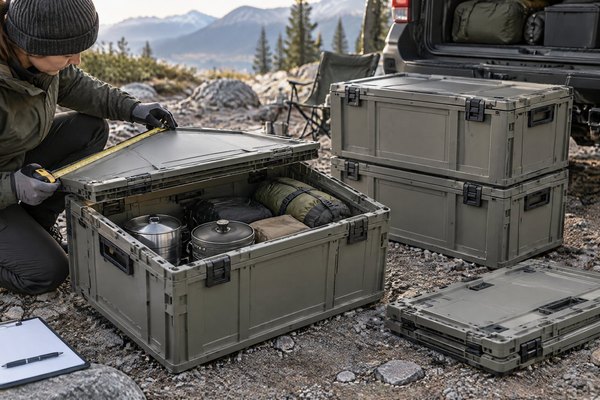
A useful sourcing decision starts with a written requirement that can be challenged, sampled, inspected, and approved.
Direct answer
A focused camping storage box drop test (plus stack strength and load trials) is essential to qualify suppliers for durable, stackable outdoor storage. For a buyer qualifying an OEM/ODM partner, require a written test matrix tied to your product specification, sample-level test reports, an on-site camping storage box factory audit, and a packing/shipping simulation before approving volume production.
Why Drop Testing Matters for Supplier Qualification
Safety and Durability Claims
A camping storage box drop test simulates the real-world shocks boxes receive during handling and transport. Passing a defined drop sequence gives you objective evidence that lids, latches, hinges and handles survive typical abuse without creating safety hazards or product failure for customers.
Customer Experience and Returns
Boxes that crack, split, or open in transit cause returns and negative reviews. Drop performance correlates strongly with perceived quality for storage systems, so include clear pass/fail criteria in the specification to reduce warranty costs.
Regulatory And Transport Risk
While consumer-safety law varies by market, transport damage creates liability and added logistics expense. Define test parameters appropriate to your destination market and shipping method, and confirm the applicable requirement with your importer or counsel.
Define The Test Matrix For Your Specification
Before any laboratory run or in-factory test, create a product-level test matrix that ties each test to a specific risk and acceptance criterion.
Drop Test Parameters
Specify: number of drops, drop heights, drop orientations (corner, edge, flat), loaded vs unloaded state, and acceptance criteria (no structural failure, latch retention, no sharp edges). Example entries should reference the camping storage box drop test you require and whether tests are on production samples or pre-production prototypes.
Stack Strength And Load Capacity
Include the camping storage box load capacity target for design and a separate cycling or static stack test to validate stack strength. Define how many units are stacked, the test duration, and allowable deflection or permanent deformation.
Material, Printing And Environmental Tests
Document the camping storage box material PP grade, UV and cold resistance expectations, and whether you require rub/adhesion tests for camping storage box logo printing. These feed into both functional and visual acceptance criteria.
Sample Review And Pre-Production Trials
A disciplined sample review process shortens the qualification cycle and reduces costly changes later.
Prototype To Pre-Production
Start with rapid prototypes to validate dimensions and mechanism geometry. Move to pre-production molded samples in the declared camping storage box material PP to measure true wall thickness and rib support before tooling is finalized.
Test Reports On Samples
Require test reports tied to each sample batch: drop test log, stack strength test results, and a concise camping storage box quality inspection checklist for appearance and functional checks. Use these reports to sign off on tooling changes.
Change Control For Specs
Track any deviations between approved sample and production run with a formal change-control document. If you accept a tooling change that alters load capacity or stacking behavior, re-run the affected camping storage box stack strength test and drop test before approval.
Factory Qualification: Audit And On-Site Tests
A camping storage box factory audit should confirm the supplier can consistently produce to your specification and carry out the in-line and final tests you require.
What To Verify In A Factory Audit
Confirm molding capabilities for the declared camping storage box material PP (machine tonnage, cavity count, process controls), tool maintenance, dimensional inspection capability (CMM or calibrated gauges), and a documented production control plan.
On-Site Testing Equipment Expectations
A factory capable of supporting supplier qualification typically has basic drop-test apparatus (configurable heights and fixtures for corners/edges), a hydraulic or mechanical stack-testing rig for static loads, and tensile/adhesion testers for logo printing samples. If the factory lacks these, require them to subcontract testing to a qualified lab and include witness rights.
Reporting And Corrective Action
Require the factory to produce an audit report that includes test data, sample identifiers, photos of failed areas, and a Corrective Action Plan (CAP). Ensure the CAP timelines, responsible persons, and re-test procedures are recorded as part of change control.
Mid-Article CTA — Request A Brief
If you want CampLume to prepare a supplier-qualification plan or a sample-testing quote, email sourcing@camplume.com with a short brief. Include:
- Product name and SKU (if any)
- Target dimensions, internal volume and expected camping storage box load capacity
- Declared camping storage box material PP grade or target properties
- Preferred camping storage box logo printing method (pad, digital, hot-stamp)
- Expected order quantity and destination market
- Required tests: camping storage box drop test, camping storage box stack strength test, any environmental tests
- Attach dimensional drawings, CAD files and any existing test reports
We will reply with a recommended test matrix and a costed plan for samples, factory audit and third-party testing steps.
Quality Inspection Checklist For Incoming And Final Inspection
Use a camping storage box quality inspection checklist that covers material, dimensions, function and appearance — applied at material receiving and again at final inspection. Key items:
- Incoming resin check: supplier certificate of analysis for PP; batch code and physical checks (melt flow range, odor, contamination visually)
- Dimensional checks: critical dimensions against CAD; wall thickness and rib clearances
- Functional checks: hinge/latch cycles, handle pull test, lid engagement
- Visual checks: flash, flow lines, sink marks, color match, surface finish
- Logo and label checks: alignment, adhesion, curing for printed/domestic applied logos
- Pack & pallet: correct inner pack count, protective inserts, carton strength and pallet stability
Inspection frequency may include AQL sampling for large batches and 100% checks for critical functional features. Tie any nonconformance to your change-control procedure so tooling or process corrections occur prior to the next lot.
Shipping, Packaging, And Change Control
Packaging and shipping simulation can reveal issues not visible in bench tests.
- Pack Stress Simulation: Conduct the camping storage box drop test on fully packaged units and run a vibration test on pallets to simulate road or sea transit.
- Pallet Stack Simulation: Perform stack load tests to simulate several pallets stacked in a shipping container. This validates palletization and carton compression, which affects your box’s stack strength when packed.
- Packaging Specs: Specify inner protection, carton bursting strength, and pallet patterns in the PO. Any change in these specs should trigger re-testing under your change-control process.
Product Application And Documentation
Document the intended product application (food storage vs general gear, wet vs dry conditions) and include any special instructions for end users. Maintain full documentation: test reports, inspection forms, audit reports and CAP records. These documents are central to importer customs inquiries and product liability investigations.
Performance Tests Buyers Should Request
Below is a compact buyer-decision table to help you choose where each test should be executed and what to expect. This is a practical comparison to help allocate cost and control for supplier qualification.
| Test | Typical Responsibility | When To Require | Quick Acceptance Check |
|---|---|---|---|
| Camping storage box drop test | Factory or Third-party lab (witnessed) | Pre-production samples and first lot | No fracture; latches intact; no occupant escape |
| Camping storage box stack strength test | Factory (rig) or lab | After tooling sign-off and for lot release when stacked transport expected | Acceptable deformation; no permanent failure |
| Camping storage box load capacity (static) | Factory | Product spec stage and batch validation | Supports declared kg with ≤X mm deflection (specify) |
| Camping storage box material PP validation | Incoming QC or third-party lab | On raw material receipt | Resin matches declared grade and basic physicals ok |
| Camping storage box logo printing adhesion | Factory process or lab | During print-process approval and first run | No peel or excessive wear under rub test |
| Packaged drop and vibration | Third-party lab or simulated in-factory | Before first shipment and after major packaging change | Cartons and inner units intact; no product shift |
Practical Notes:
- If the factory lacks an adequate drop rig, insist on third-party lab verification, and schedule a witness session for the first production run.
- For mass-market products with low margins, balance the cost of third-party tests with targeted in-factory sampling and a robust inspection checklist.
FAQ
Q: How many samples should I send for a camping storage box drop test? A: Typical practice is a minimum of three samples per orientation for pre-production runs, but require more samples if you are testing multiple load states (empty, partially loaded, fully loaded). Specify sample ID and production lot so any failure is traceable.
Q: Can the factory perform a camping storage box factory audit internally or do I need a third-party? A: An internal audit is a valid first step, but independent audits provide stronger assurance for larger buyers. For supplier qualification, require a documented camping storage box factory audit report; accept internal audits only if they include objective evidence and you retain audit follow-up rights.
Q: How to verify camping storage box material PP claims? A: Require a certificate of analysis from the resin supplier and conduct incoming checks (visual, melt flow, and basic mechanical tests). For critical applications, request third-party verification of the resin batch.
Q: What should a camping storage box quality inspection checklist include for logo printing? A: Include checks for color match, registration, adhesion/rub resistance, curing completeness, and edge quality. For applied labels, include peel tests and heat-age checks when relevant.
Q: When should I require a camping storage box stack strength test? A: Require it when products will be stacked in retail or during transport, or where the box is designed to bear load. Re-test after any tooling change or major process adjustment that could affect rib or wall strength.
Conclusion
For supplier qualification, a structured approach that combines a clear product specification, sample-level camping storage box drop test results, an on-site camping storage box factory audit, and a documented camping storage box quality inspection checklist will reduce surprises in production and shipment. CampLume is a China-based OEM/ODM camping gear manufacturer and can help translate your functional requirements into a test matrix, manage sample testing, and prepare a factory-qualification plan.
Final CTA
To start a supplier-qualification plan and receive a tailored test and inspection quote, email sourcing@camplume.com with the brief outlined above. Provide drawings and desired tests and we will return a recommended schedule, an estimated cost for sample testing, and next-step actions for sample review, factory audit and first-lot release.
Mid-Article CTA: Send Your Requirements
If you are evaluating camping storage box drop test, email info@camplume.com with your product category, selling market, estimated quantity, current specification and packaging brief. Ask for a documented reply that separates assumptions and deviations from the quotation.
FAQ
What information should a storage-box buyer give a supplier?
State the intended gear, use environment, target size and load, material preference, stacking or folding needs, logo and color scope, packaging, target market, estimated quantity and any test expectations.
How should a load or drop test be defined?
Use a written method that names the product configuration, load, condition, number of cycles or drops, inspection points and acceptable outcome. Confirm whether it is an internal check, third-party test or customer protocol.
When is a custom mould required for a camping storage box?
A new mould is normally a product-development decision when the dimensions, structure or integrated features differ from an existing platform. Ask for the tooling scope, ownership terms, sample process and revision controls in writing.
What is useful for storage-box shipment preparation?
Confirm the approved product, pack-out, carton dimensions, stacking direction, label or barcode details, pallet plan where relevant, inspection record and freight booking information before cargo release.
Conclusion: Turn the Brief Into a Controlled Buying Decision
The practical aim of a camping storage box drop test programme is not to collect broad assurances; it is to connect the approved product configuration, sample, evidence, packaging, inspection and shipment release to the same buyer brief. That record helps the product, sourcing, quality and logistics teams resolve assumptions before they become a production or delivery problem.
Final CTA: Email info@camplume.com with the product category, target market, estimated quantity, current specification and packaging stage. Request a response that identifies assumptions, open evidence and the next approval gate.
Related CampLume resources
-
Read: How to Source Outdoor Storage Boxes for a Private-Label Camping Range for a connected sourcing decision.
-
Explore CampLume storage options to compare a relevant product platform.
-
See the CampLume buyer FAQ for concise guidance on samples, MOQ, quality control, compliance and shipment preparation.
-
Discuss an OEM or ODM brief with CampLume when product configuration, custom branding or packaging needs to be scoped.
Project discussion
Need to apply this guide to a product programme?
Send your product category, target market, estimated quantity, current specification and packaging stage. CampLume will continue the discussion by email.
Email info@camplume.comSources and further reading