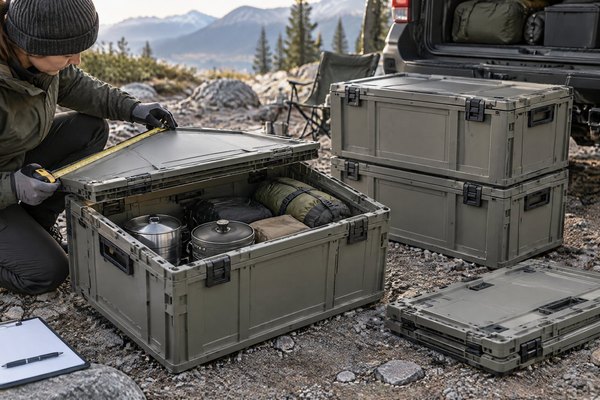
A useful sourcing decision starts with a written requirement that can be challenged, sampled, inspected, and approved.
Direct answer
Short answer: To qualify a camping storage box ODM supplier, verify the supplier can produce to your written product specification, provide samples and test evidence (including a camping storage box UV resistance test and a camping storage box cold weather test when relevant), demonstrate supply chain controls for camping storage box REACH compliance, camping storage box RoHS compliance and camping storage box UK product compliance where applicable, and give transparent pricing for tooling (including the camping storage box custom mold cost), inspection, packaging and shipping preparation.
Why this matters: storage boxes are exposed to UV, moisture, dirt, drops and low temperatures; failures show up in returns and warranty claims. Qualification reduces surprises during production ramp and helps you plan labeling, documentation and duty classification for each destination market.
Supplier Qualification Checklist — Quick Overview
- Confirm the supplier is an OEM/ODM camping gear manufacturer and produces comparable injection-molded or roto-molded products. Ask for relevant SKUs and non-customer-specific photos of factory tooling areas.
- Provide a detailed specification document and request a tolerance table, materials data and target performance levels.
- Request sample production (prototype + pre-production sample) and a written sample approval process.
- Specify required tests: UV resistance, cold weather, impact, load and chemical compliance (REACH, RoHS) depending on materials and destination.
- Ask for a transparent cost breakdown: unit price at target MOQs, camping storage box custom mold cost, testing, packaging, and freight estimates.
- Plan inspection and documentation: incoming inspection, first-article inspection, production inspection and final shipment checks; request COAs and test reports.
Product Specification: Materials, Design And Function
A clear product specification is the foundation of supplier qualification. Create a single specification file to drive samples, tooling and acceptance.
Material Selection And Additives
Specify polymer family (e.g., PP, HDPE, ABS), UV stabilizers (type and target hours), flame retardant status if required, and food-contact acceptance when needed. If you require compliance for restricted substances in the EU or UK, detail limits and acceptable alternatives — this is the basis for camping storage box REACH compliance and camping storage box RoHS compliance conversations.
Design For Intended Use
Document intended application: e.g., rooftop storage, basecamp gear, vehicle-mounted, stackable crates. Include load rating, stacking geometry, lid clearance, locking method and gasket specification. Provide CAD files or detailed drawings with tolerances and critical dimensions.
Specification Document And Tolerances
Include a parts list, target appearance standards (e.g., color code, texture), permissible flash, and an acceptance table for cosmetic defects. Specify sample approval criteria and what triggers a rework or new mold.
Regulatory Compliance And Documentation
Regulatory needs depend on destination market and product materials. Confirm applicable requirement with your compliance/legal team, then use the supplier qualification process to verify the factory can support documentation and testing.
- camping storage box REACH compliance: For EU sales you must manage restricted substances (SVHCs and annexes). Ask suppliers for material declarations, supplier chain statements and test results for required substances.
- camping storage box RoHS compliance: If your box includes electrical components (LED lights, integrated electronics), verify RoHS requirements and request test reports from accredited labs.
- camping storage box UK product compliance: Post-Brexit, the UK may require separate documentation or conformity marks. Confirm the applicable requirement for your SKU and request supplier support for test reports and declarations.
Documentation to request from suppliers: material data sheets, Certificates of Analysis (COAs) from resin suppliers, third-party lab reports for mechanical and chemical tests, and a Declaration of Conformity where applicable. CampLume, as an OEM/ODM camping gear manufacturer, can coordinate testing and documentation with your specification but confirm final compliance is your responsibility as importer/brand owner.
Performance Testing: UV And Cold Weather
Outdoor storage boxes are often used in direct sunlight and in sub-zero conditions. Include these tests in your supplier qualification plan.
UV Resistance Test Protocols
Specify a target exposure level and method: accelerated xenon or fluorescent UV with temperature and humidity cycles, or QUV-A cycles with condensation. State acceptance criteria (color change, cracking, loss of tensile strength) and required report elements. Ask for the camping storage box UV resistance test results on production samples and a description of UV stabilizer type and dosage used in production batches.
Cold Weather Test And Impact Assessment
Define low-temperature conditioning and impact tests (e.g., conditioning at -20°C for X hours followed by drop or impact tests). Make clear your pass/fail criteria for brittle failure, hinge performance, and gasket sealing. Request a camping storage box cold weather test on the final material and on the assembled unit.
Field And Cycle Testing
Complement lab testing with field samples and cycle testing for repeated opening/closing, stacking loads and lid stress. These tests help validate long-term durability beyond single-event lab tests.
Samples, Prototypes And Mold Costs
Producing correct samples and understanding tooling costs are central to making a commercial decision.
- Prototype types: 3D-printed mock-ups for fit/layout, CNC prototypes for close-fit parts, and functional prototypes produced on production tooling.
- Approval flow: concept sample -> engineering sample -> pre-production sample (PPS) -> golden sample. Each stage must have an approval sign-off sheet that becomes part of the change-control record.
- camping storage box custom mold cost: tooling can be the largest upfront cost. Request a breakdown showing steel grade, cavity count, expected shot life, lead time and repair policy. Ask the supplier to amortize the custom mold cost at several volume scenarios so you see the impact on unit cost.
Cost influences: cavity count, core/cavity complexity, slides/side-actions, molds for multi-color injection or in-mold labeling, and mold maintenance plans. For short runs, consider shared tooling or lower-cost aluminum prototypes but account for lower life and potential dimensional drift.
Factory Processes: Inspection, Packaging And Shipping Preparation
A supplier's factory processes determine whether product quality and delivery meet your retail or distribution needs.
Incoming Material Control And In-Process Inspection
Verify the factory has written procedures for incoming resin testing, color consistency, and first-article inspection. Confirm sampling plans, SPC practices (if used), and how non-conforming material is handled.
Final Inspection And Pre-Shipment
Set clear AQL levels for cosmetic and functional defects, define critical vs. major vs. minor defects, and require pre-shipment photos and a final inspection report. Consider third-party inspection for the first shipment or for high-value SKUs.
Packaging, Labeling And Shipping Prep
Specify packing unit (inner box, master carton, units per pallet), palletization pattern, protective packaging for corners, barcodes and retail-ready presentation. Include wording for country-of-origin marking, recycling labels, and shipping marks. Confirm whether the supplier can prepare commercial invoices, packing lists and assist with transport documentation like EUR1 or other certificates you may need.
Quality Management And Change Control
Long-term quality depends on robust change control and supplier communication.
- Define a product change notification process: supplier must notify you in writing of any material or process change that could affect form, fit, function or compliance.
- Requalification triggers: tooling repair, material resin change, colorant supplier change, or any failed lot test. Specify when new samples and new lab tests are required.
- Traceability: require batch codes on production records to trace issues back to resin lots, shifts and mold cavities.
CampLume can operate to your agreed change-control process as an OEM/ODM camping gear manufacturer; specify the notification windows and requalification requirements in the purchase agreement.
Buyer Decision Table
| Buyer Scenario | Typical MOQ | Tooling Priority | Testing Priority | Lead Time (tool + first run) | Recommended Supplier Capability |
|---|---|---|---|---|---|
| Small private-label run, 1–5 SKUs | 300–1,000 pcs | Low (consider shared or soft tooling) | Basic mechanical and UV | 8–14 weeks | Flexible mold shop, short-run experience |
| Large retail SKU, national distribution | 2,000+ pcs | High (steel multi-cavity) | Full battery (UV, cold, impact, chemical) | 12–20 weeks | In-house tooling, lab partners, QC systems |
| EU/UK market, compliance-driven SKU | 1,000+ pcs | Medium-High | REACH/RoHS verification, full test set | 12–20 weeks | Traceable supply chain, documentation support |
Mid-Article CTA — Request A Supplier Brief
If you want a tailored supplier brief from CampLume, email sourcing@camplume.com with this minimum information: a one-page product spec, estimated annual quantity by SKU, target retail price or target landed cost, destination market(s), required tests/certifications (e.g., camping storage box REACH compliance, camping storage box RoHS compliance, camping storage box UK product compliance), and whether you need a custom tool (ask for camping storage box custom mold cost options). We will reply with a recommended qualification plan and a rough cost/time estimate.
FAQ
Q: What sample types should I expect before full production?
A: Expect concept mock-ups, engineering prototypes, and a pre-production sample produced from final tooling. Each sample round should include a signed approval form and measured deviations from the spec.
Q: Who pays for tests and how are they organized?
A: Typically the buyer pays initial qualification testing; ongoing batch tests may be cost-shared depending on contract. Decide whether the factory arranges accredited lab testing or if you will instruct an external lab.
Q: How do I verify camping storage box UV resistance test and cold weather results?
A: Request raw test reports from an accredited lab, including test conditions, sample IDs and photos. Cross-check that the tested sample matches the final production material and lot.
Q: When is a mold requalification required?
A: Requalification is required after significant mold repair, cavity modification, or when changes to polymer grade/additives occur. Your change-control clause should define triggers.
Q: What documentation should travel with a shipment to comply with EU/UK markets?
A: At minimum: Commercial invoice, packing list, COO marking, declarations or test reports for restricted substances if requested by customs or customers. Confirm the applicable requirement for each SKU and destination.
Conclusion And Next Steps
Qualifying a camping storage box ODM supplier is a structured process: write a complete product specification, define test and compliance needs (including camping storage box UV resistance test, camping storage box cold weather test, camping storage box REACH compliance, camping storage box RoHS compliance and camping storage box UK product compliance where applicable), get prototypes and pre-production samples, understand the camping storage box custom mold cost and how tooling affects unit economics, and lock down inspection, packaging and change-control procedures before you place a production order.
If you want CampLume to prepare a qualification and costing brief, email sourcing@camplume.com with a one-page spec, target volumes, destination market(s), and a short note on required tests or whether you need a custom mold. We will respond with a recommended plan, typical timelines and what evidence we will supply for your compliance files.
(Please confirm the applicable regulatory requirements for your destination market with your compliance team; CampLume can support testing and documentation but is not a legal adviser.)
Final CTA: Email info@camplume.com with your product category, target market, estimated quantity, current specification and packaging stage. Request a documented response that identifies assumptions, open evidence and the next approval gate.
Related CampLume resources
-
Read: How to Source Outdoor Storage Boxes for a Private-Label Camping Range for a connected sourcing decision.
-
Explore CampLume storage options to compare a relevant product platform.
-
See the CampLume buyer FAQ for concise guidance on samples, MOQ, quality control, compliance and shipment preparation.
-
Discuss an OEM or ODM brief with CampLume when product configuration, custom branding or packaging needs to be scoped.
Project discussion
Need to apply this guide to a product programme?
Send your product category, target market, estimated quantity, current specification and packaging stage. CampLume will continue the discussion by email.
Email info@camplume.comSources and further reading