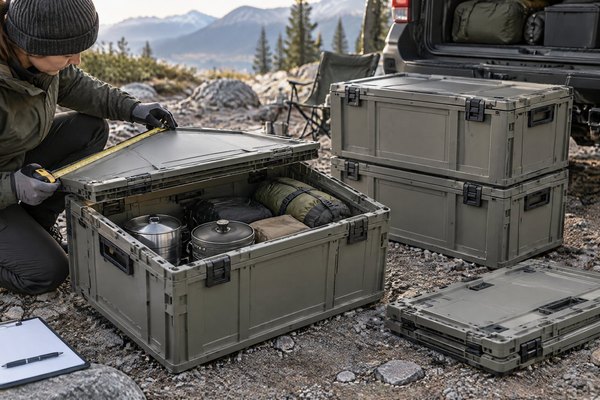
A useful sourcing decision starts with a written requirement that can be challenged, sampled, inspected, and approved.
Direct answer (short)
If you need a camping storage box supplier Germany, focus first on a complete product specification, defined test criteria (especially waterproofing), an approved sample (golden sample), documented factory test and inspection plans, and clear private label camping storage box packaging requirements. This guide walks buyers through the supplier-qualification workflow, the test methods you should ask for (including camping storage box waterproof test steps), regional sourcing considerations for the UK and USA, and practical checklists you can use with OEM/ODM partners like CampLume.
Why Supplier Qualification Matters
Sourcing a camping storage box is more than price and lead time. Many field issues — leaks, broken latches, poor stacking performance, or packaging damage — trace back to incomplete specifications, poor sample review, or missing test plans. If your goal is to launch a private-label storage system or specify an outdoor gear organizer manufacturer for your catalog, qualification reduces risk and shortens the back-and-forth after tooling starts.
1. Define Product Specification and Requirements
Clear, machine-readable product specifications are the foundation of supplier qualification. Create a single-page spec sheet and an expanded technical file.
Materials & Construction
- Primary materials (polypropylene grade, HDPE, aluminium, fabric, gasket compound), target resin grades, recyclable content if required.
- Closure type (single latch, dual latch, keyed lock), hinge design, gasket cross-section and durometer, UV stabilizer need.
- Target stacking load (kg), internal volume (L), nominal weight (grams), color codes and Pantone references.
Performance Targets & Tests
- Target ingress protection (nominal IP rating or equivalent performance) and the camping storage box waterproof test you expect.
- Drop resistance, hinge cycle count, load-bearing and stacking, temperature and UV exposure.
Branding, Packaging & Labelling
- Private label camping storage box packaging: dielines, UPC/EAN label placement, user manual language sets, and retail-ready requirements (blister, box, polybag).
- Pallet pattern, carton quantities, and preferred shipping marks.
Document tolerances, acceptance criteria, and the expected sample approval workflow (PPS, pre-production sample, and golden sample). If you will sell in Germany, UK, or USA markets, add any distributor or retailer-specific marking and packaging requirements to the spec.
2. Sample Review and Prototype Workflow
An efficient sample workflow reduces misunderstandings.
Golden Sample Approval
Agree on a golden sample that becomes the visual, dimensional and functional reference. Store photos and measurement reports with the golden sample in your supplier file.
Functional & Aesthetic Checks
- Verify gasket seating, latch torque, bubbling in plastic, color matching, and embossed logos.
- Check tolerances with calipers, functional closure cycles, and test fit of accessories (dividers, trays).
Packaging Sample and Retail Mock-Up
Always approve the final packaged sample — many shipment damages are packaging-related. The packaged sample should be the one used in ISTA-style transport tests if you plan to ship retail pallets.
3. Factory Testing, Inspection, and Test Methods
Factory testing and inspection plans are central to qualification. Ask suppliers for documented test procedures and request witness or third-party reports for critical tests.
Common On-Factory Tests
- Visual and dimensional checks per the golden sample.
- Latch and hinge cycle testing (define cycles to failure or acceptable runouts).
- Load and stacking tests using specified weights.
Waterproof Tests: Practical Steps
When buyers search "camping storage box waterproof test" or "how to test a camping storage box," they expect practical, repeatable procedures. Typical methods you can request include:
- Spray Test (Simulates rain): Position the closed box under a calibrated spray for a defined period (example: 10 minutes at a specified flow rate). Inspect interior for water ingress.
- Submersion or Partial Submersion: For higher water resistance claims, a short-duration partial submersion (for example, 1 meter for 30 minutes) can be used. Confirm the acceptable immersion depth and duration in your spec; note that submersion can be more stressful than realistic use and may require specific sealing designs.
- Internal Vapor / Condensation Check: Place absorbent indicators inside and run a cycle of temperature/humidity to detect micro-leaks that allow condensation.
- Gasket Compression and Leak Trace: Apply a pressure differential or smoke test to locate leak paths.
Use precise pass/fail criteria. For example: "No visible liquid on absorbent indicator after 30-minute spray test under X flow" rather than vague phrasing.
When to Use Third-Party Labs
For claims used in marketing or to meet retailer requirements in the UK, Germany or the USA, ask for third-party test reports from an accredited lab. Confirm the applicable requirement and whether an IP-style rating, EN, or ASTM method is required for your market.
4. Packaging, Shipping Preparation and Retail Readiness
Packaging decisions affect cost, retail presentation, and damage rates.
Private Label Packaging Requirements
Specify private label camping storage box packaging details in advance: carton DPI artwork, print quality, inner protective padding, user manual languages, and barcode placement. If your plan is shelf-ready retail in Germany or the UK, include any retail-specified hang tab, shelf-ready flap, or multilingual compliance text.
Transport Testing
Request that suppliers perform ISTA 2A/3A-style packaging tests or provide a transport simulation report. This is especially important if you will drop-ship to multiple warehouses across the USA or Europe.
Shipping Preparation
Define pallet stacking pattern, pallet type, and any heat or moisture protection for sea freight. Agree on the minimum acceptable packaging before sea-freight offers are accepted.
5. Supplier Types and Regional Considerations
Sourcing choices depend on lead time, MOQ, cost, and market support.
- Local EU Suppliers (including a camping storage box supplier Germany): Faster lead times and easier compliance checks for EU regulatory needs; higher unit cost but shorter logistics and potentially lower complexity for returns.
- UK Suppliers (camping storage box supplier UK): Good for UK retail channels where local labeling or quick restocks matter.
- US Suppliers (camping storage box supplier USA): Faster to market for North American retailers and simpler coordination of test labs and distribution.
- China OEM/ODM (outdoor gear organizer manufacturer): Typically better for volume, tooling, private label packaging, and consolidated supply chain services. An experienced OEM/ODM partner can manage sample workflow, pre-shipment inspections, and export documentation.
When you choose between these, align your selection with target lead time, MOQ, and the complexity of your private label camping storage box packaging.
Comparison Table: Quick Buyer Decision
| Supplier Type | Typical MOQ | Lead Time | Best For | Key Risk |
|---|---|---|---|---|
| Local EU Manufacturer (incl. Germany) | Medium-High | Short | Fast iterations, easier returns | Higher unit cost |
| UK Supplier | Medium | Short | UK retail compliance, rapid replenishment | Smaller capacity |
| US Supplier | Medium-High | Short | North American retail | Higher cost, limited tooling |
| China OEM/ODM (CampLume style) | Low-High (depends) | Medium | Cost-effective tooling, private label packaging | Longer shipping, need clear QC plan |
6. Quality Control, Documentation and Change Control
A formal QC and documentation strategy protects the buyer.
Incoming and In-line Controls
- Agree on AQL levels for cosmetic and functional defects.
- Define critical dimensions and functional tests to be checked at start-of-run and during production.
Pre-Shipment Inspection and Testing
Conduct a pre-shipment inspection (PSI) that includes functional checks, packaging verification, and random waterproof tests where appropriate. For higher-risk features, specify sample sizes and test frequencies.
Documentation That Should Travel With Shipments
- Packing list, commercial invoice, certificate of origin (if needed), test reports, golden sample photograph, and production QC checklist.
- Safety or material data where applicable. Confirm the applicable requirement for the destination market.
Change Control
Require written approval for design, material or supplier-subcomponent changes. Establish a change-notice window and re-validation testing when critical components change (e.g., new gasket supplier, resin supplier shift).
Mid-Article CTA: Send Your Brief (Email Template)
To get a tailored reply from an OEM/ODM camping gear manufacturer, use a short email brief. Send to info@camplume.com with this template in the body:
Subject: Brief — Private Label Camping Storage Box Project
Body:
- Product name and SKU (if any)
- Target market(s): Germany / UK / USA / other
- Target retail price or landed cost per unit
- Estimated initial order qty and annual forecast
- Key performance targets (IP goal, stacking load, dimensions)
- Required tests (e.g., camping storage box waterproof test, drop test, hinge cycles)
- Private label camping storage box packaging: dieline attachment or description
- Desired lead time and delivery port
Attach any concept drawings, photos of competitor products, or a one-page spec sheet. Expect a reply that outlines tooling, samples, lead times, and an estimated unit cost breakdown.
7. Practical Inspection & Test Checklists
Use these checklists during sample review and factory inspections.
- Dimensional: 10 critical dimensions measured and reported.
- Functional: Latch torque, hinge movement, gasket seating, lid fit.
- Performance: Select 5 units for waterproof spray test and annotate results.
- Packaging: One carton opened and checked for polybag damage, cushion placement and retail box finish.
If you need third-party verification for retailer acceptance in Germany, UK or the USA, request a lab report and keep it in the product technical file.
FAQ
Q: How do I pick between a local supplier and a China OEM/ODM? A: Base the decision on lead time, cost targets, tooling needs, and required certifications. For fast replenishment and local compliance, local suppliers help. For private label scale and tooling, a China OEM/ODM often offers lower unit costs; ensure strict QC and documented testing.
Q: What is a reasonable waterproofing requirement for a camping storage box? A: It depends on the intended use. For rain protection, a spray test with no interior wetness may be sufficient. For floatation or submersion claims, specify immersion depth/time and third-party verification. Confirm market and retailer expectations before setting the criterion.
Q: How to test a camping storage box for shipping durability? A: Combine ISTA or comparable transport simulation, random drop testing, and carton compression tests. Use packaged samples to replicate real-world distribution.
Q: What documentation should I expect from a qualified supplier? A: Golden sample records, production test procedures and results, pre-shipment inspection reports, packing lists, commercial invoice, and where applicable, third-party test reports for marketed claims.
Q: Can an outdoor gear organizer manufacturer also handle private label packaging? A: Many OEM/ODM outdoor gear organizer manufacturers provide packaging services including dieline creation, print, inner padding and retail-ready mock-ups. Confirm capabilities during the initial brief.
Conclusion and Next Steps
For buyers looking specifically for a camping storage box supplier Germany or suppliers serving Germany, UK and USA channels, the immediate next steps are: finalize your spec sheet with clear waterproof and functional test criteria, approve a golden sample, and require documented factory test plans and pre-shipment checks. If you want CampLume to review a short project brief and provide tooling and sample timelines, email info@camplume.com with the template above. We are an OEM/ODM camping gear manufacturer and can outline how we would run the sample, testing and packaging workflow for your project.
If you already have a spec, attach it to your brief. If you need help drafting the technical file, state your target markets and claimed performance and the reply will include recommended test methods and a sample plan.
Final CTA: Email info@camplume.com with your product category, target market, estimated quantity, current specification and packaging stage. Request a documented response that identifies assumptions, open evidence and the next approval gate.
Related CampLume resources
-
Read: How to Source Outdoor Storage Boxes for a Private-Label Camping Range for a connected sourcing decision.
-
Explore CampLume storage options to compare a relevant product platform.
-
See the CampLume buyer FAQ for concise guidance on samples, MOQ, quality control, compliance and shipment preparation.
-
Discuss an OEM or ODM brief with CampLume when product configuration, custom branding or packaging needs to be scoped.
Project discussion
Need to apply this guide to a product programme?
Send your product category, target market, estimated quantity, current specification and packaging stage. CampLume will continue the discussion by email.
Email info@camplume.comSources and further reading