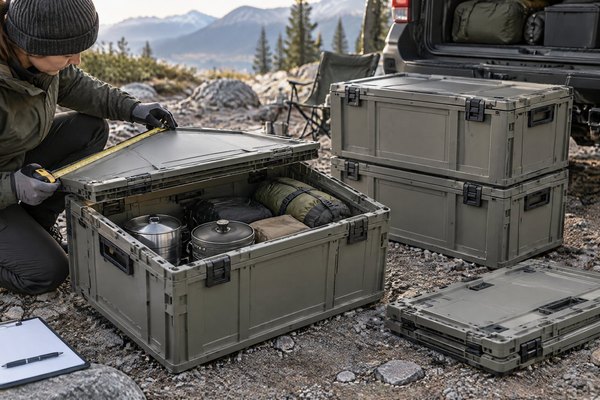
A useful sourcing decision starts with a written requirement that can be challenged, sampled, inspected, and approved.
Direct answer
If you need a scalable, durable solution for organizing camp kitchens, gear and supplies, buying a custom camping storage crate wholesale is appropriate when you have defined usage, target retail price and an MOQ. The right crate design balances load capacity, weather resistance and modular access (for example, a camping storage box with removable compartments or a camping storage box with side door). This guide shows what to specify, how to validate samples and how to run factory testing, inspection and shipping for reliable results.
Define Use Cases and Core Specifications
Start by documenting how the crate will be used. Clear use cases drive material choice, strength and feature trade-offs.
Primary applications
- Camp kitchen organization and utensil handling (camping utensil storage organizer).
- Dry storage for food/drink versus wet storage for cooking gear.
- Stackable transport crates for vehicle loading and basecamp setups.
Key specification fields to write into an RFQ
- External and internal dimensions (mm). Include required clearances for removable trays or utensil organizers.
- Target net and gross weight per unit and expected stacking load. This is where camping storage box weight limit matters; specify both static (stacked) and dynamic (lifted) loads.
- Material: HDPE/PP/ABS or composite. Specify anti-UV additives if you require a UV resistant outdoor storage box.
- Features: removable inserts, side-door access, tabletop surface, lock points, drain holes, anti-scratch finish.
- Finish and color, printing or label recesses, customized embossing or molded logos.
- Compliance expectations: country of sale requirements for labelling, chemical restrictions (e.g., confirm the applicable requirement for phthalates or heavy metals), and packaging marking.
Document acceptance criteria numerically (e.g., load capacity: 100 kg static per crate; UV fade: Delta E ≤ 3 after X hours of accelerated exposure tested at an accredited lab—note: ask the lab or assessor to test; do not assume factory alone certifies compliance).
Critical Design Features to Prioritize
Design choices have direct effects on tooling cost, per-unit price and supply chain risk. Below are frequent features buyers request and how they affect manufacturing.
Removable Compartments and Utensil Organization
A camping storage box with removable compartments increases versatility for multiple SKUs (e.g., cutlery tray for camp kitchens). Ask for a modular insert design that can be injection-molded or thermoformed as separate parts. Specify tolerances for fit (clearance mm) and retention methods (snap-fit, magnets, friction).
Include the phrase camping storage box with removable compartments in your spec so suppliers quote tooling that allows insert molds or separate inserts.
For camping utensil storage organizer features, consider molded slots, drain holes and a wipe-clean surface. If you intend to include metal utensils, specify corrosion-resistant coatings or stainless-steel fittings.
Side Access and Top Surface Use
A camping storage box with side door is useful for access when crates are stacked or when placed under a prep surface. Side doors add mechanical complexity: you will need hinge details, latch type, and gasket specifications if weather sealing is required.
If the crate must double as a work surface, specify a camping storage box with tabletop and state required load and deflection limits (for example, support a 30 kg point load with max deflection X mm). Top surface requirements affect ribbing, wall thickness and material choice.
UV Resistance and Outdoor Durability
If the product lives outdoors or in high-sun conditions, request UV-stabilized resin and confirm the crate is a UV resistant outdoor storage box in the RFQ. Ask for accelerated UV testing from an independent lab as part of the validation program rather than relying solely on vendor claims.
Performance Requirements and Factory Testing
Specify objective tests to verify performance. Doing so reduces rework and helps factories set internal quality checkpoints.
Strength and Load Testing
Include numeric criteria for camping storage box weight limit (both static and dynamic). Request load-testing protocols: gradually apply load to a stacked set or to the top tabletop and record permanent deformation. For example, require no structural failure at the specified static limit and no excessive deformation beyond a defined threshold.
Outdoor and Chemical Resistance
Ask for accelerated UV exposure reports and a description of test method used (e.g., xenon arc or QUV). Request chemical-resistance spot checks if the crate will contact fuels, cleaning solvents or acidic foods.
Functional and Life-Cycle Tests
Functional tests should cover hinge cycles for side doors, latch cycle counts, insert removal cycles and abrasion resistance for tabletop use. Define minimum cycle counts in the spec (e.g., 5,000 hinge cycles) and include acceptance criteria.
Note: factories can run these tests in-house but independent lab verification is recommended for claims used in marketing or to satisfy large retailers. Confirm the applicable requirement for your destination market and retailer.
Sample Review, Inspection and Change Control
An ordered, documented sample process reduces late changes and tooling rework costs.
Pre-Production Sample (PPS) and First Article
- Before tooling is locked, evaluate a design sample or 3D-printed prototype to validate dimensions and ergonomics.
- After tooling, request a First Production Sample (first article). Use it to verify molding, fit of removable compartments and the operation of any side doors or tabletop features.
Document deviations on a First Article Inspection (FAI) form and require corrective action plans for nonconformities. Include a specified sign-off workflow: who in your team approves the FAI (product manager, quality manager) and who signs supplier corrective action reports.
In-Process and Pre-Shipment Inspection
Specify Quality Control checkpoints: first-off, in-line (at X% completion), and final inspection. For the final batch, require a sample size and acceptance criteria (AQL level). For critical features—e.g., camping storage box weight limit or latch durability—require 100% functional checks or defined destructive samples.
Change Control
Define a contractually required change-control process: any tooling change, material substitution, or process adjustment must be proposed in writing, with impact analysis on cost, lead time and product performance. Require a trial run and re-approval of affected samples before shipping changed units.
Mid-article CTA — Send a concise email brief
If you want a formal quote, email info@camplume.com with a short brief including: intended retail price point or target landed unit cost, target MOQ, destination market and expected pallet/carton dimensions, key features required (for example: camping storage box with removable compartments, camping storage box with side door, camping storage box with tabletop, camping utensil storage organizer, UV resistant outdoor storage box, camping storage box weight limit). Attach any sketches or a PDF spec sheet. CampLume will respond with recommended construction options and a high-level cost estimate.
Mid-Article CTA: Send Your Requirements
If you are evaluating custom camping storage crate wholesale, email info@camplume.com with your product category, selling market, estimated quantity, current specification and packaging brief. Ask for a documented reply that separates assumptions and deviations from the quotation.
Packaging, Shipping Preparation and Documentation
Packaging design protects parts and reduces logistics costs. Specify packing units per carton, protective inserts and palletization rules.
Carton and Palletization Strategy
- Carton strength: request a carton test profile (e.g., edge crush test minimum) compatible with your expected stacking and storage conditions.
- Units per carton: balance carton weight to remain within handling limits and freight company maxs. If a full pallet is required, specify pallet pattern and max pallet height including pallet, carton and dunnage.
Protection and Unit-Level Packaging
If the crate has removable inserts or sensitive finishes, require separators or shrink sleeves to stop scratching. For retail-ready units, specify inner polybags, printed hang tags, and retail barcodes.
Required Shipping Documents
List standard documents to avoid delays: commercial invoice, packing list, bill of lading/airway bill, certificate of origin if needed, and any testing certificates you will present to customs or retailers. Avoid stating a factory provides legal certificates; instead, require that documents reflect actual test reports and supplier declarations.
Pricing, Lead Times and Change Control
Pricing drivers: tooling cost, part complexity, material, secondary operations (hinges, gaskets, latches), and accessory parts (removable trays, utensil organizers).
- Tooling: plan lead time and amortize tooling into unit pricing at different MOQs. Ask suppliers to show pricing for multiple MOQs to evaluate unit-price sensitivity.
- Lead times: confirm separate lead times for tooling (weeks to months), sample production, and mass production. Include buffer for pre-shipment inspection and potential reworks.
- Hidden costs: factor in packaging changes, rework, lab testing, and updated labeling.
Change control: reiterate that any changes affecting cost or performance must be handled through formal change orders with documented approvals and updated samples.
Buyer-Decision Table
| Buyer Priority | Low-Cost Bulk | Mid-Range Durable | Premium Multi-Function |
|---|---|---|---|
| Typical MOQ | 1,000+ | 500–2,000 | 200–1,000 |
| Material | Thin PP/HDPE | UV-stabilized HDPE/PP | Reinforced PP/ABS composite |
| Features | Basic box | Removable compartments, side door | Side door, tabletop, reinforced hinges, molded utensil organizer |
| Typical camping storage box weight limit | 20–50 kg | 50–120 kg | 120+ kg (specify) |
| Best for | Cost-driven wholesale | Retail brands, private label | Premium retailers, multifunction use |
Use this as a decision shortcut. Exact MOQ ranges and costs depend on your specification and destination market.
FAQ
Q: How do I determine the right camping storage box weight limit for my SKU?
A: Define the heaviest load you expect plus a safety margin (commonly 20–50%). Specify static and dynamic loads for both stacking and tabletop use. Ask the supplier to run bench testing to your specified limit and provide test reports or witness factory load tests.
Q: Can I combine a camping utensil storage organizer and removable compartments in the same crate?
A: Yes. Design the crate with dedicated molded slots for utensils plus modular removable compartments. The RFQ should call out tolerances, fit, and drainage for utensil areas.
Q: Should I require UV testing from the factory or an independent lab?
A: For marketing claims or compliance to retailer requirements, independent lab testing is preferred. Factories can run preliminary UV checks, but insist on a lab report for any claims used publicly.
Q: What documentation should I expect on shipment to avoid customs or retailer delays?
A: Commercial invoice, packing list, bill of lading/airway bill, and any test reports or supplier declarations requested by the importer or retailer. Confirm the applicable requirement for your destination market.
Q: How do I manage design changes after tooling is complete?
A: Implement a formal change-order process. Require the supplier to provide impact analysis on cost, timing and performance, plus an updated sample and re-approval before proceeding.
Conclusion
Buying custom camping storage crate wholesale requires a tightly specified RFQ, objective performance criteria (including camping storage box weight limit and UV requirements), and clear workflows for sample review, factory testing and change control. Prioritize features based on your buyer and retail channel needs: a camping storage box with removable compartments and camping utensil storage organizer features suits camp-kitchen products, while a camping storage box with side door and tabletop functionality targets multi-use and vehicle storage.
Next step: assemble a one-page brief and email info@camplume.com with your dimensions, target MOQ, destination market, target landed cost and the three most important features. CampLume will propose construction options, tooling considerations and a sample plan to support your evaluation and purchase preparation.
Final CTA: Email info@camplume.com with your product category, target market, estimated quantity, current specification and packaging stage. Request a documented response that identifies assumptions, open evidence and the next approval gate.
Related CampLume resources
-
Read: How to Source Outdoor Storage Boxes for a Private-Label Camping Range for a connected sourcing decision.
-
Explore CampLume storage options to compare a relevant product platform.
-
See the CampLume buyer FAQ for concise guidance on samples, MOQ, quality control, compliance and shipment preparation.
-
Discuss an OEM or ODM brief with CampLume when product configuration, custom branding or packaging needs to be scoped.
Project discussion
Need to apply this guide to a product programme?
Send your product category, target market, estimated quantity, current specification and packaging stage. CampLume will continue the discussion by email.
Email info@camplume.comSources and further reading