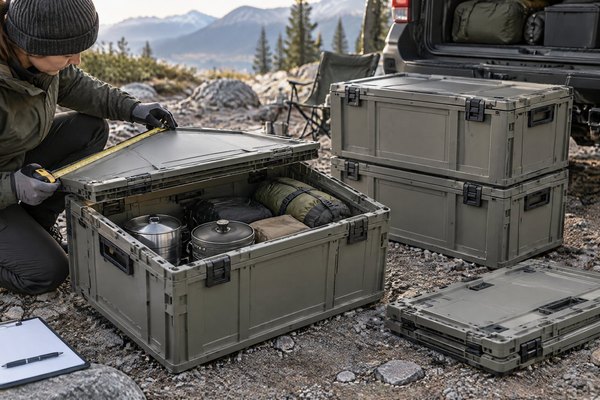
A useful sourcing decision starts with a written requirement that can be challenged, sampled, inspected, and approved.
Direct answer introduction
If you need a heavy duty camping storage box for a private-label camping line or motorhome accessory range, prioritize three things up front: a material and construction spec matched to your use case, measurable internal usable volume and weight targets, and a clear factory test and sample-review plan. This guide explains what to specify, how to evaluate samples, which features matter for retail and motorhome markets, and how to move from spec through factory testing and shipping preparation with change control to reduce launch risk.
Key Use Cases and Market Segments
Start by defining the primary applications and buyer expectations. A storage product for off-grid overlanding, a motorhome storage box for under-bench compartments, or a stackable retail-ready camping crate will have different priorities.
- Retail/backpackers: emphasize packability and lightweight camping storage box variants, price sensitivity and retail labelling.
- Overlanding and basecamp: prioritize impact resistance, water sealing and mounting points for roof racks or vehicle beds.
- Motorhome and caravan fit-outs: focus on mounting, fixed internal dimensions and compliant labelling for vehicle interiors; a motorhome storage box often requires specific mounting brackets and low-profile lids.
- Family car camping and beach use: look for large camping storage box options with generous internal volume and easy lid access.
Define the lead buyer in your workflow (product manager, importer, or retailer buyer) and record the target markets (US/UK/DE/FR) because destination rules and consumer expectations differ. Confirm the applicable requirement for materials, labelling and packaging before finalizing spec.
Materials, Construction and Performance Criteria
Choosing the right base material and construction method is the first technical decision.
Common materials and trade-offs
- Rotomolded polyethylene: excellent impact resistance and one-piece bodies for heavy duty camping storage box designs. Heavier but durable.
- Injection-molded polypropylene/PE: good for stackable, lighter-weight crates and smaller runs; allows thin ribs and features but can be less impact-tolerant than rotomould for large parts.
- Metal (aluminium, steel): used for highly rugged motorhome storage box variants or lockable camping storage box models where security is critical; needs corrosion protection.
Impact resistance and wall thickness
Specify minimum wall thickness, ribbing and corner radii tied to a drop test target (e.g., expected 1 m drop without cracking). For OEM/ODM orders, include intended use scenario so the factory can recommend shell thickness and reinforcement.
UV, chemical and weather resistance
For outdoor use, request UV-stabilized plastics and specify colour retention targets. In your specification document, list exposure expectations (sun, salt spray, mud) so the supplier can recommend additives or coatings.
Seals, gaskets and water resistance
If the product is marketed as weatherproof, specify IP-like performance objectives (e.g., splashproof for normal rain, or sealed for full immersion). Describe the expected sealing method: overmolded lid gasket, tongue-and-groove lid, or vented pressure relief. Don’t imply certification—ask suppliers for test data from their tests or third-party labs where required by your market.
Size, Capacity and “How to Choose Camping Storage Box Size”
Determining size is a mix of product strategy and dimensional engineering.
When buyers ask how to choose camping storage box size, recommend starting with intended load and the largest single item customers will store (fuel can, tent bag, folding chair). Convert that to internal usable volume and then add headroom for packing flexibility.
Common sizes and measuring usable volume
- Small (10–25 L): ideal for accessories, cookware, first-aid kits.
- Medium (25–60 L): good for clothing or cookware sets.
- Large camping storage box (60–150+ L): for tool chests, large cookware, family supplies or motorhome under-bench use.
Always specify internal usable dimensions (length × width × height), not just nominal external size. For motorhome installations, also provide mounting and clearance dimensions to ensure doors and drawers operate.
Weight vs capacity considerations
A large camping storage box increases cargo weight and may impact vehicle fuel economy. If weight is a concern, consider a lightweight camping storage box variant using thinner ribs and engineered reinforcement or hybrid materials. State your target empty weight and maximum loaded weight for structural and shipping calculations.
Features to Evaluate: Security, Usability and Serviceability
Decide which features are must-haves vs nice-to-haves. Some features drive tooling complexity and cost.
Locking and security
A lockable camping storage box is often required for travel-focused and motorhome products. Specify the lock type (padlock hasp, integrated cylinder, TSA-accepted lock), location, and minimum breaking load for hasps and hinges in the spec. For aluminium or steel models, specify surface treatment to resist corrosion.
Lids, hinges, gas struts and access
Choose lid geometry that suits usage: drop-down lids, side-hinged, or removable lids. Gas struts or friction stays improve usability for large camping storage box lids. Record hinge material and expected cycle life in your requirements to guide supplier testing.
Modularity and stacking
If you plan a family of products or retail sets, evaluate a modular camping storage system that allows stacking, interlocking lids, and shared bin dimensions. Specify locking-stack geometry and maximum safe stacked load when designing a modular range.
Modular Systems and Motorhome Integration
A modular camping storage system offers SKU efficiency and cross-sell options but requires stronger change-control discipline.
- Define a system grid (e.g., 20 cm, 40 cm increments) so multiple box sizes and accessories fit together.
- For motorhome storage box applications include bracket details for fixed installation, required fasteners, and allowed materials for vehicle interiors.
For OEM/ODM brands, ask for CAD files early to verify fit in 3D space. If your product will be part of vehicle furniture, confirm fire-safety and material rules that may apply in certain markets for interior fittings—confirm the applicable requirement with your compliance advisor.
Quality Assurance, Samples, Factory Testing and Workflow
A robust QA workflow minimizes surprises during production. For an OEM/ODM project, the standard buyer workflow elements should be included in your product development plan.
- Product specification: Create a single-source spec document with materials, tolerances, surface finish, colours (Pantone or master sample), dimensional drawings, seal and fastening details, and intended tests.
- Prototype and sample review: Begin with engineering samples to check form and function, then advance to pre-production samples that include final moulded parts, hardware and packaging.
- Factory testing or inspection: Define tests you require at the factory — e.g., drop test, stacking load test, lid cycle life, IP water ingress check. Ask the supplier to document test methods and results; where local regulations require, plan third-party lab testing in your destination market.
- In-line and final inspection: Arrange pre-shipment inspection (PSI) scope—visual, dimensional checks and function tests. Specify acceptable defect levels (AQL) appropriate to your channel.
- Packaging and shipping preparation: Provide the supplier with final packaging art and pack quantities per carton or pallet. Specify protective inserts, pallet configuration and labelling for customs and retail barcode needs.
- Documentation: Require an inspection report, material declaration, and sample master unit with batch markings. For more complex parts, request a digital panel with CAD and BOM frozen at sample approval.
- Change control: Institute a formal change-control process—no tooling or material changes without written approval. List the approvals needed for minor and major changes.
Specify lead times for each step in your project timeline and confirm them with the supplier. Keep a copy of each sample and test result at the buyer site for reference during any dispute or redesign.
Packaging, Labelling and Logistic Considerations
Plan packaging for three phases: factory carton protection, transport palletization, and in-store or direct-to-consumer presentation.
- Protective packaging: For heavy duty camping storage box units, use edge protection and internal blocking to prevent shifting during transit.
- Palletization: Define units per pallet, pallet height limits and desiccant or moisture-control needs for sea freight.
- Labelling and customs: Provide HS codes, net/gross weight, country of origin text and retail barcode requirements. Confirm any special marking rules for target markets.
For air vs sea freight, calculate dim-weight impact of bulky crates and consider nested or knock-down designs to save space. Document packaging and shipping preparation instructions in the spec to ensure repeatable pack at volume.
Quick Buyer Decision Table
| Buyer Priority | Recommended Approach | Notes for RFP / Spec |
|---|---|---|
| Maximum durability (off-road) | Rotomoulded PE, reinforced corners, metal hasps | Request drop test method and target; specify mounting points and max stack load |
| Light weight / retail price | Injection molded PP, thinner ribs, knock-down lids | Provide target empty weight and desired retail pack size |
| Motorhome integration | Low-profile lid, mounting brackets, certified fasteners | Provide CAD of installation space; request bracket kit as optional SKU |
| Security | Metal hasps or integrated lock cylinder | Specify lock type (padlock or integrated) and expected cutting torque |
| Modular SKUs | Shared base footprint, interlocking lids | Define system grid and max safe stacked height |
Mid-Article CTA — Request a Brief
To speed feasibility and quote turnaround, email a one-page brief to oem@camplume.com with the following: target SKU(s), desired material, target internal usable dimensions, target empty and loaded weight, expected annual volume, destination market(s), any required tests, colour/branding notes and requested lead time. CampLume will reply with recommended construction options, preliminary tooling guidance and sample timing.
Pricing, Tooling and Lead-Time Considerations
Tooling method drives unit cost and minimum order quantity. Rotomould tooling typically has lower per-tool cost for large hollow parts but different lead times than multi-cavity injection moulding. Include expected order ramp (first run quantity, 6–12 month forecast) so the factory can propose tooling amortization and unit pricing. Ask for breakdowns: tooling amortization, per-unit material and finishing, packaging and freight estimations.
Negotiate sample fees, sample shipping and a staged payment plan tied to design milestones and production milestones. For brand owners, request serialized sample approvals and retain master samples at CampLume or your inspection agent to avoid confusion later.
FAQ
Q: Can I get custom colours and logo printing on a heavy duty camping storage box? A: Yes, custom colours and branding are standard for OEM/ODM projects, but specify Pantone references and acceptable tolerance in the product specification. Discuss printing vs moulded-in color for durability and cost impact.
Q: Is it possible to order a lightweight camping storage box if I need a large internal volume? A: Yes. A lightweight camping storage box can be engineered using thinner ribs, optimized wall geometry or hybrid materials. State your target empty weight and maximum load so the factory can validate stiffness and impact resistance.
Q: What tests should I require from the factory? A: Typical tests include dimensional verification, lid cycle life, drop tests, stack-load tests and water ingress evaluation. For motorhome applications, add mounting vibration or torque-on-fastener tests. Specify the test method and acceptance criteria in the spec.
Q: How do I manage change requests after tooling starts? A: Use a documented change-control process. Categorize changes (cosmetic, tooling adjust, material swap) and require written approval with cost and timeline impact. Hold a small contingency budget for minor tooling changes during the first production run.
Q: Can the boxes be supplied nested or flat-packed for freight savings? A: Many designs allow nested supply or disassembled lids to reduce shipment volume. Include a packing configuration requirement in your packaging spec to confirm how units will be shipped and stored.
Conclusion and Next Steps
Choosing the right heavy duty camping storage box for a new brand or product line combines clear specification, realistic testing plans and an ordered factory workflow. Define use case (retail, overlanding, motorhome), internal usable dimensions, weight targets and essential features (lockable camping storage box, modular camping storage system, gas struts, brackets). Confirm the applicable regulatory and labelling needs for each destination market early.
If you are ready to move from concept to quote, email a one-page brief to oem@camplume.com with the details requested above. CampLume will provide construction recommendations, preliminary tooling options and a sample timeline so you can evaluate trade-offs and plan a controlled product launch.
Final CTA: Email info@camplume.com with your product category, target market, estimated quantity, current specification and packaging stage. Request a documented response that identifies assumptions, open evidence and the next approval gate.
Related CampLume resources
-
Read: How to Source Outdoor Storage Boxes for a Private-Label Camping Range for a connected sourcing decision.
-
Explore CampLume storage options to compare a relevant product platform.
-
See the CampLume buyer FAQ for concise guidance on samples, MOQ, quality control, compliance and shipment preparation.
-
Discuss an OEM or ODM brief with CampLume when product configuration, custom branding or packaging needs to be scoped.
Project discussion
Need to apply this guide to a product programme?
Send your product category, target market, estimated quantity, current specification and packaging stage. CampLume will continue the discussion by email.
Email info@camplume.comSources and further reading