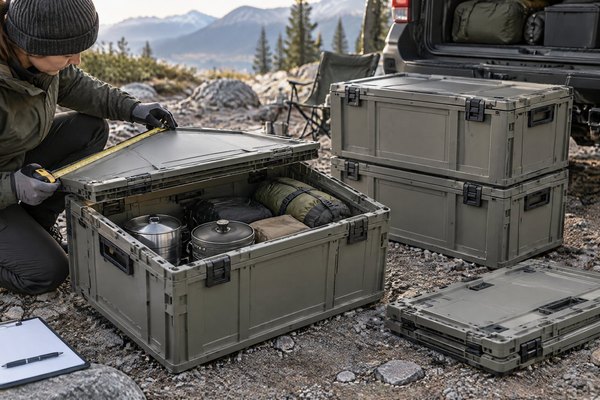
A useful sourcing decision starts with a written requirement that can be challenged, sampled, inspected, and approved.
Direct answer (brief)
If you need a multi purpose camping storage box for retail or private label, start by specifying the exact use case (camp kitchen, vehicle overland, general gear, or collapsible storage), then lock down materials, dimensions, sealing/water-resistance, and branding requirements before requesting samples and factory test data. Choosing the right OEM/ODM partner and a clear specification/sampling workflow reduces costly rework and shipping delays.
What Is a Multi Purpose Camping Storage Box (and When To Use One)
A multi purpose camping storage box is a general-purpose container designed for outdoor use: storing cookware, food, tools, clothing, or vehicle gear. Buyers commonly look for modular stackability, weather resistance, lockability, and compatibility with accessories (dividers, trays, lid tables). The term covers several product families you will see from suppliers: stackable crates, folding plastic boxes, rigid waterproof cases and vehicle-fit overland storage boxes.
Overland-focused buyers often specify higher mechanical strength, mounting points and lockable lids; those buyers will ask for an overland storage box design with vehicle-specific brackets and corrosion-resistant metals or reinforced plastic.
Key Specification Areas Buyers Must Lock Down
Product performance and cost are defined by a handful of interdependent decisions. The clearer you are up front, the faster a factory can produce accurate samples and quotes.
Materials & Durability
- Common materials: PP (polypropylene) and HDPE for injection-molded or thermoformed crates; ABS or PC blends for rigid cases; anodized aluminum for overland and vehicle-mounted boxes.
- Specify wall thickness, rib structure, UV-stabilizer levels (for PVC/PP), and any impact modifiers if your product will face cold-weather impacts.
- Ask the supplier to confirm raw-material grade and whether it complies with your market's chemical restrictions. For EU-bound products, state the requirement to confirm the applicable restriction lists and documentation.
Dimensions, Volume & Weight Limits
- Provide internal usable dimensions rather than external, and state load-bearing requirements for stacked configurations (e.g., 4 crates stacked must support X kg).
- If the box must fit existing racks or vehicle trays, include target mounting dimensions.
Closure, Seals & Water Resistance
- Be explicit: do you need IPX4 splash protection, IP66 dustwater protection, or a food-safe closure for storing edibles? Use-case determines seal choice (single-lip gasket, double- gasket, or no gasket).
- For camp kitchens that store food, ask for food-contact material declarations when relevant.
Hardware, Fasteners & Locking
- State preferred hinge type, padlock tabs, recessed hardware and whether stainless steel or plated steel is required for outdoor corrosion resistance.
Color, Surface & Branding
- If you require brand colors, specify Pantone codes and tolerance class. A Pantone color camping storage box requires color-matching instructions in the specification to avoid mismatched lids and bases.
- Provide logo artwork with size and placement, and indicate printing method (pad print, laser etch, screen print, or full-surface digital wrap).
Compliance, Market Requirements, and Documentation
Regulatory requirements depend on destination market and product application. As an OEM/ODM camping gear manufacturer, CampLume can help clarify processes but confirm the applicable requirement with your legal/compliance team.
- For EU shipments: purchasers commonly request documentation showing conformity to market rules, chemical compliance statements where applicable, and clear labeling for importer and address. If you want an EU camping storage box manufacturer to produce private-label units, state whether you require the factory to create documentation in your brand's name and confirm who will be listed as importer.
- For food-contact items (camp kitchen components), request material declarations and, where required, third-party test reports.
- Keep change-control documentation: when a design or supplier changes material or process, require an updated specification, sample sign-off, and production test plan.
Supplier Qualification Checklist (Practical Items Buyers Should Verify)
A straightforward supplier checklist prevents surprises during scaling.
Factory Capabilities & Minimums
- Confirm tooling experience (injection molds, rotational molds, metal forming), maximum mold cavity size, and lead times for new tooling.
- Request minimum order quantity (MOQ) tiers for color changes and for private-label packaging. If you need EU private label camping storage boxes, ask whether the supplier has prior experience exporting to the EU and handling required labeling.
Quality Systems & Testing
- Ask about internal QC checkpoints, first article inspection (FAI) practices and available in-line testing equipment.
- Request samples showing production tolerances and a routine test plan (e.g., drop test for lids, seal compression tests, stacking-load verification).
- If you plan to work with third-party labs, confirm the supplier allows destructive testing on pre-production samples.
Communication, IP Protection & Logistics
- Confirm language/point-of-contact, product design ownership, NDA terms, and who holds tooling ownership after tooling costs are paid.
- Verify export experience, logistics partners, and whether the supplier can ship DDP or FOB.
Sample Review, Factory Testing, and Inspection Workflow
A disciplined sample and test workflow shortens time-to-market and reduces defects in first shipments.
- Product Specification: Send a detailed spec sheet including CAD or technical drawings, materials, Pantone codes, target volumes, and acceptance criteria.
- Proto Sample (A): Request a proof-of-concept sample that verifies form and function — often made with rapid prototyping.
- Functional Sample (B): A production-representative sample made in actual materials and (if needed) a pilot mold. Use this to validate fit, seal, and stacked-load strength.
- Testing/Inspection: Define factory tests (e.g., water intrusion, seal compression, torque on hinges) and whether you require third-party lab validation.
- Sample Sign-Off: Document approval in writing; include dimensional reports and photos.
- Pre-Production Run & Pilot Inspection: Approve a small run for packaging validation and bar-code/labeling checks.
- Pre-Shipment Inspection (PSI): Arrange final inspection against the approved sample and FAI report. Include checklists for packaging, marking, and palletization.
Include change control language: any deviation from the approved sample requires a new sample, approval and updated documentation before full production.
Mid-Article CTA
If you are ready to move to sampling, send a concise email brief to info@camplume.com. Include:
- Product name and target use (e.g., camp kitchen box, overland gear box)
- Internal and external dimensions, load requirements and stacking needs
- Materials preferred and any required declarations (food-contact, UV-stabilizer, stainless steel hardware)
- Pantone codes if color matching is required (Pantone color camping storage box)
- Target market(s): EU / UK / US and any documentation needs (e.g., importer name for EU)
- Initial MOQ target and target FOB/EXW price point
- Expected delivery timeline and any packaging/labeling preferences
We will reply with a sampling plan and preliminary lead times within 48–72 hours.
Mid-Article CTA: Send Your Requirements
If you are evaluating multi purpose camping storage box, email info@camplume.com with your product category, selling market, estimated quantity, current specification and packaging brief. Ask for a documented reply that separates assumptions and deviations from the quotation.
Packaging, Shipping Preparation, and Warehousing
Packaging affects product safety and landed cost.
- Protective Packaging: For rigid boxes, consider foam inserts or kraft dividers to protect corners during sea freight. For stackable crates intended for retail, designed-in nesting and folding features reduce carton volume.
- Labeling and Palletization: Provide pallet patterns, carton dimensions, labels, and pallet-stabilization instructions. For EU private label work, confirm the required importer and address labeling.
- Shipping Preparation: Decide whether you want the supplier to perform export packing (plywood crates, fumigated wood if required) and forwarder coordination. Confirm who handles export documentation and whether you require DDP or FOB terms.
- Warehousing & Kitting: If you plan to combine the box with accessories (cutlery tray, lid table), specify kitting instructions and whether the factory should assemble kits or ship loose.
Product Applications, Variants, and Packaged SKUs
Camping storage boxes appear in many assortments. Defining SKUs early speeds tooling decisions and cost modelling.
Camp Kitchen Organizer Variants
- Camp kitchen organizer wholesale buyers typically request stackable boxes with removable cutlery trays, spice bins, or collapsible sink attachments. If you plan to sell multiples, confirm master carton and retail-ready packaging specifications.
Overland and Vehicle Solutions
- Overland storage box designs prioritize mounting points, tie-down locations, and resistance to vibration and salt spray. For vehicle-installed units, specify bracket dimensions and finish requirements.
Collapsible, Stackable and Rigid Options
- Collapsible crates save container volume in returns and shipping; rigid cases offer better weather protection. Decide which tradeoffs match your retail price points and lifecycle expectations.
Buyer Decision Table
| Use Case | Typical Material | Strengths | Typical MOQ | Best For |
|---|---|---|---|---|
| Foldable Stackable Crate | PP, collapsible hinges | Low shipping volume, low cost | 500–2,000 pcs | Mass-market camping organizers and retail displays |
| Rigid Waterproof Case | ABS/PC blend + gasket | High water resistance, lockable | 300–1,000 pcs | Overland storage box, camp kitchen food storage |
| Aluminum Overland Box | Aluminum panels + stainless steel hardware | High strength, long life, vehicle mounting | 100–500 pcs | Vehicle-mounted storage, premium private label |
Working With Wholesale Suppliers: Pricing, Lead Times & Scaling
If your program involves camp kitchen organizer wholesale or a camping organizer wholesale supplier, you will balance per-unit cost against logistics and inventory risk.
- Pricing: Tooling amortization is the primary cost for injection or metal tooling. Multiple color SKUs increase tooling and inventory costs. Request a price breakdown: tooling, per-unit cost at multiple quantity tiers, packaging cost, and freight assumptions.
- Lead Times: Typical tooling lead times range from 6–12 weeks. Production lead time depends on MOQ and factory schedule. Request realistic production calendars and contingency plans for raw material shortages.
- Scaling: For anticipated seasonal spikes, agree on a capacity reservation clause or rolling forecast to secure production slots.
FAQs (Practical Buyer Questions)
Q: How should I specify color tolerance for a Pantone color camping storage box? A: Provide exact Pantone references and acceptable Delta E tolerance (if you use a color lab). Include whether lids and bases must be color-matched across production batches. Request pre-production color swatches and a signed color approval before full production.
Q: Can a manufacturer supply EU private label camping storage boxes with my branding and packaging? A: Many OEM/ODM camping gear manufacturers offer private-label services. Clearly state labeling, packaging artwork, and who is listed as the importer for EU shipments. Request proof of packaging mockups and a final packaging sign-off sample.
Q: What test reports should I request during supplier qualification? A: Ask for routine factory tests relevant to function: seal compression tests, stacking-load tests, hinge-cycle tests, and material declarations. If the product will be subject to regional regulations, identify any third-party lab testing you require and when it will be performed.
Q: How do I control changes after the first production run? A: Require written change-control procedures: no production changes without a documented change request, re-sampling if materials or tooling change, and updated QC checklists. Embed this process in your contract with the factory.
Q: What is a realistic MOQ for a custom molded camping storage box? A: MOQs vary by process: injection-molded items are typically several hundred to a few thousand units depending on tooling cost and cycle time; metal or aluminum units can have lower MOQs but higher per-unit cost. Request exact MOQ tiers from the supplier.
Conclusion and Next Steps
Selecting the right multi purpose camping storage box requires clarifying use case, materials, sealing and mounting needs, and the regulatory requirements in your target market. Good suppliers will respond with a sampling plan, test checklist, and a production timeline tied to sign-offs and change-control steps.
To start a sample project or request a quote, email info@camplume.com with the brief listed above (product dimensions, materials, Pantone codes, target market and MOQ). Expect a sampling proposal and preliminary lead times within 72 hours. CampLume is available as an OEM/ODM camping gear manufacturer to support specification, sampling, tooling coordination and batch production — we will not provide legal or certification advice, so please confirm regulatory details for your destination market with your compliance team.
If you prefer, include preliminary CAD files and packaging artwork in your first email to speed the initial feasibility review.
FAQ
What information should a storage-box buyer give a supplier?
State the intended gear, use environment, target size and load, material preference, stacking or folding needs, logo and color scope, packaging, target market, estimated quantity and any test expectations.
How should a load or drop test be defined?
Use a written method that names the product configuration, load, condition, number of cycles or drops, inspection points and acceptable outcome. Confirm whether it is an internal check, third-party test or customer protocol.
When is a custom mould required for a camping storage box?
A new mould is normally a product-development decision when the dimensions, structure or integrated features differ from an existing platform. Ask for the tooling scope, ownership terms, sample process and revision controls in writing.
What is useful for storage-box shipment preparation?
Confirm the approved product, pack-out, carton dimensions, stacking direction, label or barcode details, pallet plan where relevant, inspection record and freight booking information before cargo release.
Final CTA: Email info@camplume.com with your product category, target market, estimated quantity, current specification and packaging stage. Request a documented response that identifies assumptions, open evidence and the next approval gate.
Related CampLume resources
-
Read: How to Source Outdoor Storage Boxes for a Private-Label Camping Range for a connected sourcing decision.
-
Explore CampLume storage options to compare a relevant product platform.
-
See the CampLume buyer FAQ for concise guidance on samples, MOQ, quality control, compliance and shipment preparation.
-
Discuss an OEM or ODM brief with CampLume when product configuration, custom branding or packaging needs to be scoped.
Project discussion
Need to apply this guide to a product programme?
Send your product category, target market, estimated quantity, current specification and packaging stage. CampLume will continue the discussion by email.
Email info@camplume.comSources and further reading