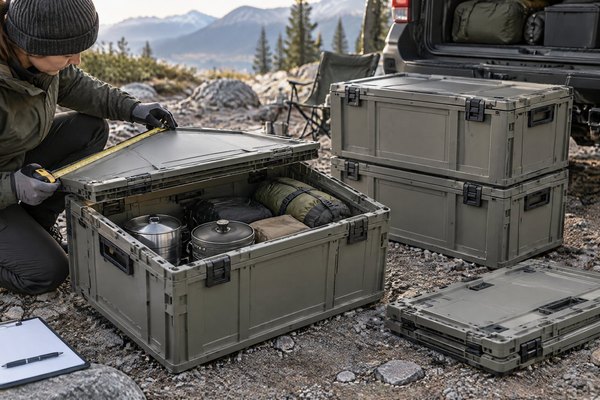
A useful sourcing decision starts with a written requirement that can be challenged, sampled, inspected, and approved.
Direct answer introduction
If you need a durable, secure solution to carry tools, recovery gear and camping essentials, choose an off road storage box sized and specified for the vehicle and overland setup you’ll use. For B2B buyers the decision comes down to three things: fit and mounting (truck bed, roof, or trailer), material and waterproofing, and the supplier quality workflow that delivers compliant production samples and reliable packaging. Requirements depend on the exact product and destination market, but this guide walks product managers, importers and private-label brands through the evaluation stage so you can write accurate specs, assess samples, and prepare inspection and shipping instructions.
What Is An Off Road Storage Box?
An off road storage box is a purpose-built container designed to withstand vibration, dust, water and impact during off-road travel. In the overland context it is often a component of a wider overland gear storage system — modular boxes, racks and internal organizers that keep accessories accessible and secure. For truck users a truck bed camping storage box is typically anchored to the bed or fitted under a canopy; for campers moving light loads a portable camping storage box or stackable camping storage boxes provide modularity and quick access.
Common buyer intents at the evaluation stage:
- Confirm whether a plastic camping storage box or metal design is best for weight, cost and durability.
- Verify waterproof camping storage box performance and ingress protection claims through factory testing.
- Define mounting tolerances and attachment points for your specific truck bed or roof system.
Key Specifications And Design Features To Compare
Before requesting a sample, set a concise specification sheet covering functional needs, manufacturing tolerances and documentation. Below are the most common fields buyers should include.
Material Choices And Implications
- Polymer (e.g., injection-molded HDPE, PP) offers lighter weight and corrosion resistance and is often used for plastic camping storage box designs.
- Aluminum or steel provides higher impact resistance and often superior security but adds cost and weight.
Specify UV-stable formulations if the box will be exposed to sunlight for prolonged periods and request material data sheets from the OEM/ODM. Materials affect tool-mounting, machining of lid bosses, and hardware attachment methods.
Dimensions, Internal Layout And Fit
- Nominal external dimensions and tolerances (± mm) to ensure a proper fit in a truck bed, under a canopy or inside a cabinet.
- Internal layout: divider options, drawer slides, foam inserts or trays for fragile equipment.
If you expect to integrate multiple boxes, define stackability and corner-lock locations. Stackable camping storage boxes must nest or lock securely under dynamic loads.
Load Capacity, Mounting And Security
- Static and dynamic load ratings (how much weight the lid and base will support) and recommended mounting hardware.
- Locking approach: padlock ears, integrated locks, or compatibility with central locking systems.
For truck bed camping storage box applications, specify mounting points and track systems. Include tolerance bands for bolt hole positions and recommended anti-vibration washers.
Common Configurations: Overland Gear Storage System Use Cases
Different use cases drive different choices. This section helps you map product variants to customer needs.
Overland Camper Or Trailer
In an overland gear storage system, modularity and weather protection are priorities. Buyers often choose a mixture of large waterproof camping storage box units for fuel or water containers and smaller portable camping storage box units for kitchen and medical kits.
Pickup Truck Bed
A truck bed camping storage box commonly requires low-profile designs that clear tonneau covers or can be mounted under a canopy. For heavy tools, metal boxes anchored to the bed rails may be preferable. Confirm bed-specific brackets and drilling templates during the specification stage.
Roof Rack And Rear-Mounted Uses
Roof-mounted boxes must consider wind loading and weight distribution. Stackable camping storage boxes used on a roof should include anti-slip feet and locking straps; consider a tie-down point specification and wind-resistance data.
Materials, Waterproofing And Durability: What To Require From Your OEM
Waterproof claims are common for outdoor storage. Don’t accept a label without a test plan. For example, a waterproof camping storage box should have a clear IP-equivalent definition in your spec (e.g., water ingress under splash and spray conditions) and the OEM should provide test methods used.
Ask the factory to indicate the gasket design, closure torque settings, and the method used to test water ingress (e.g., submersion or spray tests). For polymer boxes consider specifying impact resistance criteria (drop height), UV ageing cycles, and chemical resistance when contact with fuel or lubricants is likely.
Practical checklist to include in specifications:
- Material identification and UV-stability data sheet
- Gasket compound, profile and expected compression set after X cycles
- Closure or hinge cycle life (number of open/close cycles before failure)
- Impact and drop height requirement for final packed unit
Remember: regulatory and market-specific requirements (transport of fuel containers, ADR/RID for EU, DOT for US) vary. Confirm the applicable requirement with your compliance expert rather than assuming universal rules.
Mid-Article CTA: Send Your Requirements
If you are evaluating off road storage box, email info@camplume.com with your product category, selling market, estimated quantity, current specification and packaging brief. Ask for a documented reply that separates assumptions and deviations from the quotation.
Sample Review, Factory Testing, Inspection And Change Control
A robust sample and inspection workflow reduces surprises in production. For B2B buyers, these are the recommended steps.
Sample Review Checklist
- Confirm dimensional conformance to the specification drawing (3D or 2D CAD should be referenced).
- Functional checks: lid alignment, latch operation, gasket seating, drainage plugs.
- Fit test in intended vehicle (truck bed mock-up or template mounting)
Request documented photos, a dimensional report and a short video showing functional operation.
Pre-Production And Factory Testing
- Pre-production samples (PPS) should be signed off before full tooling or production runs begin.
- Factory tests: water spray or static immersion (per your spec), hinge/latch cycle testing, and a vibration test if the product will be used on roads with high vibration.
Ask the factory for an agreed sampling plan and acceptance criteria. If you require third-party inspection, include that in the purchase order and specify the inspection points.
On-Site Inspection And Change Control
- Schedule pre-shipment inspection (PSI) that covers appearance, dimensions, and a random functional test of waterproofing and latches.
- Establish a change-control process for any design or material changes post-approval. Even small changes (different resin lot, hardware supplier change) can affect performance and should require re-test or signed approval.
Document who can approve changes and what documentation is required (revised drawings, test reports, sample photos).
Packaging, Shipping Preparation And Documentation
Packaging matters for surface protection, stack strength and customs handling. For export shipments include clear instructions in the PO and packaging spec.
Key packaging and shipping items to specify:
- Inner protection: foam inserts or edge protectors to prevent lid warping.
- Unit packing orientation and box strength rating (useful for pallet stacking of multiple stackable camping storage boxes).
- Palletization pattern and maximum stack height to prevent crushing during transit.
- Labeling: part number, orientation arrows, gross/net weight, and hazardous goods marking if the item will contain fuel or chemicals.
Documentation checklist:
- Commercial invoice and packing list with declared weights and dimensions
- Certificate of Origin and any supplier declarations needed by your customs broker
- Test reports required at import (as agreed in your contract)
For truck bed camping storage box projects that include mounting hardware, package hardware in labeled, sealed kits with a parts list and torque instructions to ease post-delivery installation.
Buyer Decision Table And Ordering Checklist
Below is a concise comparison table to help you prioritize requirements when evaluating suppliers.
| Priority | Feature / Test | Typical Buyer Requirement | Why It Matters |
|---|---|---|---|
| High | Materials & UV stability | Specify polymer grade or metal alloy, request MDS | Determines longevity outdoors |
| High | Waterproofing | Define test (spray/immersion) and acceptance | Ensures gear stays dry in wet conditions |
| High | Mounting fit | CAD/fixture fit test for truck bed or rack | Prevents retrofit issues and rework |
| Medium | Stackability | Lock points and nesting dimensions | Important for modular overland systems |
| Medium | Packaging strength | Box and pallet spec | Prevents damage in transit |
| Medium | Sample & inspection plan | PPS, PSI, and change-control steps | Controls quality before mass production |
Ordering checklist (quick):
- Finalize spec sheet (materials, dimensions, IP test, mounting)
- Request PPS and 3rd-party PSI options
- Agree packaging and lead times
- Include change-control process in contract
Mid-article CTA — Request A Brief
To evaluate options, send a one‑page brief to info@camplume.com with the following: target vehicle type (truck model or rack), preferred material (plastic or metal), intended contents (tools, fuel, food), target unit weight, target MOQ and desired lead time. CampLume, as an OEM/ODM camping gear manufacturer, will reply with lead-time ranges and standard sample workflows. Include any compliance needs specific to your destination market so we can quote appropriate testing and documentation.
FAQ
Q: Can I get both a plastic camping storage box and an aluminum design from the same OEM?
A: Many OEM/ODM factories supply both material families, but tooling and process differ. Specify which designs should match in fit and mounting; expect separate samples and potentially different lead times for each material option.
Q: How should I specify waterproofing for an off road storage box?
A: Define the test (spray, static immersion, or IP rating equivalent), gasket compound and compression requirement, and the acceptance criteria (no visible water ingress into the internal cavity during/after test). Ask for test methods and results with samples.
Q: Are stackable camping storage boxes suitable for roof use?
A: Stackable boxes can be used on roofs if they have anti-slip bases and secure fastening points. However roof-mounted use increases wind and dynamic loads, so require wind-load data and tie-down specifications in your procurement spec.
Q: What should I expect during pre-shipment inspection (PSI)?
A: A PSI will typically include a visual check, dimensional sampling, functional checks (lid, latch, gasket), and packaging verification. Specify pass/fail criteria and whether a random functional test (e.g., water spray) is required on a sample basis.
Q: How do I control future design changes after approval?
A: Implement a formal change-control clause: all material or tooling changes require a written change notice, re-sample if the change affects performance, and approval signatures from both buyer and factory before implementation.
Final Conclusion and Next Steps
Choosing the right off road storage box reduces warranty events and returns. Prioritize fit for the intended application (truck bed, roof, or trailer), clear waterproofing and material specifications, and a documented sample-to-production workflow that includes pre‑production samples, factory testing and pre‑shipment inspection. For a tailored quote and sample plan, email a one‑page brief to info@camplume.com with the vehicle type, desired materials, target MOQ and any market-specific compliance needs. CampLume can outline tooling, sample and inspection timelines so you can move from evaluation to a controlled production run with confidence.
(End of buyer guide)
Final CTA: Email info@camplume.com with your product category, target market, estimated quantity, current specification and packaging stage. Request a documented response that identifies assumptions, open evidence and the next approval gate.
Related CampLume resources
-
Read: How to Source Outdoor Storage Boxes for a Private-Label Camping Range for a connected sourcing decision.
-
Explore CampLume storage options to compare a relevant product platform.
-
See the CampLume buyer FAQ for concise guidance on samples, MOQ, quality control, compliance and shipment preparation.
-
Discuss an OEM or ODM brief with CampLume when product configuration, custom branding or packaging needs to be scoped.
Project discussion
Need to apply this guide to a product programme?
Send your product category, target market, estimated quantity, current specification and packaging stage. CampLume will continue the discussion by email.
Email info@camplume.comSources and further reading