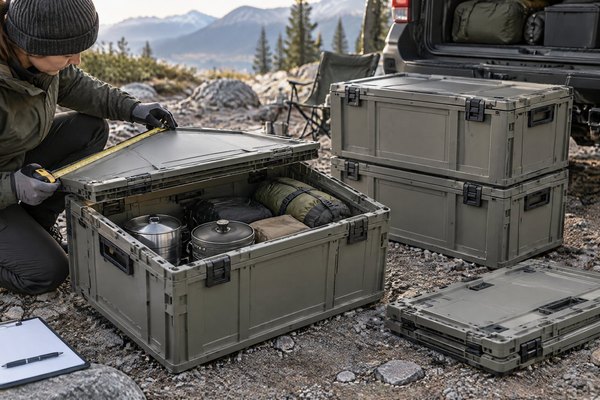
A useful sourcing decision starts with a written requirement that can be challenged, sampled, inspected, and approved.
Direct answer (short)
A weatherproof camping gear box is a sealed, durable storage system designed to protect equipment from water, dust and impact in outdoor and vehicle environments. For a B2B buyer the critical decisions are material and sealing specification, load and stacking capacity, internal organization options, and the supplier’s sample, testing and change-control workflows that ensure repeatable production for your destination market.
Why this guide is for you
This guide walks product managers, buyers, and private-label brands through the discovery and evaluation stages: what to specify, which features to prioritize, how to evaluate samples and factory testing, and practical advice on how to organize and pack the boxes for end users. Requirements depend on the exact product and destination market—confirm the applicable requirement during specification.
What Is a Weatherproof Camping Gear Box?
A weatherproof camping gear box is a reusable storage system (rigid or semi-rigid) engineered to keep camping equipment dry and clean. It ranges from small crates and organizers to large campervan storage boxes and lockable heavy-duty chests used in overlanding. Weatherproofing is achieved by design choices: sealing gaskets, interlocking lids, material selection, and robust hardware.
Primary buyer intent in this category is protection and predictability: the buyer wants a product that reliably keeps gear dry, stacks safely, and fits into logistics and vehicle constraints while being manufacturable to price.
Key Specifications To Define Up Front
A clear specification reduces costly iterations. Before you request quotes, document the following.
Materials and Structural Specs
- Primary body material (e.g., polypropylene, rotational-molded polyethylene, aluminum): list UV stabilizer, flame classification (if needed), and recyclability targets. Do not rely on vendor claims—ask for material data sheets (MDS).
- Wall thickness, ribbing and expected static/dynamic load capacities.
- External finish tolerances and color targets (Pantone or RAL references).
Seals, Latches and Hardware
- Target ingress protection approach (gasketed lid, tongue-and-groove, overmolding). If you need an IP rating, specify the test method or ask the factory for equivalent test protocols.
- Locking options (padlock eyes, integrated keyed locks, TSA for travel case variants).
- Hinge type, hinge cycles target (e.g., 5,000 cycles) and salt-spray resistance for metal parts.
Size, Weight and Fit Constraints
- External and internal dimensions with acceptable tolerances.
- Nesting or stacking requirements for empty/loaded states.
- Weight limits per box and per stack; include how boxes will be handled (manual lift, forklift, mounted in a roof rack).
Regulatory and Marking Requirements
- Country-of-import labeling, material declarations, and any restricted substance lists (e.g., confirm the applicable requirement rather than assuming universal restrictions).
- Required user instructions, multilingual labels, and packaging barcodes/GTIN.
Best Features and Design Tradeoffs
What buyers mean by "best" varies by use case. Below are common features to evaluate and the tradeoffs they create.
Core Best Camping Storage Box Features
- Effective gasketed seal: best for wet environments but increases cost and assembly complexity.
- Robust latches and lock options: improve security but add weight.
- Stackability with positive alignment: essential for warehouse and campervan stowage; can limit internal volume if design includes nesting lips.
- Modular internal organization (removable trays, dividers): increases versatility but can raise SKU complexity.
Handles, Weight and Ergonomics
- Recessed handles reduce snagging in campervan applications but may be harder to grab with gloves.
- Telescoping or folding handles help with carrying but add moving parts needing durability checks.
Internal Organizer vs. Open Crate
- An integrated camping equipment organizer (molded inserts, foam, or removable trays) speeds user setup and protects smaller items.
- Open camping storage crate styles are lower cost and more flexible for odd-shaped gear.
Use Cases: Campervan Storage Boxes And Other Applications
Different buyers target distinct end uses; specify the intended application early.
- Campervan storage boxes: often constrained by height and mounting points. Specify mounting points, tie-down locations, and anti-slip bases. Campervan customers prioritize stackability and low-profile lids.
- Overland and roof-box variants: require secure locking, venting for pressure changes, and restraint for heavy loads.
- General campsite and picnic crates: prioritize easy-clean interiors and low weight.
Examples of product variants to consider: minimalist camping storage crate for retail bundles; premium weatherproof camping gear box with integrated dividers for private-labels; durable metal-reinforced cases for rental fleets.
How To Organize and Pack For The End User
This section answers the practical questions B2B customers will need for packaging and user guidance: how to organize camping gear in storage boxes and how to pack a camping storage box for shipment or use.
Packing For Retail Consumer Use
- Create recommended packing cards: itemized lists showing a suggested load, e.g., "Floor tent (folded), 2 sleeping bags, 2 inflator pumps, stakes pouch." Visual cards reduce returns and improve user satisfaction.
- Use removable dividers or soft pouches for small items (cutlery, first-aid kits) to avoid rattle and abrasion.
How To Organize Camping Gear In Storage Boxes (step-by-step)
- Sort items by frequency-of-use. Place daily items on top.
- Put heavy and dense items at the bottom to lower the center of gravity. This improves stability in campervan storage boxes.
- Group fragile items in padded compartments; use foam inserts for electronics.
- Seal items that could leak (fuel bottles, toiletries) in secondary bags.
- Label locations with durable adhesive or removable tags.
How To Pack A Camping Storage Box For Transport
- For shipment: empty boxes should be nested where possible; full boxes should be secured with restraining straps and blocked to prevent movement in containers. Provide packing-instruction diagrams for your contract packer.
- For vehicle integration: include tie-down points and recommend a maximum height for stacked boxes to avoid blocking driver visibility.
Mid-Article CTA: Send Your Requirements
If you are evaluating weatherproof camping gear box, email info@camplume.com with your product category, selling market, estimated quantity, current specification and packaging brief. Ask for a documented reply that separates assumptions and deviations from the quotation.
Sampling, Testing, Inspection and QC Workflow
A structured QA workflow protects launch timelines and reduces surprises. The stages below are standard for OEM/ODM production.
Sample Stages and Review
- Design Verification Sample (DVS): close to production design for form/fit checks.
- Pre-Production Sample (PPS): produced using the intended production tooling and assembly method. Use this sample to finalize the bill of materials (BoM), packaging and labeling.
- First Production Sample (FPS): taken from the first production batch and used for final approval before full run.
Document every sample decision in a change-control log with date, sample serial number, and approval signatory.
Factory Testing and Inspection
Recommend tests and inspections you will ask the factory to run or source via third-party labs. Confirm the applicable requirement for your market.
- Ingress tests: water spray and drip tests, or a specified IP-equivalent protocol.
- Mechanical: drop tests from specified heights, hinge/latch cycle counts, stack load tests.
- Environmental: UV exposure for plastics, salt spray for metal hardware where relevant.
- Chemical: material compliance to local restricted substances if required.
On-site inspection: define acceptance criteria (AQL for visible defects and major defects), and schedule pre-shipment inspection (PSI). If you require third-party inspection results, specify the inspection firm and scope in your purchase order.
Documentation and Change Control
- Maintain a product file (specs, MDS, approved samples, packaging artwork, inspection reports).
- Issue Engineering Change Orders (ECO) for any design or supplier component change. Require sample approval for changes affecting fit, finish or function.
Packaging, Shipping Preparation and Labeling
Packaging choices affect landed cost and retail readiness.
- Palletization: define boxes per pallet, pallet height limits, and strapping method.
- Moisture control: use desiccants and vapor-barrier bags for sensitive components when shipping long sea legs.
- Packaging for retail: include insertion cards, UPC/GTIN labels and multilingual instructions as specified.
- Shipping marks and customs: specify HS code and any export/import document requirements in the PO—confirm the applicable requirement with your customs broker.
Buyer-Decision Table (Quick Comparison)
| Option | Typical Use | Weather Resistance | Internal Organization | Cost | Recommended For |
|---|---|---|---|---|---|
| Basic Crate | Dry gear, retail bundles | Splash-resistant | None / removable pouches | Low | High-volume retail packs |
| Sealed Box | Campervan storage boxes, campsite use | Gasketed / high | Removable trays, dividers | Mid | Private-label consumer products |
| Heavy-Duty Chest | Overlanding, rental fleets | Gasketed + reinforced | Foam inserts / modular trays | High | Rental / commercial applications |
Mid-article CTA
If you are evaluating production, send a short email brief to sourcing@camplume.com with:
- Product name and target market (US/UK/DE/FR)
- Target external dimensions and internal volume
- Desired materials and features (gasket type, locks, dividers)
- Required testing or certifications
- Target price per unit and annual forecast
- Sample timeline and delivery address
We will reply with a suggested specification checklist and an indicative tooling and sample timeline.
Product Application and Lifecycle Considerations
Think beyond the first purchase: rental and B2B fleets need higher durability, spare-part availability (hinges, latches, gaskets), and versioning documentation. Include spare parts in the initial BoM to simplify future QC and change-control.
- Serviceability: design for replaceable seals and parts.
- Traceability: add batch codes and manufacturing dates to help with recalls or warranty management.
- End-of-life: specify recyclable materials or a take-back plan if sustainability is a selling point.
Procurement and Commercial Terms To Negotiate
- Minimum Order Quantity and pricing tiers: request FOB and EXW quotes and compare landed cost.
- Tooling ownership and amortization: clarify who pays for molds and whether you retain tool ownership.
- Lead times and penalties: specify acceptable lead time and remedies for missed deadlines.
- Warranty terms and returns process: define acceptable defect rates and return logistics.
FAQ
Q: What is the difference between a camping storage crate and a weatherproof camping gear box? A: A camping storage crate is usually an open or lightly sealed container for general use; a weatherproof camping gear box emphasizes sealing (gaskets), stronger latches and higher ingress protection designed to keep water and dust out.
Q: How should I specify ingress protection for outdoor boxes? A: Specify functional requirements (e.g., withstand rain, resist splashes from 1 minute at X flow). If you need an IP rating, confirm the applicable requirement rather than assuming a single global standard, and indicate test methods you want applied.
Q: What inspections should I require at the factory? A: Ask for dimensional checks, visual quality checks (AQL), functional tests for latches/hinges, and a sample of environmental tests appropriate for your market (UV, water spray). Include pre-shipment inspection in the PO.
Q: Can internal organizers be modular? A: Yes. Modular inserts (removable trays, foam with cutouts, or webbed pouches) increase flexibility. They raise unit cost, so specify material, attachment method, and durability targets.
Q: What packaging details reduce damage in transit? A: Use edge protectors, inner blocking to prevent movement, moisture barrier bags for long sea shipments, and clear packing diagrams for contract packers.
Q: How do I manage design changes after tooling is made? A: Use a formal ECO process. Small cosmetic tweaks may be done in production, but structural or seal changes usually require tooling updates and new samples; budget time and cost for those.
Conclusion and Next Steps
A weatherproof camping gear box is a systems decision: material, sealing, internal organization and the factory QA workflow determine whether the final product meets your market’s expectations. During discovery and evaluation, prioritize a clear specification, an agreed sampling and testing plan, and documented change control to avoid costly rework.
Ready to evaluate options? For a tailored specification checklist and an indicative tooling and sample timeline, email sourcing@camplume.com with the brief outlined above. Include target market and volume so we can provide realistic timelines and cost drivers.
CampLume is an OEM/ODM camping gear manufacturer experienced in producing storage systems for consumer and commercial channels. We can provide manufacturing recommendations, sample management and production readiness workflows; confirm the applicable market requirements early to align testing and documentation.
(End of guide)
Final CTA: Email info@camplume.com with your product category, target market, estimated quantity, current specification and packaging stage. Request a documented response that identifies assumptions, open evidence and the next approval gate.
Related CampLume resources
-
Read: How to Source Outdoor Storage Boxes for a Private-Label Camping Range for a connected sourcing decision.
-
Explore CampLume storage options to compare a relevant product platform.
-
See the CampLume buyer FAQ for concise guidance on samples, MOQ, quality control, compliance and shipment preparation.
-
Discuss an OEM or ODM brief with CampLume when product configuration, custom branding or packaging needs to be scoped.
Project discussion
Need to apply this guide to a product programme?
Send your product category, target market, estimated quantity, current specification and packaging stage. CampLume will continue the discussion by email.
Email info@camplume.comSources and further reading